CM Sawant Cheers Goan Youth Keeping Cultural Heritage Alive
Synopsis
Goa Chief Minister Pramod Sawant praised young Goans for actively preserving the state's cultural traditions — Ghumat Vadan, Tiatr, and Natak — calling them the torchbearers of a heritage shaped by centuries of history and still very much alive.
Key Takeaways
CM Pramod Sawant posted on 29 September 2026 celebrating Goan youth for carrying forward traditional art forms.
He specifically named Ghumat Vadan , Tiatr , and Natak as living expressions of Goa's cultural heritage.
The post was accompanied by a video , giving the tribute a documented, visual dimension.
Goa's cultural identity was forged through Portuguese-era influence and post- 1961 liberation revival efforts.
Institutions like the Kala Academy, Panaji have anchored state efforts to sustain these performing arts across generations.
Urbanisation and outward migration make youth engagement in intangible heritage a genuine preservation challenge for the state.
The rhythmic thunder of the Ghumat, the sharp wit of a Tiatr performance, the dramatic sweep of Natak — Goa Chief Minister Pramod Sawant wants the world to know that young Goans are not letting these traditions fade. On Tuesday, 29 September 2026, Sawant took to X to celebrate the next generation's embrace of the state's living cultural legacy.
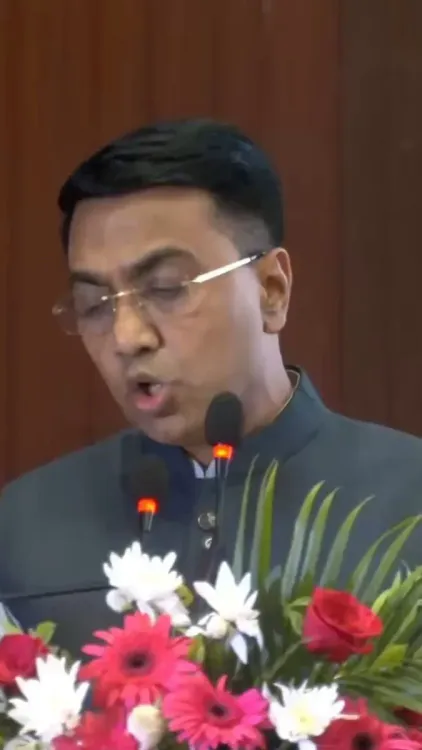
In his post, Sawant wrote: 'We are proud to see Goan youth embracing and carrying forward Goa's rich cultural heritage through Ghumat Vadan, Tiatr, Natak, and various other traditional art forms, keeping our traditions alive for generations to come.' The statement was accompanied by a video, underscoring that the pride is not merely rhetorical — it has a visible, documented face.
What makes Ghumat, Tiatr, and Natak distinctly Goan
The Ghumat is Goa's own earthen percussion instrument, its hollow resonance inseparable from festival celebrations and devotional music across Konkani-speaking communities. Tiatr — a form of musical theatre performed in Konkani — has been Goa's most popular stage tradition since the early twentieth century, blending social commentary with song in a way no other Indian regional form quite does. Natak, the broader theatrical tradition, deepens that storytelling lineage. Together they form the performative spine of a culture that absorbed centuries of Portuguese colonial rule and still emerged with a distinct, resilient identity after Goa's liberation in 1961.Youth as custodians in an age of migration and urbanisation
The challenge is real and the stakes are high. Goa's rapid urbanisation, booming tourism economy, and steady outward migration of working-age Konkani speakers have put pressure on intangible heritage for decades. Institutions such as the Kala Academy in Panaji have long anchored state efforts to nurture these forms, running workshops, competitions, and festivals that keep practitioners connected to younger audiences. Sawant's public salute to youth participants signals that the state government sees this generational handoff as a live priority — not a heritage-board footnote. India's broader push to document and promote intangible cultural heritage, aligned with UNESCO frameworks, has given state governments stronger rationale to resource these programmes. For Goa, whose cultural brand is as central to its tourism proposition as its beaches, the economics and the identity argument run in the same direction.Point of View
The stakes are economic as much as cultural: the state's tourism brand depends on a living, practised heritage, not a museum version. The shout-out to youth also signals an awareness that demographic pressures — migration, urbanisation, digital distraction — are real threats to transmission. Whether the sentiment translates into sustained institutional funding for bodies like the Kala Academy will be the measure of its seriousness.
NationPress
29 Sept 2026
Frequently Asked Questions
What is Ghumat Vadan in Goa?
Ghumat Vadan refers to the playing of the Ghumat, a traditional earthen percussion instrument unique to Goa, central to Konkani festival and devotional music traditions.
What did CM Pramod Sawant say about Goa's cultural heritage?
On 29 September 2026, CM Sawant said he is proud to see Goan youth embracing and carrying forward the state's rich cultural heritage through Ghumat Vadan, Tiatr, Natak, and other traditional art forms.
Which institution promotes traditional arts in Goa?
The Kala Academy in Panaji is Goa's premier state institution for promoting and preserving traditional and performing arts, including Tiatr and folk music forms.
Why is preserving Goa's cultural heritage important?
Goa's distinct Konkani cultural identity, shaped by centuries of Portuguese colonial history and post-1961 liberation revival, faces pressure from urbanisation and migration; keeping these art forms alive is both an identity and an economic priority given the state's tourism-driven economy.