CM Sawant Pays Tribute to Goa's First CM Bandodkar
Synopsis
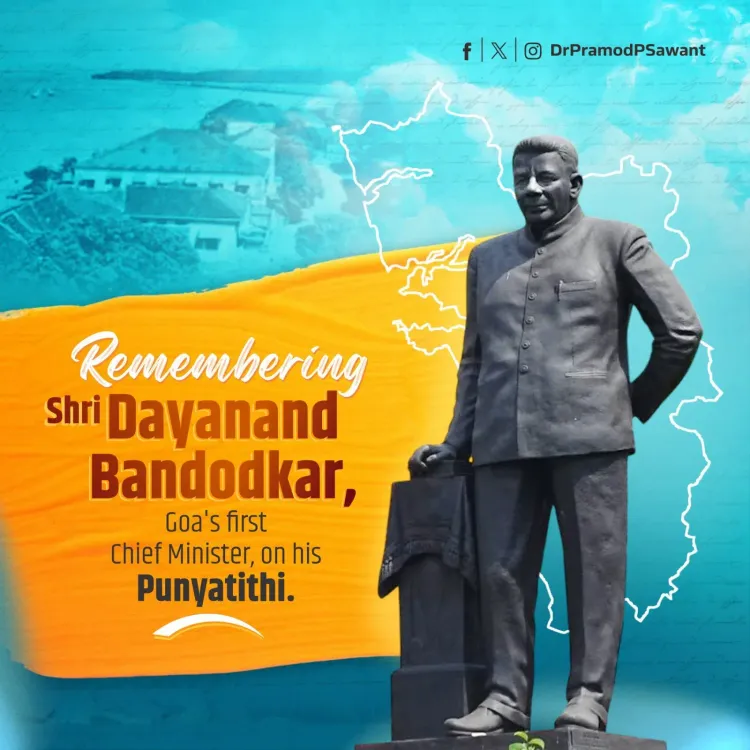
Goa Chief Minister Pramod Sawant on 12 August 2026 paid tribute to Dayanand Bandodkar — Goa's first Chief Minister and beloved 'Bhausaheb' — on his death anniversary, honouring a decade-long legacy of education expansion and rural welfare that shaped the state's earliest years.
Key Takeaways
Dayanand Bandodkar served as Goa's first Chief Minister from 1963 to 1973 , two years after liberation from Portuguese rule.
Bandodkar prioritised primary school expansion and rural infrastructure across Goa's villages during his tenure.
He is widely remembered as Bhausaheb — elder brother — a term of public affection that endures decades after his death.
Goa was a union territory during Bandodkar's entire tenure; it achieved full statehood only in 1987 .
CM Pramod Sawant issued the tribute on 12 August 2026 as part of the state's annual remembrance of its founding leader.
On his Punyatithi (death anniversary), Goa Chief Minister Pramod Sawant paused to honour the man who built the state from the ground up — Dayanand Bandodkar, Goa's first Chief Minister, affectionately known as Bhausaheb.
Who was Bhausaheb Bandodkar?
Dayanand Bandodkar served as Goa's first Chief Minister from 1963 to 1973, steering the newly liberated territory through its most formative decade. He came to power just two years after Goa's liberation from Portuguese rule in 1961, inheriting a state with little administrative infrastructure and deep rural poverty. His government moved quickly — expanding primary schools across villages and laying rural roads and infrastructure that connected Goa's hinterland to its coast.
His focus was deliberate and unglamorous: classrooms over monuments, the farmer over the city. That quiet prioritisation earned him the enduring title Bhausaheb — elder brother — a term of affection that outlasted his tenure by decades.
Sawant's tribute and the continuity it signals
In his post on Wednesday, 12 August 2026, CM Sawant described Bandodkar as having 'played a pioneering role in shaping Goa's early years as a state, with a strong focus on education, rural development and the welfare of ordinary citizens.' The tribute is part of a broader pattern in Indian state politics — sitting chief ministers marking the death anniversaries of predecessors to reinforce continuity in governance priorities. In Goa's case, that thread runs from Bandodkar's classroom-building of the 1960s to the rural welfare schemes of the present day.
Goa itself did not become a full state until 1987, more than a decade after Bandodkar's tenure ended — meaning he governed a union territory, not yet a state, yet laid foundations that statehood would be built upon.
Decades on, the name Bhausaheb still carries weight in Goa's villages. That is the measure of a political legacy — not the office held, but the memory kept.
Frequently Asked Questions
Who was Dayanand Bandodkar?
Dayanand Bandodkar was Goa's first Chief Minister, serving from 1963 to 1973. Known affectionately as Bhausaheb, he is remembered for prioritising primary education and rural development in Goa's earliest years after liberation from Portuguese rule.
When did Goa become a state?
Goa became a full Indian state in 1987. Before that, from its liberation in 1961, it was a union territory — meaning Bandodkar governed it as a union territory, not a state, throughout his tenure.
Why is Bandodkar called Bhausaheb?
Bhausaheb means 'elder brother' in Marathi and Konkani, and was a term of public affection given to Dayanand Bandodkar for his accessible, people-first style of governance focused on ordinary citizens and rural communities.
Who is Pramod Sawant?
Pramod Sawant is the current Chief Minister of Goa and a BJP leader. He issued the tribute to Bandodkar on 12 August 2026 via his official account on X.