CM Sawant targets Congress over Goa's 2007-2012 fund lapse
Synopsis
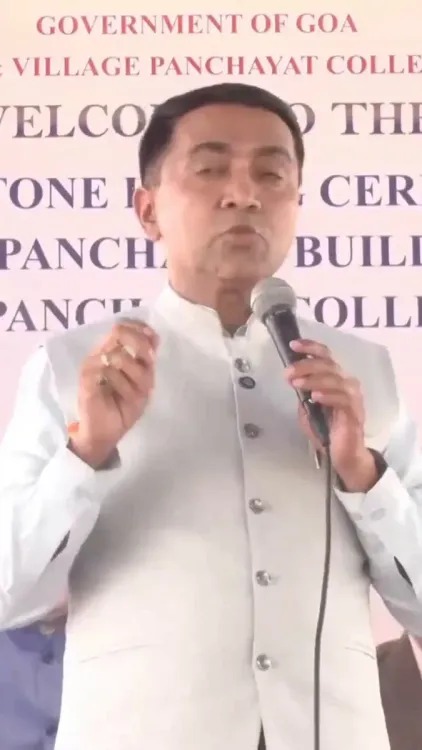
Goa Chief Minister Pramod Sawant has accused the Congress-led government of Digambar Kamat of failing to use available funds or deliver development projects between 2007 and 2012, escalating BJP's pre-election political narrative in the state.
Key Takeaways
Goa CM Pramod Sawant posted a direct attack on the Congress-led government that ruled Goa from 2007 to 2012 .
He alleged that 'substantial funds' were available but developmental projects were neither undertaken nor completed during that period.
The tenure referenced corresponds to Digambar Kamat's Congress coalition government, which lost the 2012 Goa assembly elections to the BJP.
Sawant has been Chief Minister of Goa since 2019 , representing the Bharatiya Janata Party .
The post fits a broader BJP pattern of highlighting Congress-era governance gaps as part of pre-election political messaging in Goa.
No specific fund figures or project names were cited in the post; those claims remain unverified in the public record.
A pointed political charge landed on Wednesday when Goa Chief Minister Pramod Sawant accused the previous Congress-led government of squandering five years of development opportunity — alleging that between 2007 and 2012, substantial funds sat available while critical projects for the state either never began or were left unfinished.
Sawant's post pulls no punches: 'Between 2007 and 2012, despite the availability of substantial funds, the then Government failed to undertake or complete the developmental projects Goa needed.' The charge is specific in its time-frame and blunt in its verdict — money was there, will was not.
The Congress tenure in Goa that Sawant is targeting
The period in question corresponds directly to the tenure of Congress leader Digambar Kamat, who headed a coalition government in Goa from 2007 to 2012. That government was voted out in the 2012 Goa assembly elections, which brought a BJP-led coalition to power — beginning a political realignment that the BJP has held, with Sawant at the helm since 2019.
The allegation of fund non-utilisation is a familiar weapon in state-level political contests. Across India, ruling parties routinely excavate the previous administration's record on infrastructure delivery — but the charge carries weight when it can be tied to specific projects and audited fund flows. Sawant's post gestures at that specificity without laying out figures or a project list, leaving the evidentiary detail for another forum.
BJP's recurring playbook on Congress-era governance
Goa's political landscape has been a two-party tug-of-war between Congress and BJP for over two decades, with governance performance — roads, water supply, tourism infrastructure — consistently at the centre of electoral argument. State-level BJP leaders across India have made 'inherited neglect' a standard campaign frame, and Sawant's Wednesday post fits squarely into that pattern.
What sharpens the timing is the approach of the next Goa assembly elections. Political messaging of this kind rarely surfaces in isolation — it is typically the opening move in a longer narrative-building exercise designed to contrast past inaction with present delivery. Whether the Congress responds with its own data from the 2007-2012 period will determine how far this exchange travels.
For now, Sawant has staked out the terrain: the question of what Goa could have built — and did not — is back on the table.
Point of View
Bounded period of alleged Congress failure rather than making abstract charges. By invoking 2007-2012, he is not just attacking a record; he is asking Goa's electorate to measure what was promised against what was built. The Congress faces a familiar dilemma: engage with the charge and risk amplifying it, or stay silent and cede the framing. For the BJP, this kind of retrospective accountability messaging has proven durable in state after state, particularly when infrastructure gaps remain visible to ordinary voters.
NationPress
30 Sept 2026
Frequently Asked Questions
What is Pramod Sawant accusing the Congress government of in Goa?
Goa Chief Minister Pramod Sawant has accused the Congress-led government that ruled Goa between 2007 and 2012 of failing to utilise available funds and leaving developmental projects incomplete or unstarted.
Who was Goa's Chief Minister between 2007 and 2012?
Congress leader Digambar Kamat served as Chief Minister of Goa from 2007 to 2012, heading a coalition government that was voted out in the 2012 state assembly elections.
When did the BJP come to power in Goa?
The BJP-led coalition first returned to power in Goa after the 2012 assembly elections. Pramod Sawant became Chief Minister in 2019.
Why is Sawant raising the 2007-2012 governance record now?
With Goa assembly elections on the horizon, BJP leaders are building a political narrative contrasting Congress-era governance with current delivery — a standard pre-election framing strategy used across Indian states.
Were specific projects or fund amounts mentioned in Sawant's post?
No. Sawant's post referenced 'substantial funds' and developmental projects in general terms without naming specific schemes, amounts, or project lists.