Rajnath Singh hails Cabinet nod to Rabi MSP hike for 2027-28
Synopsis
The Union Cabinet approved an MSP hike for Rabi crops for 2027-28 on September 30, 2026. Defence Minister Rajnath Singh praised PM Modi's decision, linking it to farmer welfare and crop diversification — continuing a twice-yearly practice anchored to a 1.5x cost-of-production benchmark set in 2018.
Key Takeaways
The Union Cabinet approved a hike in Minimum Support Price (MSP) for Rabi crops for 2027-28 on September 30, 2026 .
Rajnath Singh announced the decision on X, crediting PM Narendra Modi and calling it a sign of the government's 'continuous commitment' to farmers.
The hike is aimed at providing a 'fair and remunerative price' and at encouraging crop diversification .
The government's MSP policy benchmarks support prices at a minimum of 1.5 times the cost of production across 22 mandated crops , a standard announced in 2018 .
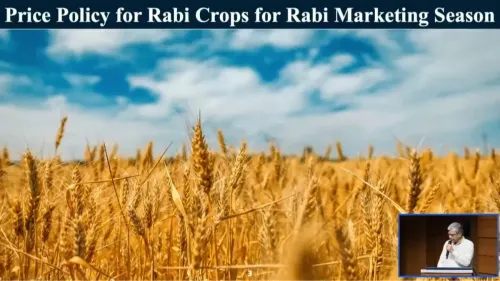
Rabi crops — including wheat, mustard, and gram — are sown in winter months, making the late-September Cabinet nod a critical pre-sowing signal for farmers.
Every harvest season, a number decided in a Cabinet room ripples across millions of farm fields — and on Wednesday, September 30, 2026, that number moved in farmers' favour. Union Defence Minister Rajnath Singh announced that the Cabinet, under Prime Minister Narendra Modi, approved a hike in the Minimum Support Price (MSP) for Rabi crops for the 2027-28 season, calling it a reaffirmation of the government's 'continuous commitment to protecting the interests and bright future of our annadata' — the providers of grain.
What the Cabinet approved — and what it signals to farmers
Singh, posting in Hindi on X, said the decision would ensure 'a fair and remunerative price for farmers' hard work and produce' while also incentivising crop diversification — a key policy goal aimed at shifting cultivation patterns away from water-intensive staples toward a broader mix of crops. He expressed 'heartfelt gratitude' to Prime Minister Modi for the move.
The language is deliberate. 'Remunerative price' and 'crop diversification' are not rhetorical flourishes; they map directly to a 2018 government commitment that fixed MSP at a floor of 1.5 times the cost of production for 22 mandated crops — a benchmark the present administration has cited consistently as it announces twice-yearly revisions for Rabi and Kharif seasons.
The twice-yearly ritual — and why this one matters
India's MSP architecture is one of the most consequential price-setting exercises in any democracy. Successive governments have revised support prices before each sowing season to give cultivators a guaranteed floor, effectively influencing what gets planted across hundreds of millions of acres. Rabi crops — principally wheat, mustard, gram, and barley — are sown in the winter months, making a late-September Cabinet decision the critical signal before seeds go into the ground.
By tying the announcement to crop diversification, the government is also nudging farmers toward pulses and oilseeds, where India continues to depend on imports. A higher MSP for those alternatives can shift the calculus on the farm without a single directive.
Rajnath Singh's role in the political messaging
Singh is not the agriculture minister, but as a senior BJP leader, former Uttar Pradesh Chief Minister, and former Union Home Minister, his public endorsement of the decision carries weight beyond a routine ministerial statement. Uttar Pradesh — a state he governed and still commands political resonance in — is among India's largest wheat-producing states. His post frames the MSP hike explicitly as a trust-building exercise: 'the confidence of our hardworking farmer brothers and sisters will grow stronger.'
Whether that confidence translates into measurable income gains will depend on the actual revised figures — which the government is expected to notify formally — and on how effectively procurement machinery reaches small and marginal cultivators, who historically struggle to access MSP benefits even when the numbers look good on paper.
The next test comes in Parliament's winter session, where the specific MSP figures and their cost-of-production basis are likely to face close scrutiny from the opposition.
Point of View
The Modi government is threading two policy needles at once — addressing farmer distress optics while nudging cultivation patterns toward import-substitution crops like pulses and oilseeds. Rajnath Singh's personal endorsement, given his deep roots in Uttar Pradesh's agrarian belt, amplifies the political signal well beyond the Agriculture Ministry's remit. The real test, as always, lies not in the Cabinet note but in whether the procurement infrastructure actually delivers the announced floor price to the last-mile farmer.
NationPress
30 Sept 2026
Frequently Asked Questions
What is MSP and why does it matter for Indian farmers?
MSP, or Minimum Support Price, is a government-guaranteed floor price for specific crops. It matters because it protects farmers from price crashes during bumper harvests, ensuring they receive at least the declared amount when selling to government procurement agencies.
Which crops are covered under the Rabi MSP hike for 2027-28?
Rabi crops typically covered include wheat, gram (chana), mustard (rapeseed), barley, and lentils (masoor). The specific revised figures for each crop are notified formally by the government after Cabinet approval.
What is the government's benchmark for setting MSP?
Since 2018, the government has committed to fixing MSP at a minimum of 1.5 times the cost of production for 22 mandated crops, a formula meant to guarantee a reasonable profit margin for cultivators.
Why did Rajnath Singh comment on an agriculture decision when he is the Defence Minister?
As a senior BJP leader and former Chief Minister of Uttar Pradesh — one of India's largest farming states — Singh regularly speaks on farmer welfare issues. His endorsement carries political weight in key agricultural constituencies beyond his ministerial portfolio.
What is crop diversification and why is it linked to MSP?
Crop diversification means shifting cultivation from a narrow range of staples like wheat and rice to a broader mix including pulses, oilseeds, and coarse grains. Offering higher MSPs for underproduced crops makes it financially attractive for farmers to switch, helping reduce import dependence.