CM Sawant's Mhajo Flat Scheme Enables Cost-Free Redevelopment
Synopsis
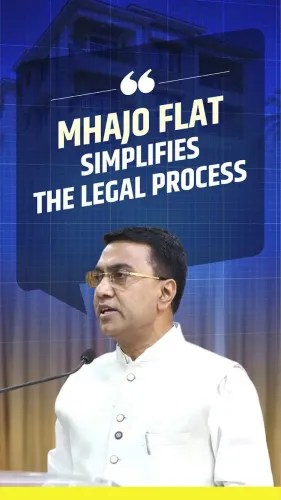
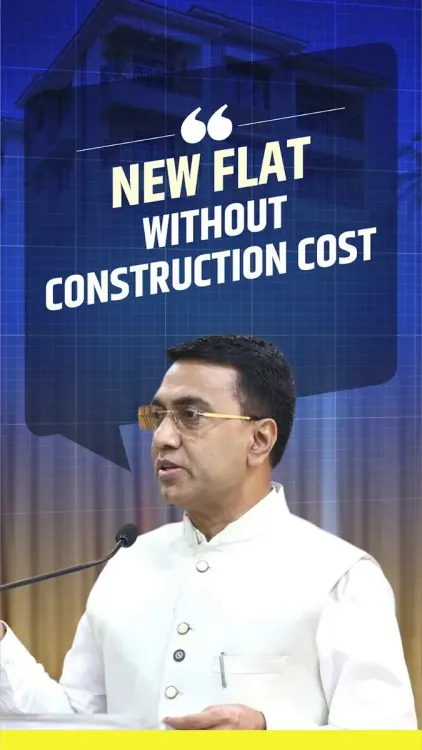
Goa Chief Minister Pramod Sawant has spotlighted the Mhajo Flat Scheme's redevelopment feature, allowing cooperative housing societies to partner with builders and secure new flats for members without bearing construction costs — a model aimed at reviving ageing residential complexes across the state.
Key Takeaways
Goa CM Pramod Sawant highlighted the Mhajo Flat Scheme on 16 November 2026 .
The scheme enables cooperative housing societies to partner with private builders for redevelopment of old complexes.
Existing members receive new flats without bearing construction costs — the builder recoups investment through additional open-market units.
The model addresses the problem of ageing, deteriorating housing stock in land-scarce Goa.
Implementation details — eligible complexes, timelines, and builder criteria — are yet to be announced via formal state notifications.
Goa has previously engaged with national frameworks like PMAY alongside state-specific housing initiatives.
Goa's aging housing complexes may finally get a new lease of life — without residents paying a rupee in construction costs. Goa Chief Minister Pramod Sawant highlighted on Monday, 16 November 2026 a key feature of the state's Mhajo Flat Scheme: cooperative housing societies can partner directly with builders to redevelop old complexes, with existing members receiving new flats at zero personal construction expense.
How the Mhajo Flat Scheme's Redevelopment Model Works
The scheme's redevelopment provision rests on a straightforward exchange. A cooperative housing society enters an agreement with a private builder, who finances and executes the construction. In return, existing members are allotted new flats — the builder typically recoups investment through additional units sold on the open market. The resident bears no direct construction cost. It is a model that has taken root in several Indian states, and Goa is now formalising it under a state-branded scheme.
Chief Minister Sawant's post underscores that the scheme is not simply a new-build programme — it also addresses the pressing problem of deteriorating older housing stock in a state where land is scarce and redevelopment has historically been slow and contentious.
Cooperative Societies at the Centre of the Plan
Placing cooperative housing societies as the primary counterparty — rather than individual flat owners negotiating alone — is significant. It gives residents collective bargaining weight against builders, reduces the risk of holdouts stalling projects, and streamlines regulatory approvals. For Goa, where many housing complexes date back several decades, this structure could unlock redevelopment that individual owners have been unable to pursue on their own.
Goa has previously participated in national frameworks such as the Pradhan Mantri Awas Yojana (PMAY) for affordable housing, while also pursuing state-specific initiatives. The Mhajo Flat Scheme appears to extend that tradition with a model tailored to the state's dense cooperative-housing landscape.
What Residents and Societies Should Watch For
Key details — eligible complexes, minimum age of structures, builder empanelment criteria, and dispute resolution mechanisms — will determine whether the scheme delivers at scale. State government notifications and budget announcements spelling out implementation timelines are the next critical signposts for cooperative societies weighing whether to initiate redevelopment under the scheme.
For thousands of Goan families living in ageing buildings, the promise is clear: a brand-new flat, same address, no construction bill. Whether the fine print matches the headline is the question every housing society in Goa will now be asking.
Point of View
The Mhajo Flat Scheme reflects a broader Indian policy trend of using collective structures to de-risk urban housing upgrades. For a small, land-constrained state like Goa, the builder-partnership model is potentially high-impact, but its success will hinge on robust regulatory safeguards to prevent builder dominance over societies with limited legal resources. Politically, the scheme allows the BJP government in Goa to claim a welfare dividend targeted at middle-income flat-owners — a constituency that sits outside traditional pro-poor housing narratives but represents a significant urban vote bank. The real test comes when the first redevelopment agreements are signed and scrutinised.
NationPress
17 Nov 2026
Frequently Asked Questions
What is the Mhajo Flat Scheme in Goa?
The Mhajo Flat Scheme is a Goa state housing initiative announced by Chief Minister Pramod Sawant. Among its features is a provision allowing cooperative housing societies to redevelop old residential complexes by partnering with private builders, with existing members receiving new flats without paying construction costs.
Who is eligible for the Mhajo Flat Scheme redevelopment benefit?
According to CM Sawant's post, existing members of cooperative housing societies in Goa with old housing complexes are the intended beneficiaries. Detailed eligibility criteria — including minimum building age and society size — are expected to be specified in forthcoming state government notifications.
How do builders benefit from the Mhajo Flat Scheme redevelopment model?
In the redevelopment model, builders finance and execute construction in exchange for rights to sell additional units created beyond those allotted to existing society members, allowing them to recover costs and generate profit through the open market.
Will cooperative housing society members have to pay anything for their new flat?
CM Sawant has stated that the Mhajo Flat Scheme facilitates redevelopment 'without bearing construction costs' for existing members, meaning they receive new flats without direct construction expenses under the builder-partnership arrangement.
Is the Mhajo Flat Scheme connected to PMAY or a central government scheme?
The Mhajo Flat Scheme appears to be a Goa state-specific initiative. While Goa has previously participated in central schemes like the Pradhan Mantri Awas Yojana (PMAY), the Mhajo Flat Scheme as described by CM Sawant is a distinct state-branded programme, though formal notifications clarifying its relationship to central frameworks are awaited.