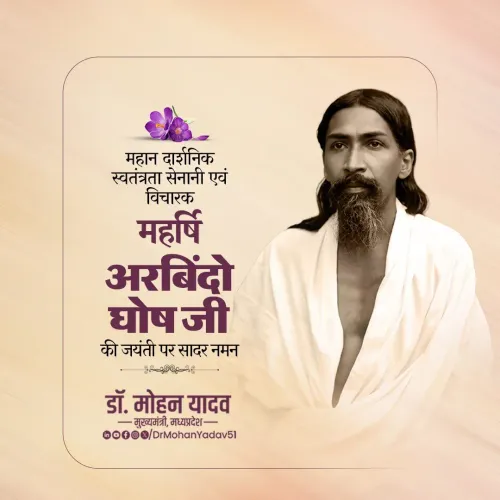
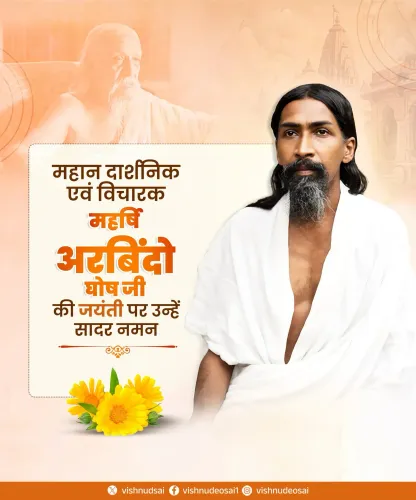
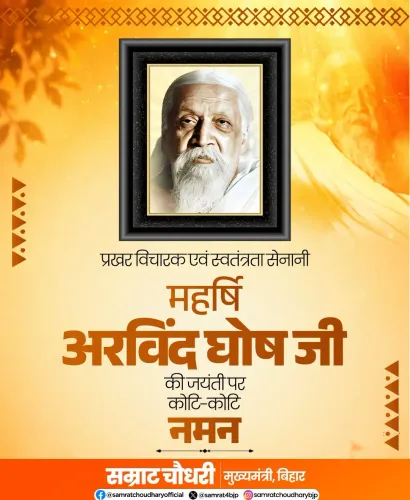
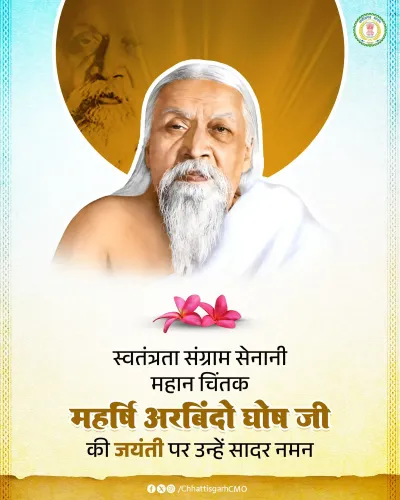
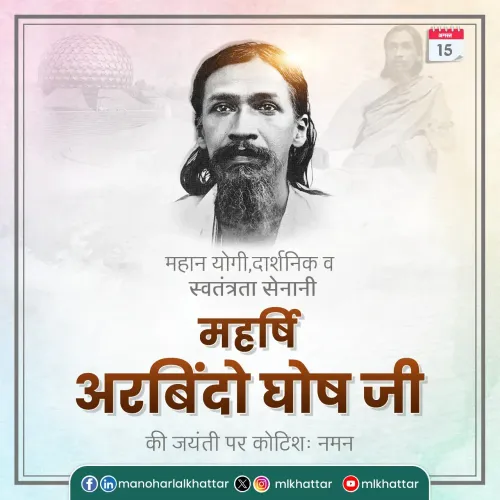
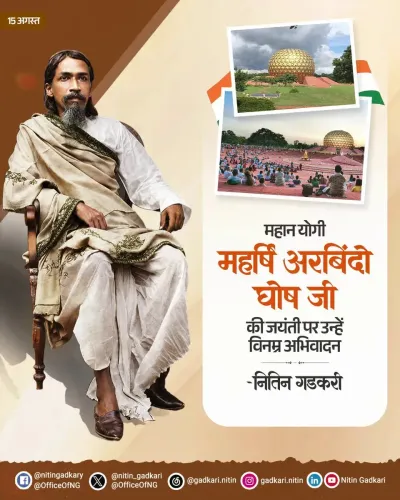
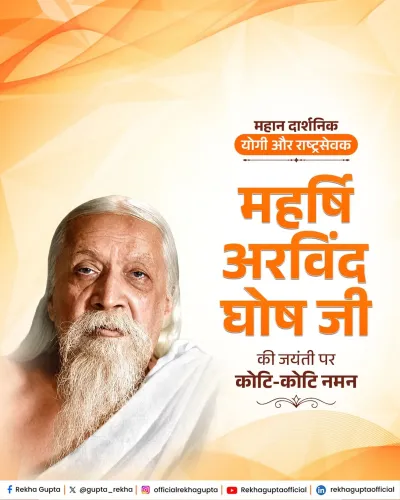
CM Bhajan Lal Sharma pays tribute to Aurobindo on birth anniversary
Synopsis
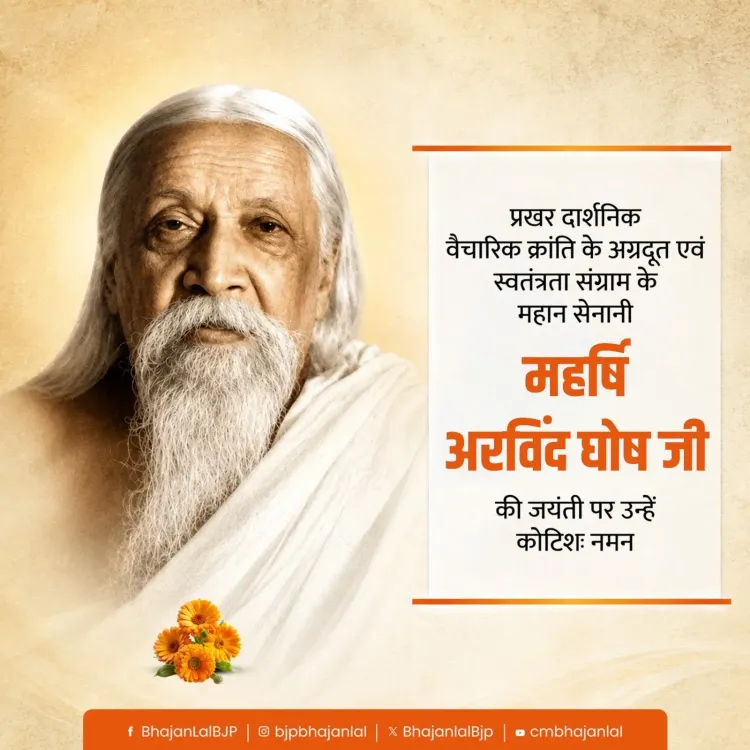
Rajasthan Chief Minister Bhajan Lal Sharma marked Maharshi Aurobindo Ghosh's birth anniversary on Independence Day, honouring the philosopher-patriot's legacy of spiritual awakening, cultural nationalism, and human welfare as enduring inspiration for modern India.
Key Takeaways
Rajasthan CM Bhajan Lal Sharma paid tribute to Maharshi Aurobindo Ghosh on his birth anniversary, 15 August 2026 .
The post described Aurobindo as a 'sharp philosopher, pioneer of ideological revolution, and great warrior of the freedom struggle.' Aurobindo Ghosh was born on 15 August 1872 , exactly 75 years before India's independence in 1947 .
Aurobindo founded the Sri Aurobindo Ashram in Pondicherry and developed the philosophy of Integral Yoga .
CM Sharma stated that Aurobindo's ideas on spiritual awakening, nationalism, and human welfare 'continue to give society a new direction and inspiration today.'
On India's Independence Day, 15 August 2026, Rajasthan Chief Minister Bhajan Lal Sharma paid homage to Maharshi Aurobindo Ghosh, saluting the philosopher-patriot whose birth anniversary falls on the same day the nation celebrates its freedom — a coincidence Aurobindo himself once called destiny's signature.
In his post, CM Sharma wrote: 'प्रखर दार्शनिक, वैचारिक क्रांति के अग्रदूत एवं स्वतंत्रता संग्राम के महान सेनानी' — 'a sharp philosopher, pioneer of ideological revolution and great warrior of the freedom struggle' — offering 'countless salutations' (kotishaः naman) to Aurobindo's memory. He noted that Aurobindo's ideas on spiritual awakening, nationalism, and human welfare 'continue to give society a new direction and inspiration even today.'
The man born on the day India would one day be free
Aurobindo Ghosh was born on 15 August 1872 — exactly 75 years before India achieved independence in 1947. He began his public life as a fierce anti-colonial agitator, a key voice in Bengal's revolutionary politics in the early 1900s, before a transformative spiritual experience in Alipore Jail redirected his energy inward. He eventually settled in Pondicherry, where he founded the Sri Aurobindo Ashram and developed his philosophy of Integral Yoga — a synthesis of action, devotion, knowledge, and self-transcendence aimed at collective human evolution.
His legacy straddles two worlds: the barricades of nationalist politics and the silence of contemplative philosophy. That duality is precisely why he remains a figure both political leaders and spiritual seekers claim as their own.
Why BJP leaders invoke Aurobindo
Indian political figures across the spectrum issue tributes on Aurobindo's birth anniversary, but BJP leaders have drawn on him with particular frequency — connecting his brand of cultural nationalism and spiritual self-reliance to the party's own ideological lineage. CM Sharma's framing — 'new direction and inspiration for society' — fits squarely within that tradition, presenting Aurobindo not as a historical relic but as a living intellectual resource for the present.
The tribute, posted at dawn on Independence Day, carries its own quiet symbolism: a Chief Minister of a major state beginning the national holiday with a salute to the man whose birthday the holiday has always shared.
Point of View
Whose blend of spiritual philosophy and anti-colonial politics offers ideological breadth. Posting on Independence Day — which Aurobindo shares as his birthday — amplifies the symbolism without requiring additional argument. For CM Sharma, the gesture is low-risk but high-visibility: it associates Rajasthan's government with a revered, non-partisan intellectual at a moment of peak national attention. The broader pattern signals that Aurobindo's legacy remains actively contested political terrain, not merely archived history.
NationPress
29 Sept 2026
Frequently Asked Questions
Why is Aurobindo Ghosh's birthday celebrated on 15 August?
Maharshi Aurobindo Ghosh was born on 15 August 1872 , which is the same date India gained independence in 1947 — a coincidence Aurobindo himself acknowledged as deeply significant.
What did Bhajan Lal Sharma say about Aurobindo Ghosh?
CM Bhajan Lal Sharma called Aurobindo a 'sharp philosopher, pioneer of ideological revolution, and great warrior of the freedom struggle,' adding that his ideas on spiritual awakening, nationalism, and human welfare continue to inspire society.
What is Aurobindo Ghosh known for?
Aurobindo Ghosh is known for his early role in India's anti-colonial movement, his philosophy of Integral Yoga , and founding the Sri Aurobindo Ashram in Pondicherry .
Who is Bhajan Lal Sharma?
Bhajan Lal Sharma is the Chief Minister of Rajasthan and a senior BJP leader.
What is Integral Yoga?
Integral Yoga is the spiritual philosophy developed by Aurobindo Ghosh that synthesises action, devotion, and knowledge, aiming at the collective spiritual evolution of humanity.