CM Siddaramaiah Launches 123 km Bengaluru Business Corridor
Synopsis
Chief Minister D.K. Shivakumar, speaking at the 517th Kempegowda Jayanti in Bengaluru on June 27, announced a 123 km Business Corridor with tenders floated, a Hebbala tunnel road starting within days, and a hybrid land-compensation model offering owners 35% commercial or 40% residential land, or TDR.
Key Takeaways
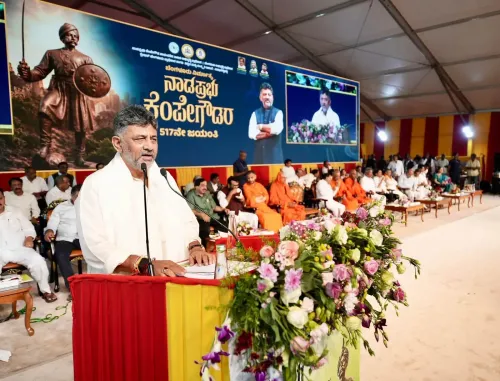
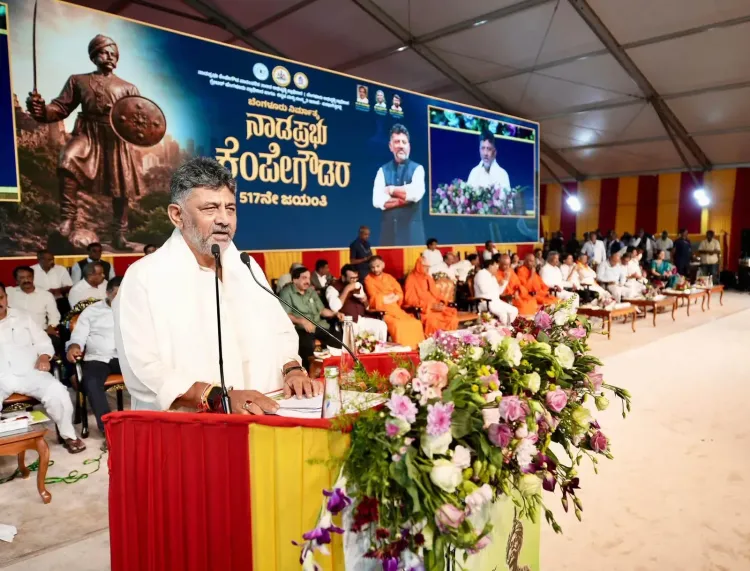
Shivakumar addressed the 517th Kempegowda Jayanti at the BDA's new Kempegowda Layout on June 27, 2026 .
Tenders have been called for the 123 km Bengaluru Business Corridor ; a final notification for the Electronic City–Mysore Road section is imminent.
A tunnel road near Hebbala will begin construction within days as part of a broader congestion-relief plan.
Landowners losing property to the corridor may choose 35% commercial land , 40% residential land , or TDR as compensation.
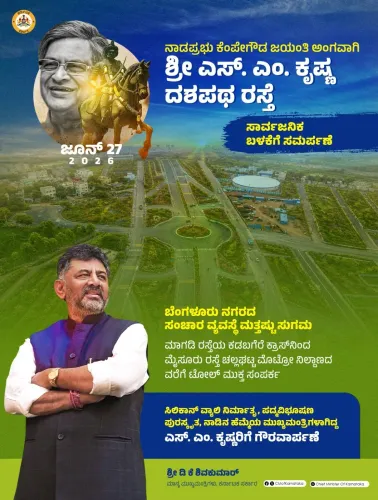
The CM invoked the 'three Ks' — Kempegowda , Kengal Hanumanthaiah , and S.M.
Krishna — as the three pillars of Bengaluru's historical development.
A dedicated officials' team will be constituted to oversee Bengaluru's infrastructure projects.
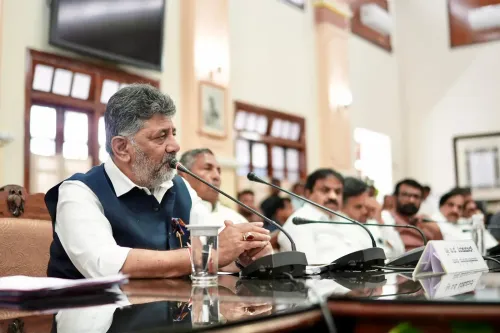
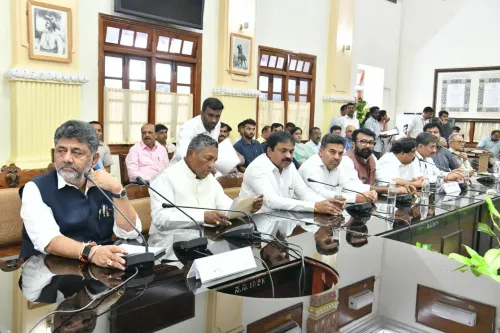
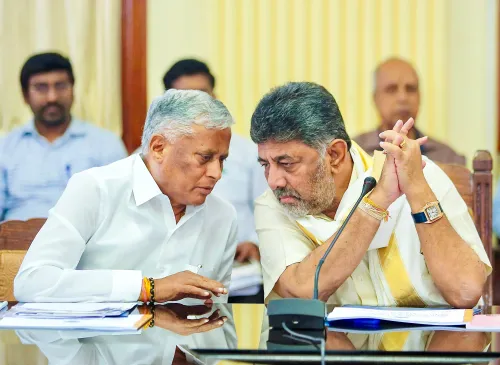
Chief Minister D.K. Shivakumar on Saturday, June 27, 2026, addressed the 517th Kempegowda Jayanti celebrations at the newly developed Kempegowda Layout built by the Bengaluru Development Authority (BDA), announcing a series of major infrastructure initiatives for the city and invoking the legacies of three historic figures who shaped Bengaluru.
Context
Speaking at the jayanti event, CM Shivakumar paid tribute to what he called the 'three Ks' that Bengalureans must remember: Nadaprabhu Kempegowda, the 16th-century founder of Bengaluru; Kengal Hanumanthaiah, the former Chief Minister who built Vidhana Soudha; and S.M. Krishna, the former Chief Minister credited with taking Bengaluru to international prominence as an IT hub. 'Those who forget history cannot create history,' he said, quoting B.R. Ambedkar, adding that he personally prefers creating history over merely reading or recalling it.
The Chief Minister described the event not merely as a celebration of affection for Kempegowda but as a programme to adopt his principles. He noted that Sri Nirmalananda Swamiji and Sri Nanjavadhuta Swamiji had together decided to observe Kempegowda Jayanti on June 27, after which the tradition has been followed. He also extended congratulations to Revanna for standing by him during that period.
Policy Backdrop
The centrepiece announcement was the 123-kilometre Bengaluru Business Corridor road project, for which tenders have already been called. The CM stated that a final notification for the section connecting Electronic City to Mysore Road will be issued shortly. He framed the project as existential for the city: 'If this road does not come, Bengaluru cannot survive.'
The corridor revives and expands upon the earlier Peripheral Ring Road proposal, which a previous Karnataka government had approved but not implemented. Shivakumar stated that after taking charge of Bengaluru's development, he moved forward with the project, saying 'criticisms die, work endures.' A dedicated team of officials will also be constituted to oversee execution.
On land acquisition, the government announced a hybrid compensation model: landowners who lose property to the project may choose between 35% commercial land, 40% residential land, or Transferable Development Rights (TDR). Owners may select whichever option suits them, marking a shift from purely monetary compensation toward value-capture financing.
Stakeholders and Impact
Urban commuters in Bengaluru, one of India's most congested cities and its leading IT hub, stand to benefit most directly from the corridor and associated tunnel projects. The CM announced that construction of a short-distance tunnel road near Hebbala will begin within days, with plans for a larger tunnel road also in the pipeline to ease traffic congestion across the city.
Landowners along the corridor alignment face acquisition but are being offered developed land parcels rather than only cash, a model that has precedent in earlier metro and ring-road phases in Indian cities. The BDA's new Kempegowda Layout, where the event was held, itself represents the authority's ongoing urban development work.
What's Next
The immediate milestones to watch are the issuance of the final land-acquisition notification for the Electronic City–Mysore Road section, the commencement of tunnel road construction near Hebbala within weeks, and the evaluation of tenders already floated for the 123 km Business Corridor. The government has signalled it intends to move decisively, with the CM stating he will take 'bold decisions' to ensure the project proceeds. The constitution of a dedicated officials' team is also expected shortly, which will set the administrative machinery for one of Bengaluru's largest road infrastructure undertakings in recent years.
Point of View
CM Shivakumar is deploying a well-worn Karnataka political playbook — tying civic ambition to cultural memory — while also seeking to differentiate his government by actually moving stalled projects to tender stage. The hybrid TDR-plus-land compensation model signals a maturation in how Karnataka handles urban land acquisition, borrowing from value-capture frameworks that have gradually gained traction in Indian metro projects. The 'three Ks' framing is also a subtle political move, placing Shivakumar in a lineage that includes Congress icon S.M. Krishna, reinforcing a Congress-era developmental narrative ahead of any electoral cycle. Whether the corridor clears the perennial bottleneck of land acquisition and litigation will be the real test of whether this jayanti speech translates into durable policy.
NationPress
26 Sept 2026
Frequently Asked Questions
What is the Bengaluru Business Corridor and how long is it?
The Bengaluru Business Corridor is a 123-kilometre road project for which the Karnataka government has already floated tenders. It is designed to ease traffic movement across the city and is partly an evolution of the earlier Peripheral Ring Road proposal.
What compensation will landowners get for the Bengaluru Business Corridor?
Landowners whose property is acquired for the corridor can choose between 35% commercial land , 40% residential land , or Transferable Development Rights (TDR) — whichever option suits them best.
When will the Hebbala tunnel road construction begin?
CM Shivakumar announced that construction of the short-distance tunnel road near Hebbala will begin within a few days of the June 27 announcement.
Who are the 'three Ks' of Bengaluru that CM Shivakumar mentioned?
The 'three Ks' are Nadaprabhu Kempegowda , the 16th-century founder of Bengaluru; Kengal Hanumanthaiah , who built Vidhana Soudha; and S.M. Krishna , who elevated Bengaluru to international IT prominence.
What is the 517th Kempegowda Jayanti and where was it held?
The 517th Kempegowda Jayanti , observed on June 27 each year, marks the birth anniversary of the 16th-century ruler who founded Bengaluru. The 2026 event was held at the Kempegowda Layout developed by the Bengaluru Development Authority.