CM Shivakumar seeks Union nod for Bengaluru metro, RRTS projects
Synopsis
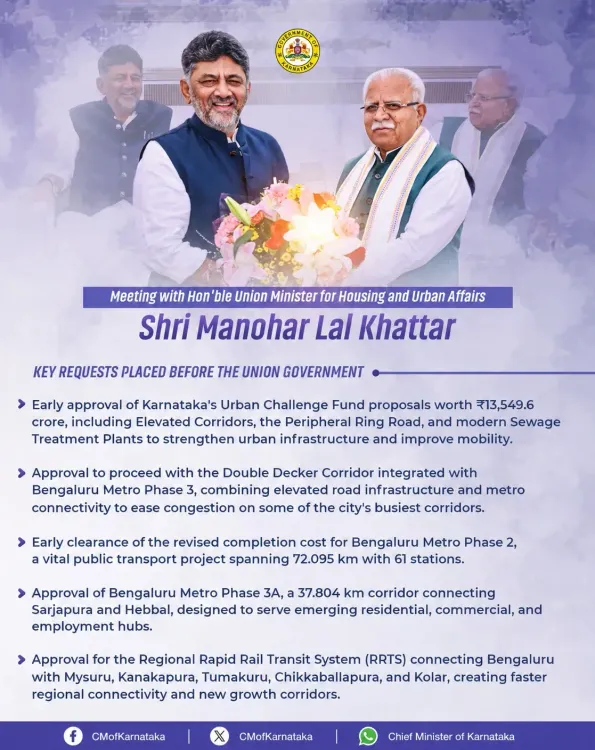
Karnataka Chief Minister D K Shivakumar met Union Minister Manohar Lal Khattar on 10 June 2026, seeking fast-track central clearances for Bengaluru Metro Phase 3A, the RRTS, a Double Decker Corridor, revised Metro Phase 2 costs, and Urban Challenge Fund proposals to boost the state's urban mobility.
Key Takeaways
CM D K Shivakumar met Union Minister Manohar Lal Khattar on 10 June 2026 to push for central clearances on urban infrastructure projects.
Five proposals were placed before the Union government: Urban Challenge Fund submissions, Bengaluru Metro Phase 3A , revised costs for Metro Phase 2 , a Double Decker Corridor , and the RRTS .
Metro Phase 2 originally received central sanction in 2017 ; cost escalations require fresh Union approval before the project can fully proceed.
The RRTS would link Bengaluru with surrounding towns, mirroring the regional rail model being implemented in Delhi-NCR .
Karnataka framed the push as an exercise in cooperative federalism , with the state and Union government jointly financing urban transit expansion.
Central approvals and subsequent land acquisition will determine how quickly these projects move from proposals to construction.
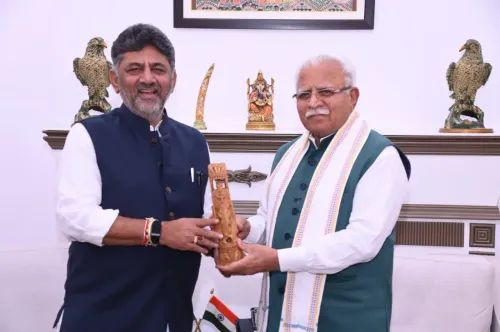
Chief Minister D K Shivakumar of Karnataka met Union Minister for Housing and Urban Affairs Manohar Lal Khattar on Wednesday, 10 June 2026, urging the central government to fast-track approvals for a clutch of urban infrastructure and mobility projects that the state government says will define Karnataka's next phase of growth.
What was sought
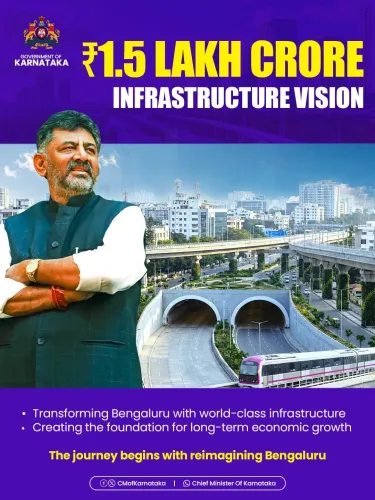
CM Shivakumar pressed for expeditious clearance on five specific proposals: the Urban Challenge Fund submissions, Bengaluru Metro Phase 3A, the revised cost estimate for Metro Phase 2, an integrated Double Decker Corridor, and the Regional Rapid Transit System (RRTS) connecting Bengaluru with surrounding regions. The Chief Minister's Office described all five as aimed at 'enhancing connectivity, easing congestion, and creating new growth corridors across the State.'
The request for a revised cost approval for Metro Phase 2 is significant: the project received initial central sanction in 2017 and cost escalations since then require fresh Union government endorsement before work can advance at full pace.
Policy backdrop
India's Metro Rail Policy 2017 requires states to obtain central clearances for any metro project that draws on Union funding or sovereign guarantees. Under this framework, states submit detailed project reports and cost revisions to the Ministry of Housing and Urban Affairs, which evaluates them before forwarding recommendations to the Union Cabinet.
The AMRUT 2.0 scheme, launched in 2021, provides an additional financing window for urban mobility and infrastructure upgrades in mission cities, and Bengaluru is among the eligible cities. The Urban Challenge Fund operates as a competitive grant mechanism through which states pitch transformative urban proposals for central co-funding.
The proposed RRTS corridor for Bengaluru follows a national model already under construction in the Delhi-NCR region, where regional rapid rail has been positioned as a tool to decongest urban cores by linking satellite towns to the main metropolitan area.
Stakeholders and impact
Bengaluru, India's technology and startup capital, has long struggled with road congestion that economists argue imposes a measurable drag on productivity. Expanding the metro network through Phase 3A and adding a Double Decker Corridor would extend mass transit access to areas currently underserved by the existing network.
The RRTS, if cleared and built, would connect peripheral towns to Bengaluru's core, potentially reshaping real estate demand and easing pressure on arterial roads. Urban local bodies, commuters, and the real estate sector all stand to be directly affected by the pace of approvals and subsequent implementation.
The Government of Karnataka framed the meeting within the language of cooperative federalism, stating it 'remains steadfast in its commitment to building future-ready infrastructure' in partnership with the Union government.
What's next
The Union Ministry of Housing and Urban Affairs will need to evaluate the detailed project reports and cost revisions before forwarding them to the Union Cabinet for formal sanction. Analysts watching the sector will track whether these clearances feature in the next Union Cabinet meeting cycle or are bundled into the forthcoming Union Budget deliberations.
Progress on land acquisition and finalisation of detailed project reports for Metro Phase 3A and the RRTS corridors will be the next on-ground indicators of how quickly these proposals can move from ministerial meetings to construction sites. For Bengaluru, where urban infrastructure demand has consistently outpaced supply, the pace of central approvals will be closely watched by city planners and commuters alike.
Point of View
Softening the optics of a Congress-ruled state seeking funds from a BJP-led centre. Whether the approvals materialise quickly will serve as a litmus test for how effectively India's federal architecture can respond to the infrastructure demands of its fastest-growing urban economy.
NationPress
26 Oct 2026
Frequently Asked Questions
What projects did Karnataka CM Shivakumar seek approval for from the Union government?
CM D K Shivakumar sought central clearances for Bengaluru Metro Phase 3A , revised costs for Metro Phase 2 , the Regional Rapid Transit System (RRTS) , an integrated Double Decker Corridor , and Urban Challenge Fund proposals during his meeting with Union Minister Manohar Lal Khattar on 10 June 2026 .
What is the Bengaluru RRTS and how is it different from the metro?
The Regional Rapid Transit System (RRTS) is a proposed high-speed rail corridor designed to connect Bengaluru with surrounding towns and satellite areas, operating at higher speeds and over longer distances than the city metro. It mirrors the Delhi-NCR RRTS model and is intended to decongest arterial roads by offering a fast inter-city transit option.
Why does Metro Phase 2 need a fresh central approval if it was already sanctioned?
Bengaluru Metro Phase 2 received its original central sanction in 2017 , but construction costs have escalated since then. Under India's Metro Rail Policy 2017 , any significant revision to project costs requires fresh Union government endorsement before additional central funding or guarantees can be extended.
What is the Urban Challenge Fund?
The Urban Challenge Fund is a central government competitive grant scheme under which states pitch transformative urban infrastructure and mobility proposals. Selected projects receive co-funding from the Union government, encouraging states to design ambitious, outcome-linked urban interventions.
What is cooperative federalism in the context of urban infrastructure in India?
In urban infrastructure, 'cooperative federalism' refers to the joint financing and implementation model where state governments design and execute projects while the Union government provides funding, guarantees, and policy clearances — as seen in metro rail projects, AMRUT 2.0 , and the RRTS programme across Indian cities.