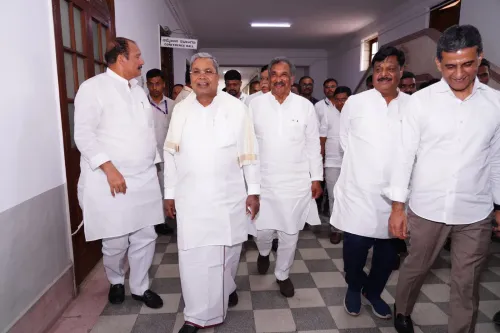
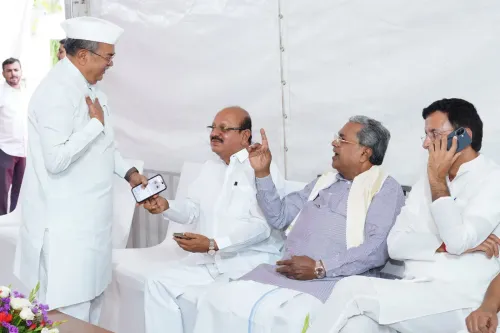
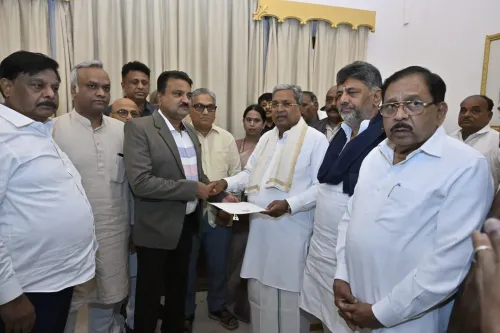
CM Siddaramaiah Votes in Karnataka MLA-to-MLC Election
Synopsis
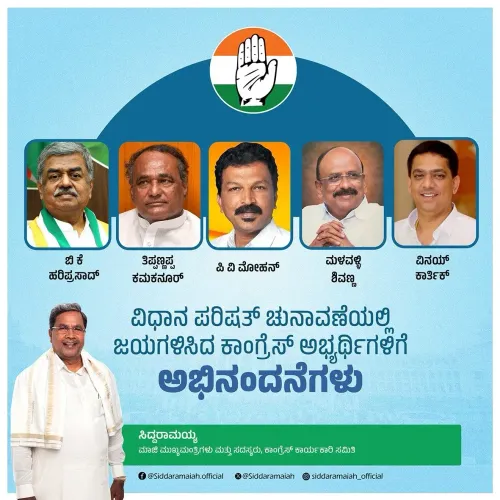
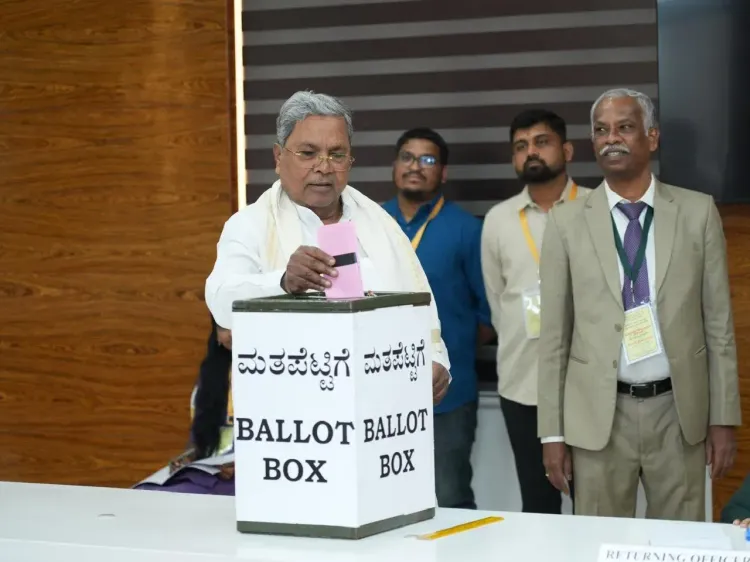
Karnataka Chief Minister Siddaramaiah cast his vote on 18 June 2026 in the biennial MLA-to-MLC election, declaring all Congress legislators stand united and expressing full confidence that the party's five candidates will win seats in the Legislative Council.
Key Takeaways
Siddaramaiah cast his vote on 18 June 2026 in the biennial election from the Karnataka Legislative Assembly to the Legislative Council.
He expressed full confidence that all five Congress candidates would win the contested seats.
The Chief Minister said all Congress MLAs had united 'like one family' behind the party's nominees.
The Karnataka Legislative Council has 75 members , with one-third replaced biennially through elections by the 224-member assembly.
Congress has governed Karnataka since May 2023 , giving it a numerical advantage in any MLA-to-MLC vote.
The result will be closely watched as a test of party discipline and internal cohesion within the state Congress unit.
Karnataka Chief Minister Siddaramaiah cast his vote on Thursday, 18 June 2026, in the biennial election from the Karnataka Legislative Assembly to the Karnataka Legislative Council, expressing full confidence that all five Congress candidates would win the seats.
Posting on X in Kannada, the Chief Minister wrote: 'ವಿಧಾನಸಭೆಯಿಂದ ವಿಧಾನ ಪರಿಷತ್ತಿಗೆ ಇಂದು ನಡೆಯುತ್ತಿರುವ ಚುನಾವಣೆಯಲ್ಲಿ ನನ್ನ ಅಮೂಲ್ಯ ಮತವನ್ನು ಚಲಾಯಿಸಿದೆ.' ('I have cast my precious vote in today's election from the Legislative Assembly to the Legislative Council.') He added that all Congress legislators had stood united 'like one family' behind the party's nominees.
Context
The election is part of Karnataka's periodic biennial replenishment of the Karnataka Legislative Council, the state's upper house. Under the constitutional framework, one-third of the 75-member Council retires every two years, with replacements elected by the 224 MLAs of the Legislative Assembly. This mechanism means the ruling party's strength in the lower house directly shapes its prospects in the upper house.
The Indian National Congress has governed Karnataka since May 2023, when it won a decisive majority in the state assembly elections. That majority gives the party a significant numerical advantage in any MLA-to-MLC election.
Policy Backdrop
Karnataka is one of only six states in India that maintains a bicameral legislature, the others being Andhra Pradesh, Telangana, Maharashtra, Bihar, and Uttar Pradesh. The Council serves as a revising chamber and also provides a route to the legislature for leaders who may not contest direct elections. Control of the upper house carries practical significance for the passage of legislation and for the government's overall parliamentary arithmetic.
Siddaramaiah previously served as Chief Minister from 2013 to 2018 before the Congress lost power. His return to the office in 2023 has been accompanied by a stated emphasis on party discipline and unity — a theme he reinforced in today's post.
Stakeholders and Impact
The immediate stakeholders are the five Congress candidates contesting the seats and the MLAs whose votes determine the outcome. A clean sweep for Congress would strengthen the party's position in the Council, easing the passage of government legislation and reducing the opposition's ability to stall bills in the upper house.
Opposition parties — whose combined MLA strength is lower than Congress's — are contesting the seats but face an uphill task given the arithmetic. The result will also be read as a gauge of internal party cohesion, particularly whether any cross-voting occurs among Congress legislators.
What's Next
Results for the Council seats are expected to be declared on the same day or shortly after the close of polling. A strong Congress performance would consolidate the ruling party's grip on both houses of the Karnataka legislature and could influence the government's legislative agenda in the months ahead. Any evidence of cross-voting, however, would trigger scrutiny of factional dynamics within the state Congress unit.
Point of View
Reducing friction in the upper house for the government's legislative programme. The emphasis on MLAs standing 'like one family' is also a pre-emptive message against cross-voting, a recurring vulnerability in council elections across Indian states. How the results land will set the tone for intra-party dynamics in Karnataka through the remainder of Siddaramaiah's term.
NationPress
19 Sept 2026
Frequently Asked Questions
What is the MLA-to-MLC election in Karnataka?
It is a biennial election in which the 224 elected members of the Karnataka Legislative Assembly vote to fill one-third of the seats in the 75-member Karnataka Legislative Council, the state's upper house.
How many candidates is Congress fielding in the Karnataka MLC election 2026?
Chief Minister Siddaramaiah stated that Congress is fielding five candidates in the election held on 18 June 2026.
Who is Siddaramaiah?
Siddaramaiah is the Chief Minister of Karnataka and a senior leader of the Indian National Congress. He previously served as CM from 2013 to 2018 and returned to office after Congress won the 2023 Karnataka assembly elections.
Why does Congress have an advantage in the Karnataka MLC election?
Congress won a strong majority in the 2023 Karnataka assembly elections, giving it a large number of MLAs whose votes directly determine the outcome of the MLA-to-MLC election.
When will Karnataka MLC election 2026 results be declared?
Results are expected on the same day as the vote, 18 June 2026, or shortly after polling closes, though official confirmation follows the counting process.