CM Sukhu: ₹1,000 cr buildings aren't development
Synopsis
Himachal Pradesh CM Sukhvinder Singh Sukhu declared on 24 September 2026 that constructing ₹1,000 crore buildings is not real development, urging need-based public spending and framing the CM's office as a permanent public institution that transcends any single government.
Key Takeaways
CM Sukhvinder Singh Sukhu posted on 24 September 2026 that building structures worth ₹1,000 crore does not constitute development.
He argued that public money must be spent based on genuine need and future requirements, not prestige projects.
Sukhu explicitly said the Chief Minister's office is not his personal property and belongs to the institution of governance.
He acknowledged that an opposition chief minister will occupy the same office in the future, framing it as a reason for fiscal restraint on administrative buildings.
Himachal Pradesh is a fiscally stressed state, making the call for need-based infrastructure spending particularly significant.
The statement signals a policy preference for redirecting resources from administrative showcase construction to direct public service delivery.
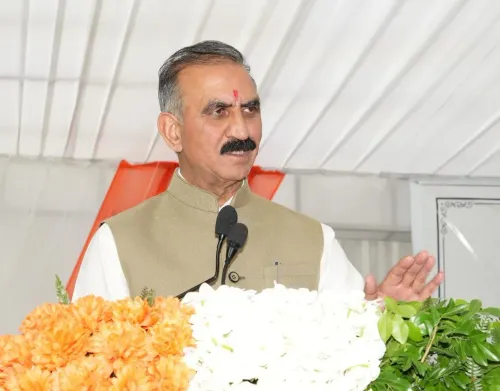
A chief minister's office belongs to the public — not to whoever occupies the chair. That is the sharp, unambiguous message Himachal Pradesh Chief Minister Sukhvinder Singh Sukhu sent on Thursday, 24 September 2026, in a post on X that cut straight to the heart of how governments spend taxpayers' money on themselves.
Posting in Hindi, CM Sukhu stated: '1,000 करोड़ रुपये की इमारतें बना देना विकास नहीं है' — 'Building structures worth ₹1,000 crore is not development.' He argued that public money must be spent with an eye on genuine need and the demands of the future, not on optics or prestige.
The remark carried an unusually candid, institutional framing. 'The Chief Minister's office is not my personal home,' he wrote. 'Today I am the Chief Minister. Fifteen or twenty years from now, a Chief Minister from the opposition will also come and sit here. This office will always be in the service of the people.'
Fiscal discipline framing in a debt-burdened state
Himachal Pradesh is among India's more financially stressed hill states, heavily dependent on central transfers and borrowings to fund its expenditure. In that context, a sitting chief minister publicly questioning the value of large-scale administrative construction carries real political weight — it signals a preference for redirecting scarce resources toward service delivery over showcase infrastructure.
Indian chief ministers periodically invoke fiscal restraint around proposals for new secretariat buildings or upgraded government complexes. Such statements typically surface when capital expenditure on administrative premises faces public or legislative scrutiny. Sukhu's formulation goes a step further: it explicitly decouples the office from its current occupant, framing government property as a multigenerational institution, not a political asset.
Continuity across party lines — a pointed sub-text
The acknowledgement that an opposition chief minister will one day sit in the same chair is not merely gracious — it is politically loaded. It implicitly argues that grandiose spending on official premises by any ruling party is, in effect, also spending for the benefit of future rivals. The logic becomes a restraint mechanism: if the building outlasts the government, the government has no exclusive claim to it.
The statement aligns with a broader governance principle that public offices are institutional assets to be maintained functionally, not trophy projects to be rebuilt each time power changes hands. Whether it translates into specific budget decisions — revised estimates for administrative infrastructure, deferred tenders — will be visible in the state's forthcoming fiscal documents.
For a state government navigating tight finances and a watchful electorate, the message is clear: development is measured in outcomes for people, not in the cost of the buildings that house the people who govern them.
Point of View
Linking fiscal restraint to democratic principle rather than just budget arithmetic. For a Congress government in a hill state with tight finances and a history of competitive populism, anchoring development credibility on restraint — rather than visible construction — is a deliberate repositioning. Watch whether this rhetoric finds expression in actual capital-expenditure deferrals in the next budget cycle.
NationPress
24 Sept 2026
Frequently Asked Questions
What did Himachal Pradesh CM Sukhu say about ₹1,000 crore buildings?
CM Sukhvinder Singh Sukhu stated on 24 September 2026 that constructing buildings worth ₹1,000 crore is not development, and that public money must be spent based on genuine need and future requirements rather than on expensive showcase infrastructure.
Why did CM Sukhu say the CM's office is not his personal home?
Sukhu used the statement to emphasise that the Chief Minister's office is a public institution that will be used by all future governments, including opposition administrations, and therefore should not be treated as a personal or partisan asset by any incumbent.
Is Himachal Pradesh facing financial constraints?
Yes. Himachal Pradesh is among India's more fiscally stressed states, heavily dependent on central transfers and borrowings, which makes statements about restraint in administrative infrastructure spending particularly relevant to the state's budget priorities.
What is Sukhvinder Singh Sukhu's political background?
Sukhvinder Singh Sukhu is the Chief Minister of Himachal Pradesh and an Indian National Congress leader who has held the office since December 2022.
What should we watch for after Sukhu's fiscal restraint statement?
Analysts and observers should track Himachal Pradesh's state budget documents, revised expenditure estimates, and any tenders related to administrative infrastructure projects to see if the political messaging translates into actual spending decisions.