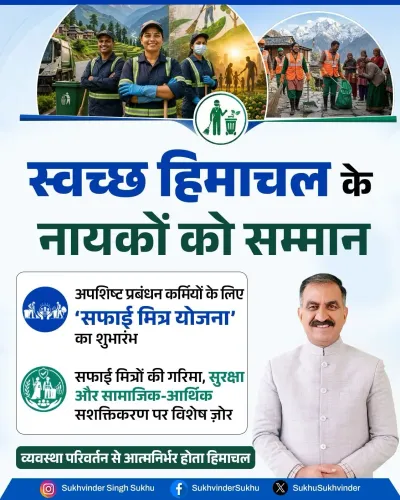
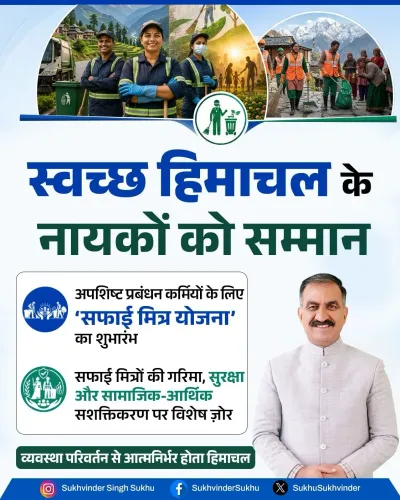
CM Sukhu Pledges Dignity and Safety for Sanitation Workers

Synopsis
Chief Minister Thakur Sukhvinder Singh Sukhu reaffirmed on June 8, 2026, that Himachal Pradesh will work to secure dignity, safety, and opportunity for sanitation workers. The pledge aligns with national frameworks under the Swachh Bharat Mission and the 2013 manual scavenging prohibition law.
Key Takeaways
CM Thakur Sukhvinder Singh Sukhu publicly committed to ensuring safai mitras receive respect, security, and opportunity.
The statement was posted on June 8, 2026 via the official Chief Minister's Office of Himachal Pradesh X account.
Himachal Pradesh participates in central sanitation worker welfare frameworks, including the Swachh Bharat Mission launched in 2014 .
The Prohibition of Employment as Manual Scavengers and their Rehabilitation Act, 2013 forms the legal backbone for sanitation worker protections in India.
Concrete follow-through — budget allocations, scheme guidelines, protective equipment supply — will determine the real-world impact of the stated commitment.
The Chief Minister's Office of Himachal Pradesh, on behalf of Chief Minister Thakur Sukhvinder Singh Sukhu, reaffirmed the state government's commitment to the welfare of sanitation workers — locally referred to as safai mitras — on Monday, June 8, 2026. The statement underlines the government's intent to ensure that those who keep public spaces clean receive the respect, protection, and opportunities they rightfully deserve.
Context
Chief Minister Sukhu stated, in his own words: 'Hamara prayas hai ki safai mitron ko woh samman, suraksha aur avsar mile, jinke woh sachche adhikari hain' — meaning, 'Our endeavour is that safai mitras receive the respect, security, and opportunity that they truly deserve.' The statement, posted via the official Chief Minister's Office of Himachal Pradesh account on X, is a direct affirmation of the state's policy direction on sanitation worker welfare.
Sanitation workers, or safai mitras, form a critical yet historically marginalised section of the municipal workforce across India. Their work involves waste collection, drain cleaning, and maintaining public hygiene — tasks that carry significant occupational health risks when performed without adequate protection.
Policy Backdrop
India's legislative and policy framework for sanitation worker welfare has evolved significantly over the past decade. The Prohibition of Employment as Manual Scavengers and their Rehabilitation Act, 2013 was a landmark step that criminalised manual scavenging and mandated rehabilitation of affected workers. The Swachh Bharat Mission, launched in 2014, further accelerated efforts to modernise sanitation infrastructure and improve working conditions.
Central guidelines now require state governments to supply personal protective equipment, extend insurance cover, and provide skills training to sanitation workers employed in municipal and panchayat bodies. Himachal Pradesh participates in these national frameworks, aligning its district-level implementation with broader mechanisation and dignity-at-work mandates.
The push for mechanisation — replacing manual hazardous tasks with machinery — has been a recurring theme in how state governments have sought to reduce occupational risk for this workforce.
Stakeholders and Impact
The primary beneficiaries of any welfare push in this space are the thousands of safai mitras employed across Himachal Pradesh's urban local bodies and gram panchayats. These workers often belong to economically and socially vulnerable communities, making targeted policy intervention especially significant.
Civil society organisations and trade unions representing sanitation workers have long demanded formalisation of employment, access to health insurance, and an end to hazardous manual practices. A renewed political commitment from the Chief Minister's Office signals that these demands are being registered at the highest level of the state government.
Municipal administrators and district officials will be key implementation actors if the government moves from stated intent to specific scheme guidelines or budget allocations.
What's Next
The statement sets an expectation for follow-through in the form of concrete policy measures — whether through dedicated budget lines in the state's annual financial exercise, new scheme guidelines, or district-level directives on protective equipment and insurance for safai mitras. Observers will watch for whether CM Sukhu's stated commitment translates into measurable improvements in working conditions across Himachal Pradesh's sanitation workforce. The alignment of state action with central frameworks under the Swachh Bharat Mission will be a key indicator of implementation depth.
Point of View
And it fits within the Congress government's broader social equity messaging since taking office in December 2022. By invoking the language of rights — 'sachche adhikari hain' (true rightful claimants) — the Chief Minister frames sanitation worker welfare not as charity but as an entitlement, which carries distinct political weight. The statement arrives in the context of a national conversation about occupational dignity for municipal workers, where states are under pressure to demonstrate tangible progress beyond legislation. Whether this rhetorical commitment is followed by measurable policy action will be the real test of the government's seriousness on this issue.
NationPress
24 Oct 2026
Frequently Asked Questions
What did CM Sukhu say about sanitation workers in Himachal Pradesh?
Chief Minister Thakur Sukhvinder Singh Sukhu stated on June 8, 2026, that the government's endeavour is to ensure safai mitras receive the respect, security, and opportunity they rightfully deserve.
Who are safai mitras in India?
Safai mitras is the term used for sanitation workers employed in municipal bodies and panchayats across India. They perform waste collection, drain cleaning, and public hygiene maintenance, often in hazardous conditions.
What is the legal protection for sanitation workers in India?
The Prohibition of Employment as Manual Scavengers and their Rehabilitation Act, 2013, is the primary law protecting sanitation workers. It bans manual scavenging and mandates rehabilitation and alternative livelihood support for affected workers.
How does Himachal Pradesh support sanitation worker welfare?
Himachal Pradesh aligns with central government frameworks, including the Swachh Bharat Mission, to supply protective equipment, extend insurance cover, and provide training to sanitation workers at the district level.
What is the Swachh Bharat Mission's role in sanitation worker welfare?
The Swachh Bharat Mission, launched in 2014, includes provisions to modernise sanitation infrastructure and improve working conditions for sanitation workers, with state governments responsible for ground-level implementation.