CM Sukhu dares BJP to come to HP, cites 18 MLAs at Vigilance Office
Synopsis
Himachal Pradesh CM Sukhvinder Singh Sukhu challenged the BJP on X, claiming his government acted on corruption tip-offs and alleged that 18 BJP MLAs visited the Vigilance Office to shield a colleague facing an inquiry.
Key Takeaways
CM Sukhvinder Singh Sukhu publicly dared the BJP to bring its political fight to Himachal Pradesh while he remains Chief Minister.
Sukhu claimed documents received by his government led to action against 'several individuals' in ongoing anti-corruption proceedings.
He alleged 18 BJP MLAs arrived at the state Vigilance Office to secure the release of one of their party colleagues under inquiry.
The Congress government has prioritised anti-corruption enforcement as a core commitment since winning the 2022 Himachal Pradesh assembly elections .
The BJP is the principal opposition in the state's 68-seat assembly ; a bloc of 18 MLAs represents a significant portion of that opposition bench.
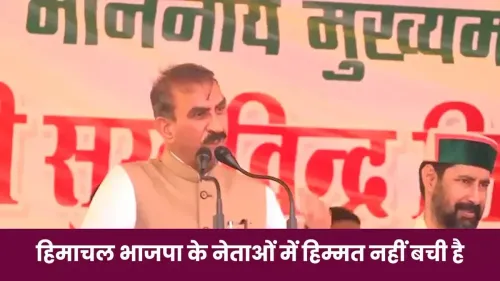
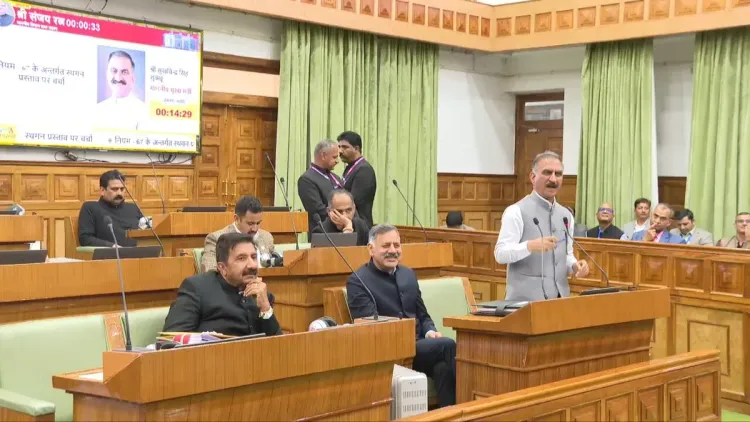
A direct challenge from the top — Himachal Pradesh Chief Minister Sukhvinder Singh Sukhu threw down a sharp political gauntlet on Tuesday, 17 November 2026, daring the opposition to bring its fight to Himachal Pradesh while his government is in office, and citing a dramatic scene of 18 BJP MLAs descending on the state Vigilance Office to shield one of their own from an ongoing anti-corruption action.
Posting on X in Hindi, Sukhu declared: 'Mere mukhyamantri rahte agar idhar aana hai, toh aa jao' — 'If you want to come here while I am Chief Minister, come ahead.' The message was unmistakably combative, framing his administration's anti-graft drive as both a promise kept and a dare extended to the Bharatiya Janata Party.
Papers, action, and the vigilance trail
Sukhu claimed that documents handed over to the government had triggered action against 'several individuals.' He did not name the cases or specify the source of the papers, but the implication was pointed: material furnished — possibly by informants or opposition whistleblowers — had been acted upon. That alone is a significant political statement, signalling the Vigilance Department is not merely a shelf agency under the Congress administration.
The Congress government in Himachal Pradesh made anti-corruption enforcement a centrepiece of its platform after winning the 2022 assembly elections, publicly committing to investigate alleged irregularities from the preceding BJP regime. Actions since then have kept the two parties in a state of near-constant political friction.
18 BJP MLAs and the Vigilance Office standoff
The sharpest detail in Sukhu's post is the most politically loaded one: he alleged that 18 BJP MLAs turned up at the Vigilance Office to secure the release of one of their colleagues caught in an ongoing inquiry. The image — nearly one-third of the opposition bloc walking into an anti-corruption agency to lobby for a fellow legislator — will resonate well beyond Shimla. Sukhu deployed it as evidence not of his government's vulnerability but of the opposition's discomfort.
The Himachal Pradesh assembly has 68 seats, making a bloc of 18 legislators a substantial show of political muscle. Whether the visit was a formal representation or a pressure tactic is not established; Sukhu's framing treats it as the latter. Vigilance departments in Indian states operate under the state government, and opposition parties routinely allege that such agencies are weaponised by the ruling party — a charge BJP is likely to press here as well.
A pattern playing out across Indian state politics
What Sukhu describes fits a familiar arc in Indian state politics: an incoming government intensifies vigilance actions against perceived misdeeds of the previous regime; the opposition mobilises en masse to push back; both sides frame their moves as democratic duty. Himachal Pradesh has seen this cycle before, and the state's mountainous, constituency-dense politics make each episode sharply personal.
The Chief Minister's post, however, goes one step further than the usual press statement — the direct-address tone ('come ahead') signals that Sukhu is comfortable, even eager, to fight this battle publicly in real time, with his own credibility staked on the outcome of the vigilance cases now in motion.
With assembly proceedings and potential court challenges likely to follow any vigilance action involving sitting MLAs, the drama Sukhu described in one post may be only the opening act.
Point of View
The CM converts an administrative proceeding into a liability for the opposition. This mirrors a broader Congress strategy in state governance: use the machinery of anti-corruption agencies as both a governing tool and a campaign message, keeping the previous regime permanently in the dock of public opinion. The risk is reciprocal — if any of the vigilance actions are challenged in court or seen as selective, the optics could reverse quickly.
NationPress
17 Nov 2026
Frequently Asked Questions
What did Himachal Pradesh CM Sukhu say about the BJP on X?
CM Sukhu challenged the BJP to bring its fight to Himachal Pradesh while he is in office, claiming his government acted on corruption-related documents and that 18 BJP MLAs visited the Vigilance Office to free a colleague under inquiry.
Why did 18 BJP MLAs go to the Himachal Pradesh Vigilance Office?
According to CM Sukhu's post, the BJP MLAs went to the Vigilance Office to secure the release of one of their colleagues who was facing anti-corruption action; the BJP's response to this claim was not included in the post.
What is the Himachal Pradesh Vigilance Department?
The Vigilance Department is a state agency in Himachal Pradesh responsible for investigating corruption and misconduct cases involving government officials and public figures.
What anti-corruption actions has the Sukhu government taken in Himachal Pradesh?
Since coming to power after the 2022 elections, the Congress government under Sukhu has publicly committed to investigating alleged irregularities from the previous BJP administration and claims to have taken action against several individuals based on documents received.
How many seats does Himachal Pradesh assembly have and what is BJP's strength?
The Himachal Pradesh Legislative Assembly has 68 seats; the BJP is the principal opposition party, and 18 MLAs visiting the Vigilance Office together would represent a substantial bloc of that opposition contingent.