Chhattisgarh's Tuhar Token App Cuts Queues for Paddy Farmers
Synopsis
The Chhattisgarh Chief Minister's Office says the Tuhar Token App is issuing digital queue tokens to paddy farmers, sparing them long waits at procurement centres during the Dhan Kharidi 2026 season and deepening the state's farmer-welfare e-governance push.
Key Takeaways
The Tuhar Token App , launched under the Sushasan Sarkar initiative, allows Chhattisgarh farmers to book paddy-sale slots digitally without standing in queues.
The app targets the annual Dhan Kharidi (paddy procurement) season, during which minimum support price operations are conducted at state centres.
Chhattisgarh is one of India's major paddy-producing states, making smooth MSP access a high-stakes governance priority each harvest season.
The move extends the state's farmer-support tradition, which includes the Rajiv Gandhi Kisan Nyay Yojana (2019) that institutionalised direct agricultural welfare outreach.
India's broader e-governance trend sees multiple states digitising mandi bookings to cut waiting times and improve procurement transparency.
Usage data, farmer uptake in remote blocks, and payment integration will be critical benchmarks for the 2026-27 procurement season .
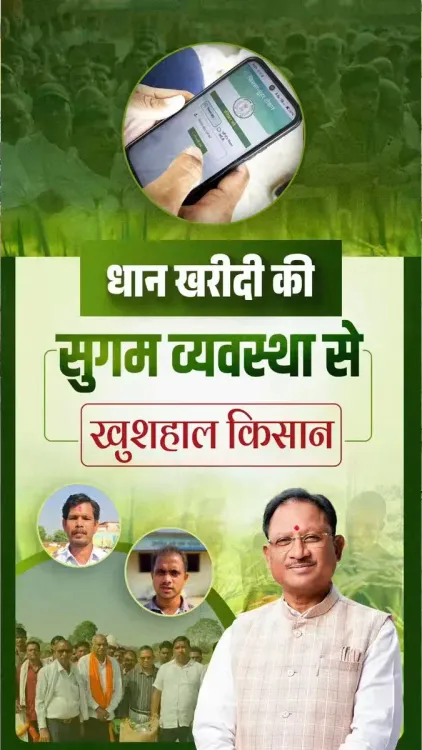
No more standing in line before dawn. The Chief Minister's Office of Chhattisgarh announced on Tuesday, 17 November 2026 that farmers across the state are now receiving paddy-sale tokens directly through the Tuhar Token App — a digital-first move that is reshaping how the annual grain procurement drive works on the ground.
The CMO's post, shared in Chhattisgarhi, stated: 'Tunhar Token App se aasan hui dhan bechne ki raah, samay ki bachat se kisanon ko mil rahi suhulyat' — 'The Tuhar Token App has eased the path to selling paddy; farmers are gaining convenience through time saved.' Under the Sushasan Sarkar (Good Governance Government) initiative, farmers can now claim a slot at their nearest procurement centre without physically lining up, eliminating the exhausting wait that has long defined the Dhan Kharidi season in rural Chhattisgarh.
What the Tuhar Token App actually changes
The core problem the app targets is deceptively simple but deeply painful: paddy farmers — many travelling hours from interior villages — would arrive at procurement centres only to wait in queues stretching through the day, often without shelter or certainty of being served. The Tuhar Token App issues a digital token that assigns a farmer a time window, turning an unpredictable ordeal into a scheduled visit. The CMO described the system as making the dhaan kharidi (paddy procurement) process 'adhik sugam aur suvidhajanpur' — 'more smooth and convenient.'
Chhattisgarh's farmer-welfare arc: from Kisan Nyay to digital tokens
Chhattisgarh is one of India's major paddy-producing states, and procurement at minimum support price (MSP) is a politically and economically critical operation each season. The state's engagement with structured farmer-support programmes stretches back to the Rajiv Gandhi Kisan Nyay Yojana, launched in 2019, which built the institutional habit of direct-benefit outreach to cultivators. The Tuhar Token App extends that logic into the operational layer — not just what farmers receive, but how they access it.
Across India, state governments have progressively digitised mandi booking and procurement queuing, recognising that MSP guarantees mean little if accessing them costs a farmer half a day's wages in lost time. Chhattisgarh's app fits squarely within this e-governance for agriculture trend, alongside similar systems piloted in other grain-surplus states.
What to watch in the 2026-27 procurement season
The real test will come in the weeks ahead. Usage numbers, farmer feedback from remote blocks, and the app's ability to handle peak-season load will determine whether the Dhan Kharidi 2026 campaign marks a genuine operational leap or a promising pilot still in search of scale. Integration with wider agri-marketing platforms — and whether the token system eventually syncs with payment timelines — will be the next benchmark for the state's digital farm-welfare stack.
For now, the signal from Raipur is clear: the government wants procurement queues to be a problem of the past. Whether that ambition holds through the harvest rush will tell its own story.
Point of View
Reducing procurement pain is a tangible governance signal ahead of any electoral cycle. The harder test — whether the app scales equitably to low-connectivity areas and integrates with payment pipelines — will reveal the depth of the commitment.
NationPress
17 Nov 2026
Frequently Asked Questions
What is the Tuhar Token App in Chhattisgarh?
The Tuhar Token App is a mobile application by the Chhattisgarh government that issues digital tokens to paddy farmers, allowing them to book a time slot at a procurement centre instead of standing in long queues during the Dhan Kharidi season.
How does the Tuhar Token App help paddy farmers?
By assigning a scheduled time window digitally, the app eliminates the need for farmers to wait for hours at procurement centres, saving travel time and reducing uncertainty about whether they will be served on a given day.
What is Dhan Kharidi 2026 in Chhattisgarh?
Dhan Kharidi 2026 is the annual paddy procurement drive run by the Chhattisgarh state government, during which farmers sell their paddy at the minimum support price (MSP) at designated government centres.
What is the Sushasan Sarkar initiative in Chhattisgarh?
Sushasan Sarkar, meaning 'Good Governance Government,' is the Chhattisgarh government's overarching framework for administrative and service-delivery reforms, under which farmer-friendly digital tools like the Tuhar Token App are being introduced.
Is Chhattisgarh the first Indian state to use a digital token system for paddy procurement?
No. Multiple Indian states have introduced digital booking and token systems for grain procurement at mandis in recent years as part of a broader e-governance trend, though the Tuhar Token App is Chhattisgarh's specific implementation for its paddy procurement season.