CM Dhami Reaffirms Uttarakhand's Push for Farmer Welfare
Synopsis
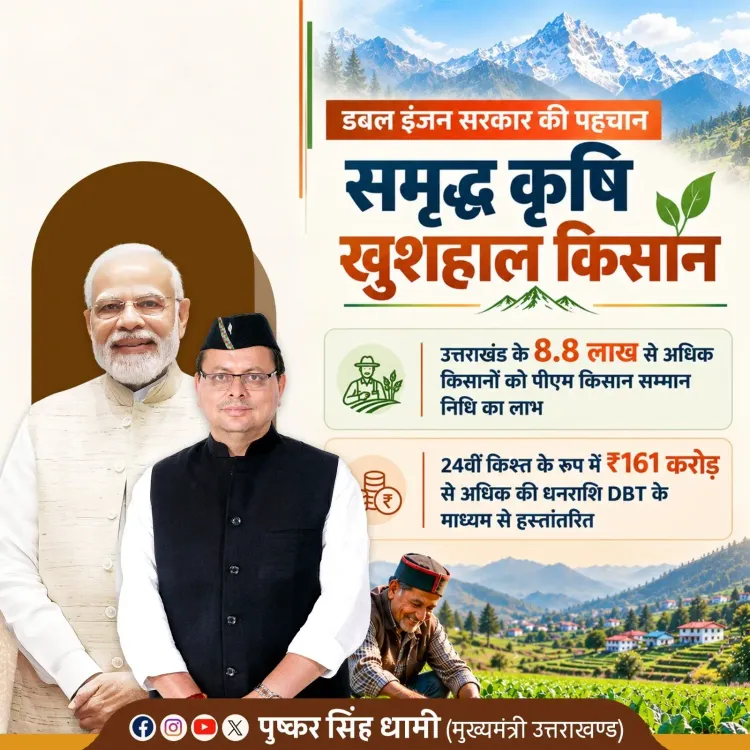
Uttarakhand CM Pushkar Singh Dhami on November 2, 2026 reaffirmed the BJP double-engine government's commitment to farmer welfare, citing economic support, crop insurance and horticulture drives aligned with PM Modi's national agricultural priorities.
Key Takeaways
CM Pushkar Singh Dhami posted on November 2, 2026 , pledging the Uttarakhand government's highest priority to farmer welfare and profitable agriculture.
The post invokes the BJP's 'double-engine government' framing, where central and state governments share the same party and coordinate policy delivery.
The nationally launched PM-KISAN scheme provides eligible farm families ₹6,000 per year in direct income support — a key plank in Uttarakhand's farmer-welfare push.
Since 2021 , the Uttarakhand government has expanded focus on crop insurance and horticulture promotion suited to the state's hill terrain.
Upcoming state agriculture budget announcements will be the key indicator of whether new outlays back the stated commitments.
Farmers in Uttarakhand are at the centre of the state government's agenda — and Uttarakhand Chief Minister Pushkar Singh Dhami made that commitment explicit on Monday, November 2, 2026, reaffirming that the BJP's 'double-engine' government is working without pause to make agriculture prosperous and self-reliant in the hill state.
Posting in Hindi on X, CM Dhami wrote that under the 'skilled leadership' of Prime Minister Narendra Modi, the state government is giving 'highest priority' to farmers' interests — aiming to provide them economic support, honour their hard work, and make farming profitable: 'किसानों की मेहनत को सम्मान देने और खेती को लाभकारी बनाने की दिशा में अनेक प्रयास किए जा रहे हैं' ('many efforts are being made to honour farmers' hard work and make farming profitable').
The 'Double-Engine' Formula and What It Means for Uttarakhand's Fields
The phrase 'double-engine government' is a recurring BJP framing for states where the same party governs both at the centre and in the state — the argument being that policy alignment removes friction and accelerates delivery. In Uttarakhand, a predominantly hill state with a large smallholder farming base, that coordination has been channelled toward schemes like the PM-KISAN programme, which has provided eligible farm families a direct income transfer of ₹6,000 per year since its national launch in 2019.
Since CM Dhami took office in 2021, the state has expanded its focus on crop insurance and horticulture promotion — sectors particularly relevant to Uttarakhand's terrain, where fruit orchards and vegetable cultivation supplement grain farming. The emphasis on making agriculture 'self-reliant' (aatmanirbhar) mirrors the broader national vocabulary the BJP has used since 2020 to frame rural economic policy.
Uttarakhand's Farmers: A Smallholder Landscape Under Pressure
Uttarakhand's agricultural sector is characterised by fragmented landholdings across difficult Himalayan terrain — a structural challenge that makes income-support mechanisms and insurance backstops more urgent than in plains states. The state government's repeated invocation of farmer welfare signals that rural distress and out-migration from hill villages remain politically live issues heading into the next budget cycle.
What the state's agriculture department announces in upcoming budget presentations will be the real test of whether the rhetoric translates into measurable outlays — in direct transfers, input subsidies, rural credit expansion, or horticulture market infrastructure.
The mountain fields are waiting. The question is always what follows the promise.
Point of View
The emphasis on 'profitable farming' also signals recognition that income-support alone is insufficient — the harder task of structural agricultural transformation remains unaddressed in the post's broad strokes.
NationPress
2 Nov 2026
Frequently Asked Questions
What did CM Pushkar Singh Dhami say about farmers in Uttarakhand in November 2026?
CM Dhami reaffirmed on November 2, 2026 that the Uttarakhand government under PM Modi's leadership is giving highest priority to farmer welfare, working to provide economic support, honour farmers' hard work, and make agriculture profitable and self-reliant.
What is the 'double-engine government' model CM Dhami referred to?
'Double-engine government' is the BJP's term for states where the same party governs both at the centre and in the state, enabling aligned policy delivery. In Uttarakhand, this is used to frame coordinated action on farmer income support and agricultural schemes.
What is the PM-KISAN scheme and how does it help Uttarakhand farmers?
PM-KISAN, launched nationally in 2019, provides eligible farmer families a direct income transfer of ₹6,000 per year. It forms a key pillar of the central government's farmer welfare agenda that Uttarakhand's state government has also promoted.
What agricultural initiatives has the Uttarakhand government taken since 2021?
Since CM Dhami took office in 2021, Uttarakhand has expanded crop insurance coverage and promoted horticulture — including fruit orchards and vegetable cultivation — suited to the state's hill terrain and smallholder farming base.
Why is farmer welfare a politically important issue in Uttarakhand?
Uttarakhand has fragmented landholdings across Himalayan terrain, making farming economically precarious. Rural distress and out-migration from hill villages are ongoing challenges, making farmer welfare a consistently live political issue for the state government.