Pralhad Joshi Welcomes PM Modi to Bharat RE Summit Inauguration
Synopsis
Union Minister Pralhad Joshi welcomed PM Narendra Modi to inaugurate the Bharat RE Summit on 2 November 2026 — a 130-country, 75,000-participant clean-energy event running alongside the 9th ISA Assembly, underscoring India's drive toward its 500 GW renewable target.
Key Takeaways
Prime Minister Narendra Modi inaugurated the Bharat RE Summit on 2 November 2026 .
The summit draws participants from over 130 countries , with 75,000+ attendees , 400+ exhibitors , 500+ speakers and 80+ curated sessions .
The event coincides with the 9th Assembly of the International Solar Alliance , a treaty body co-founded by India and France at COP21 in 2015.
India's renewable target of 500 GW non-fossil capacity by 2030 , pledged at COP26, provides the policy backdrop for the summit.
Union Minister Pralhad Joshi posted in both English and Kannada, signalling outreach to Karnataka's growing renewables sector.
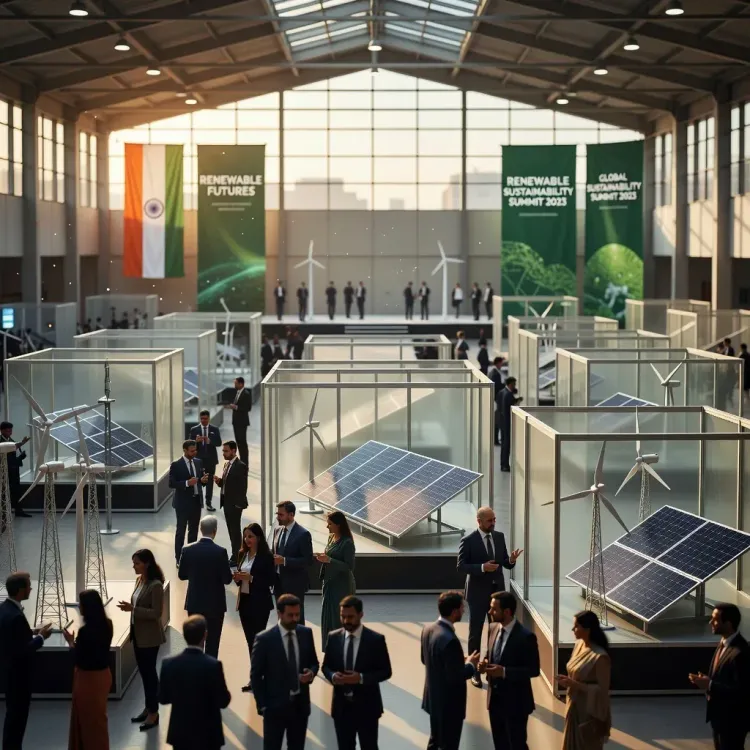
A summit of historic scale opened its doors on Monday, 2 November 2026, as Union Minister for New and Renewable Energy Pralhad Joshi welcomed Prime Minister Narendra Modi to inaugurate the Bharat RE Summit — a clean-energy congregation drawing representatives from over 130 countries to one stage.
What makes the Bharat RE Summit the largest of its kind
The numbers alone tell the story. The #BREsummit brings together 400+ exhibitors, 75,000+ participants, 80+ curated sessions, 500+ speakers and 25+ knowledge partners — a scale that organisers describe as unprecedented for a global clean-energy gathering. The event runs concurrently with the 9th Assembly of the International Solar Alliance (#9ISAssembly), adding a treaty-body dimension to what is already a major industry-and-diplomacy moment.
Minister Joshi, posting in both English and Kannada on X, framed the Prime Minister's presence as a catalyst: 'ಪ್ರಧಾನಿಗಳ ಉಪಸ್ಥಿತಿಯು ಜಾಗತಿಕ ಸ್ವಚ್ಛ ಇಂಧನ ಸಮುದಾಯಕ್ಕೆ ಹೆಚ್ಚಿನ ಸ್ಫೂರ್ತಿ ಸಿಗಲಿದೆ' ['The Prime Minister's presence will provide greater inspiration to the global clean-energy community']. The bilingual post — rare for a central minister on a policy matter — signals a deliberate outreach to Karnataka's political and industrial base, a state emerging as a renewable-energy hub.
The ISA thread connecting Paris 2015 to New Delhi 2026
The International Solar Alliance, co-launched by India and France at COP21 in Paris in 2015, forms the institutional backbone of today's assembly. What began as a compact among sun-rich nations to mobilise solar deployment has since grown into a treaty-based organisation with over 130 member countries — the same number Joshi cites as participants in the Bharat RE Summit. The overlap is not accidental: India has consistently used ISA assemblies and RE-INVEST-style summits to synchronise investor pipelines with diplomatic commitments.
That strategy has a concrete target behind it. At COP26 in Glasgow in 2021, India pledged 500 GW of non-fossil electricity capacity by 2030 and a net-zero emissions goal by 2070. Hosting a summit of this scale keeps those pledges visible to the international community while signalling to domestic industry that policy continuity is assured.
Modi's inauguration and what investors will be watching
Prime ministerial inaugurations of clean-energy summits carry a specific market signal: they compress the distance between political will and investment decision. Industry participants at the Bharat RE Summit will be watching not just the ribbon-cutting but any fresh commitment — capacity additions, green-hydrogen corridors, or cross-border solar grid frameworks — that emerges from the 9th ISA Assembly sessions running alongside the main summit.
For Minister Joshi, who holds the dual charge of Consumer Affairs and New and Renewable Energy, the summit is also a visibility moment at home. Karnataka, his electoral base, hosts significant wind and solar capacity, and a high-profile international event strengthens the case for further state-level investment.
With half the world's clean-energy diplomats, investors, and technologists converging on one venue, the Bharat RE Summit is less a conference and more a pressure test for India's claim to lead the global energy transition — and the clock is running.
Point of View
Using a high-visibility PM inauguration to compress the gap between political pledge and investor action. Hosting the 9th ISA Assembly alongside the summit reinforces India's claim to institutional leadership in multilateral solar governance — a role New Delhi has cultivated since Paris 2015. For Minister Joshi, the event is a dual play: advancing the 500 GW target nationally while consolidating his stature as the political face of India's energy transition. The real test will be whether the summit produces binding investment announcements or remains a showcase, as critics of such mega-forums often note.
NationPress
2 Nov 2026
Frequently Asked Questions
What is the Bharat RE Summit?
The Bharat RE Summit is a large-scale international clean-energy conference hosted in India, bringing together governments, investors and technology providers from over 130 countries to advance the global energy transition.
Why did PM Modi inaugurate the Bharat RE Summit in 2026?
PM Modi inaugurated the summit to signal strong political commitment to India's renewable energy goals, including the target of 500 GW non-fossil capacity by 2030, and to attract global investment and diplomatic backing.
What is the International Solar Alliance and how is it connected to this summit?
The International Solar Alliance is a treaty-based organisation co-founded by India and France at COP21 in 2015 to boost solar deployment among member nations. Its 9th General Assembly runs alongside the Bharat RE Summit.
What is Pralhad Joshi's role in the Bharat RE Summit?
Pralhad Joshi, Union Minister for New and Renewable Energy, is the nodal minister overseeing the event and formally welcomed the Prime Minister to the inauguration.
What is India's renewable energy target for 2030?
India pledged to achieve 500 GW of non-fossil electricity capacity by 2030, a commitment made at COP26 in Glasgow in 2021, which underpins events like the Bharat RE Summit.