CM Sukhu Says He Contributed to Ram Mandir, Urges Unity
Synopsis
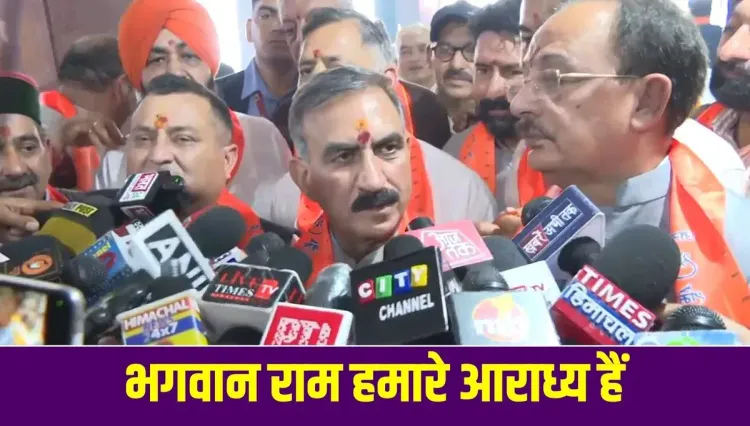
Himachal Pradesh CM Sukhvinder Singh Sukhu has revealed he personally contributed to the Shri Ram Mandir construction fund, calling it a matter of great fortune. He urged true devotees to use Lord Ram's name to unite society and spread harmony, not for political ends.
Key Takeaways
CM Sukhvinder Singh Sukhu publicly disclosed that he contributed to the Shri Ram Mandir construction fundraising campaign.
He said party workers approached him at the Sera Rest House during the nationwide donation drive.
Sukhu described Lord Ram as his personal deity and called participation in the temple campaign a matter of great fortune.
He drew a clear distinction between genuine devotion and using Lord Ram's name for political purposes.
The statement fits a broader Congress pattern of affirming personal religious sentiment while criticising the electoral use of the Ram Mandir issue.
The Ram Mandir in Ayodhya was inaugurated on 22 January 2024 after a nationwide fundraising drive from 2020 onward.
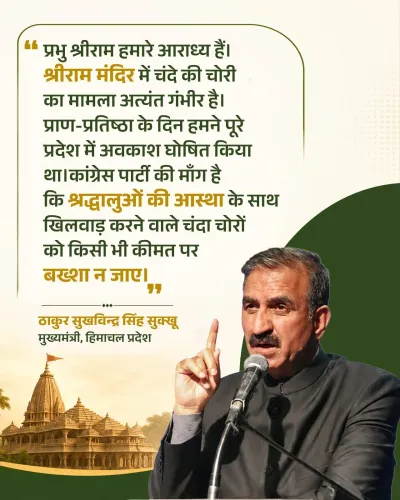
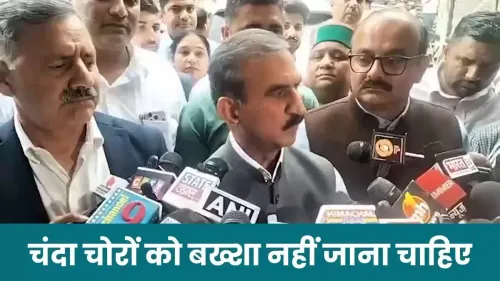
Himachal Pradesh Chief Minister Sukhvinder Singh Sukhu on Tuesday, 7 July 2026, publicly recalled his personal contribution to the Shri Ram Mandir construction fund, stating that being part of the sacred campaign was a matter of great fortune for him. Sukhu also drew a sharp distinction between genuine devotion to Lord Ram and the use of his name for political purposes.
Posting in Hindi on X, the Chief Minister wrote: 'श्रीराम मंदिर निर्माण के लिए जब देशभर में धन-संग्रह का अभियान चल रहा था, तब सेरा रेस्ट हाउस में कार्यकर्ता मेरे पास आए थे।' ['When the nationwide fundraising campaign for the construction of the Shri Ram Mandir was underway, party workers came to me at the Sera Rest House.'] He added that he had made his contribution to the temple construction and that Lord Ram is his personal deity.
Context
The Shri Ram Janmabhoomi Teerth Kshetra Trust conducted a nationwide donation drive from 2020 onward to fund the construction of the Ram Mandir in Ayodhya, Uttar Pradesh. The bhoomi pujan (ground-breaking ceremony) was held in August 2020, and the completed temple was inaugurated on 22 January 2024. The fundraising campaign reached millions of households and institutions across the country, drawing participation from individuals across political affiliations.
Sukhu's statement places him among those who contributed during that drive, a detail he chose to make public now. His disclosure comes as the Indian National Congress, which he leads in Himachal Pradesh, continues to navigate cultural and religious messaging at both the state and national level.
Policy Backdrop
The Congress party has historically maintained a position of personal religious respect for Lord Ram while opposing what it describes as the political weaponisation of the Ram Mandir issue. Several Congress leaders have affirmed their devotion to Ram while criticising the Bharatiya Janata Party's electoral use of the temple cause — a pattern visible since the temple movement of the 1980s and 1990s and which intensified significantly after 2014.
Sukhu's post follows this established template. He explicitly stated: 'प्रभु श्रीराम के भक्त उनके नाम को समाज को जोड़ने तथा प्रेम और सद्भाव का संदेश देने का माध्यम बनाते हैं, न कि उनके नाम पर राजनीति करने का।' ['True devotees of Lord Ram use his name as a medium to unite society and spread the message of love and harmony — not to do politics in his name.'] The closing line is a clear, if implicit, rebuke of those he sees as exploiting religious sentiment for electoral gain.
Stakeholders and Impact
The statement is aimed at multiple audiences simultaneously: Hindu voters in Himachal Pradesh who may question the Congress's religious credentials, Congress workers and supporters who need a cultural counternarrative, and opposition BJP leaders who have consistently projected the party as the custodian of the Ram Mandir cause. By establishing personal devotional credentials, Sukhu seeks to blunt that narrative in the state.
For Himachal Pradesh's Congress government, which has faced pressures on development spending and fiscal management, the post represents a pivot to cultural terrain. The invocation of Lord Ram's ideals — framed as social harmony and love — also aligns with a broader Congress effort to present an inclusive, values-based identity distinct from identity-based mobilisation.
What's Next
Responses from the BJP's Himachal Pradesh unit or central leadership are likely, given the implicit political challenge embedded in Sukhu's message. Any follow-up statements at the next Himachal Pradesh assembly session or at a national Congress conclave could amplify this line of messaging into a wider party position. The post signals that the Congress in Himachal Pradesh intends to contest the cultural space, not cede it.
Point of View
He pre-empts the standard BJP charge that Congress leaders are indifferent or hostile to the Ram Mandir cause. The closing line about 'politics in Ram's name' is the real payload: it reframes the entire Ram Mandir discourse as one the Congress can inhabit while simultaneously indicting its opponents. This mirrors a pattern seen across Congress-governed states since 2024, where leaders have sought to neutralise BJP's cultural advantage without alienating the party's secular base. Whether this messaging resonates with Himachal Pradesh voters or invites a sharp BJP counter will be an early test of its effectiveness.
NationPress
6 Oct 2026
Frequently Asked Questions
Did CM Sukhu contribute to the Ram Mandir construction fund?
Yes. Himachal Pradesh CM Sukhvinder Singh Sukhu stated on 7 July 2026 that he personally contributed to the Shri Ram Mandir construction fundraising campaign when party workers approached him at the Sera Rest House during the nationwide donation drive.
What did CM Sukhu say about Ram Mandir and politics?
Sukhu said true devotees of Lord Ram use his name to unite society and spread love and harmony, not to do politics in his name — an implicit criticism of those he views as exploiting the Ram Mandir cause for electoral gain.
When was the Ram Mandir inaugurated in Ayodhya?
The Ram Mandir in Ayodhya, Uttar Pradesh was inaugurated on 22 January 2024 . The bhoomi pujan was held in August 2020 and the donation drive by the Shri Ram Janmabhoomi Teerth Kshetra Trust ran from 2020 onward.
Why is Congress CM Sukhu talking about Ram Mandir now?
The statement appears to be part of a broader Congress strategy to affirm personal religious sentiment toward Lord Ram while countering the BJP 's claim to be the sole custodian of the Ram Mandir cause, particularly among Hindu voters in Himachal Pradesh .
What is Sukhvinder Singh Sukhu's position?
Sukhvinder Singh Sukhu is the Chief Minister of Himachal Pradesh and a leader of the Indian National Congress , holding office since 2022 .