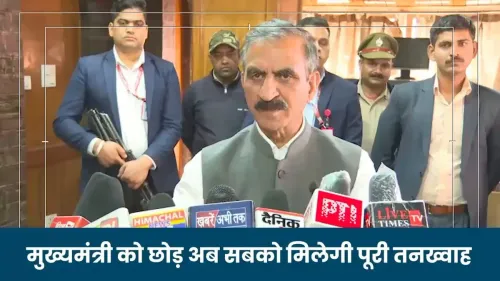
CM Sukhu flags court rulings straining HP's finances
Synopsis
At a convocation attended by top judges, Himachal Pradesh CM Sukhvinder Singh Sukhu publicly argued that court verdicts awarding retrospective pay benefits to contract employees — reversing a 2003 policy — are destabilising a state budget already devoting 70% to salaries and pensions.
Key Takeaways
70% of Himachal Pradesh's annual budget is spent on salaries and pensions, leaving little fiscal headroom.
A 2003 state government decision barred contract employees from seniority and pay-increment benefits; the rule was never included in recruitment norms.
A court ruling roughly 20 years later awarded those very benefits, creating a retrospective liability the state had never planned for.
CM Sukhu made the appeal directly to the Chief Justice of the HP High Court, a sitting Supreme Court judge, and a former Chief Justice of India at a formal convocation ceremony.
Sukhu balanced the argument by acknowledging employee welfare, but insisted the state's financial interests cannot be ignored.
The public intervention signals a deliberate attempt to open a judicial-executive dialogue on fiscal sustainability in service-benefit rulings.
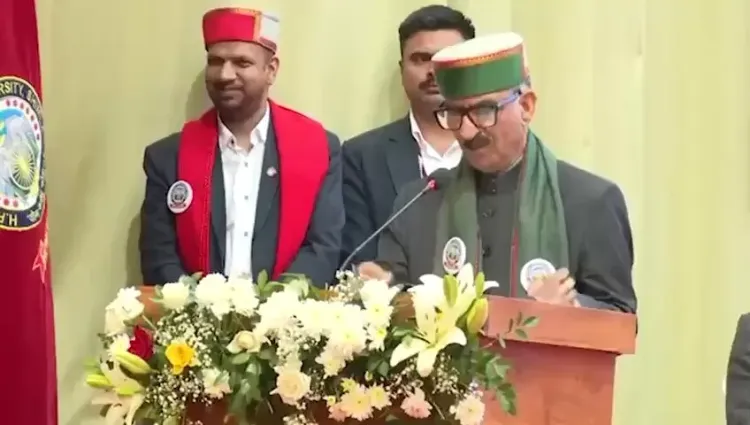
Standing before the Chief Justice of the Himachal Pradesh High Court, a sitting Supreme Court judge, and a former Chief Justice of India at a convocation ceremony, Himachal Pradesh Chief Minister Sukhvinder Singh Sukhu on Sunday, October 11, 2026, delivered a pointed appeal: judicial decisions on employee benefits, however well-intentioned, are quietly destabilising the state's finances.
A budget stretched to breaking point
Sukhu's core argument is starkly numerical. Nearly 70 percent of Himachal Pradesh's annual budget, he said, is consumed by salaries and pensions — leaving barely a third for development, infrastructure, and welfare spending. That structural constraint, he argued, makes every fresh financial liability imposed from outside the executive especially consequential for a small hill state with limited revenue of its own.
The 2003 contract-employee rule and a 20-year judicial reversal
The flashpoint is a ruling that upended a 2003 government decision. That year, the then-administration had explicitly determined that contract employees would not be entitled to seniority benefits or pay increments — provisions that were never written into the recruitment rules of the time, and remain absent today. Sukhu pointed out that nearly two decades later, a court awarded precisely those financial benefits, creating a retrospective liability the state had structurally never budgeted for.
In the Chief Minister's framing — delivered directly to the judiciary's most senior representatives — such verdicts do not merely strain a line item. They 'disrupt the state's financial management,' as he put it, cascading through a budget already under severe compression.
A rare public appeal to judges in the room
The choice of platform matters. A convocation ceremony hosting the High Court's Chief Justice, a Supreme Court judge, and a former Chief Justice of India is not a press conference or a party rally — it is a formal, legally elevated space. By raising fiscal concerns there, Sukhu was making a calculated, on-the-record appeal to the judiciary itself, not just commentating for political audiences. He was careful to balance the argument: 'Karmachariyon ke hit zaroori hain, lekin pradesh ke vittiya hiton ki andekhi bhi nahin ho sakti' — 'The interests of employees are important, but the financial interests of the state cannot be ignored either.'
That balance — acknowledging employee welfare while insisting on fiscal sustainability — signals the CM is threading a narrow political needle, unwilling to be cast as anti-worker yet determined to flag the judicial dimension of the state's fiscal crisis.
Whether the judiciary recalibrates how it factors in state fiscal capacity when ruling on service-benefit matters, or whether this becomes a broader national conversation about the limits of judicial intervention in public finance, Himachal Pradesh's convocation hall just became an unlikely arena for that debate to begin.
Frequently Asked Questions
Why is Himachal Pradesh in a financial crisis?
Himachal Pradesh spends nearly 70% of its annual budget on salaries and pensions, leaving very little for development. CM Sukhu has highlighted that court-ordered retrospective pay benefits to contract employees are adding further pressure to an already strained budget.
What did CM Sukhu say about contract employees at the convocation?
CM Sukhu said a 2003 government rule had explicitly denied contract employees seniority and pay increments — provisions never included in recruitment rules. He argued that a court reversing this two decades later created an unbudgeted financial burden for the state.
Who was present at the convocation where CM Sukhu spoke?
The Chief Justice of the Himachal Pradesh High Court, a sitting Supreme Court judge, and a former Chief Justice of India were all present at the convocation where CM Sukhu made his remarks on October 11, 2026.
Is CM Sukhu against employee rights?
No. Sukhu explicitly acknowledged that employee interests are important, but argued that the financial interests of the state cannot be ignored alongside them. His position is one of balance, not opposition to worker welfare.
Can a state government challenge court orders on employee pay?
State governments can appeal such orders through higher courts, but they have limited tools to resist binding verdicts. Sukhu's appeal at the convocation appears to be a political and moral appeal directly to the judiciary to factor in state fiscal capacity in future rulings.