CM Sukhu Invokes Revolutionary Verse from Shimla Secretariat
Synopsis
Himachal Pradesh Chief Minister Sukhvinder Singh Sukhu posted a defiant Hindi couplet from Lok Bhawan, Shimla on 21 July 2026, invoking the language of revolution against oppression from the corridors of power. The verse signals political resistance, with the BJP and assembly observers expected to respond.
Key Takeaways
CM Sukhvinder Singh Sukhu posted a Hindi protest couplet on X on 21 July 2026 .
The post was geotagged at Lok Bhawan, Shimla , the official state secretariat.
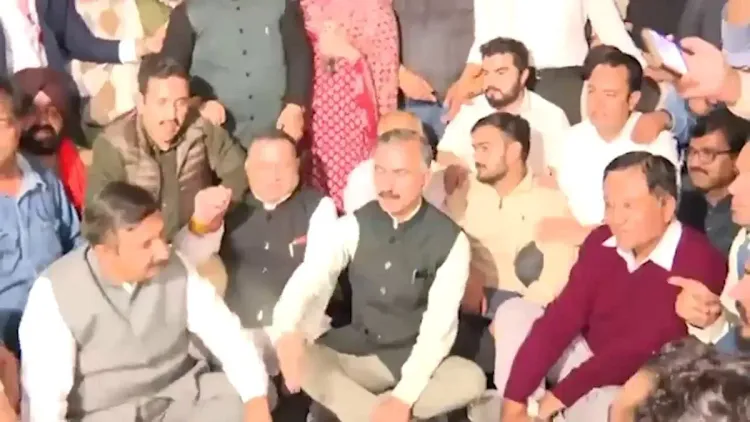
The couplet translates as: 'Every time the oppressor acts from the corridors of power, every inch of the land will echo with the slogans of revolution.' The post was accompanied by a video and carries the tone of formal political communication.
CM Sukhu has led the Congress government in Himachal Pradesh since December 2022 .
The specific trigger for the post has not been officially stated; BJP response and assembly proceedings are being watched.
Himachal Pradesh Chief Minister Sukhvinder Singh Sukhu posted a defiant couplet on X (formerly Twitter) on Tuesday, 21 July 2026, from Lok Bhawan, Shimla — the state's official secretariat complex — signalling a mood of political resistance through the language of protest poetry.
Context
The post, in Hindi, reads: 'Julmi jab jab julm karega satta ke galiyaron se, chappa chappa goonj uthega inqalab ke naaron se' — loosely translated as: 'Every time the oppressor commits oppression from the corridors of power, every inch of the land will resound with the slogans of revolution.' The couplet carries the cadence of classical Urdu-inflected protest verse, a form with deep roots in India's independence movement and its post-independence political culture.
The post was accompanied by a video and geotagged at Lok Bhawan, Shimla, signalling that it is an official communication from the seat of the state government rather than a personal message. CM Sukhu has led the Indian National Congress government in Himachal Pradesh since December 2022, when Congress ended BJP rule in the hill state after the assembly elections.
Policy Backdrop
Revolutionary and protest poetry has been a recurring device in Indian political discourse across decades, deployed by leaders of varying ideological stripes to mobilise public sentiment and frame political conflict in moral terms. The tradition draws on Urdu shairi, progressive literature, and the idiom of mass movements to communicate resistance without specifying a single legislative or administrative target.
Chief ministers from opposition-governed states have periodically used public statements, slogans, and symbolic gestures to signal friction with the central government or to energise their own political base. The choice of Lok Bhawan — an official government venue — as the stated location lends the post institutional weight beyond a personal political expression.
Stakeholders and Impact
Congress workers and political activists in Himachal Pradesh are the immediate audience for such messaging, which reinforces the party's positioning as a voice against what it characterises as overreach or injustice. The couplet's deliberately broad language — referencing 'corridors of power' without naming a specific actor — allows it to function both as an internal rally call and as a wider statement of political identity.
The BJP, which remains the principal opposition in the state, is expected to respond to the post's combative tone. Any follow-up in the state assembly — particularly during the monsoon session — could sharpen the debate around the specific grievances the Chief Minister may be signalling.
What's Next
Political observers will watch for clarification from CM Sukhu's office or party on the precise context prompting the verse — whether it relates to a state-Centre dispute, a local political development, or a broader national issue. The use of protest poetry from an official government platform is itself a political signal, and the BJP's formal response, if any, will indicate how seriously the ruling party at the Centre reads the statement. Assembly proceedings in Shimla in the coming days could provide the clearest indication of what lies behind the couplet's pointed imagery.
Point of View
Maximising resonance across different grievances. Posting from Lok Bhawan converts a poetic gesture into an institutional statement, blurring the line between party politics and state authority. This fits a broader pattern of opposition chief ministers using cultural and rhetorical tools to assert autonomy against a dominant Centre. The verse's vagueness is both its political strength and its journalistic limitation — it invites interpretation without committing to a specific fight.
NationPress
22 Jul 2026
Frequently Asked Questions
What did Himachal Pradesh CM Sukhu post on X on 21 July 2026?
CM Sukhvinder Singh Sukhu posted a Hindi couplet from Lok Bhawan, Shimla, invoking the imagery of revolution against oppression from the corridors of power, along with a video.
What does Sukhu's couplet mean in English?
The couplet translates as: 'Every time the oppressor commits oppression from the corridors of power, every inch of the land will resound with the slogans of revolution.'
Why did CM Sukhu post this from Lok Bhawan, Shimla?
Lok Bhawan is Himachal Pradesh's official government secretariat complex. Geotagging the post there signals it is an official or semi-official communication rather than a purely personal political remark.
Who is Sukhvinder Singh Sukhu?
Sukhvinder Singh Sukhu is the Chief Minister of Himachal Pradesh and a senior Indian National Congress leader. He assumed office in December 2022 after Congress won the state assembly elections.
Is this post directed at the BJP or the central government?
The couplet does not name a specific target. The phrase 'corridors of power' is broad, and the precise context or trigger for the post has not been officially clarified by CM Sukhu's office.