CM Sukhu Pays Tribute to Brigadier Mohammad Usman on Martyrdom Day
Synopsis
Himachal Pradesh Chief Minister Sukhvinder Singh Sukhu marked the 78th martyrdom anniversary of Brigadier Mohammad Usman, the 'Lion of Naushera,' on 3 July 2026, honouring his decisive role in the 1947-48 Kashmir War and his rejection of Jinnah's offer to join Pakistan.
Key Takeaways
Brigadier Mohammad Usman was killed by Pakistani shellfire on 3 July 1948 during the first Kashmir War.
He was posthumously awarded the Mahavir Chakra , India's second-highest wartime gallantry honour.
Usman's forces repulsed multiple Pakistani tribal militia attacks on Naushera and Jhangar in early 1948, earning him the title 'Lion of Naushera.' Muhammad Ali Jinnah reportedly invited Usman to join Pakistan's military after Partition; Usman declined and remained with the Indian Army.
CM Sukhu invoked Usman's life as a lesson in 'duty, courage, and love for the nation' for India's youth.
Such tributes are part of a broader pattern of Indian political leaders marking 1947-48 Kashmir War anniversaries to highlight inclusive patriotism.
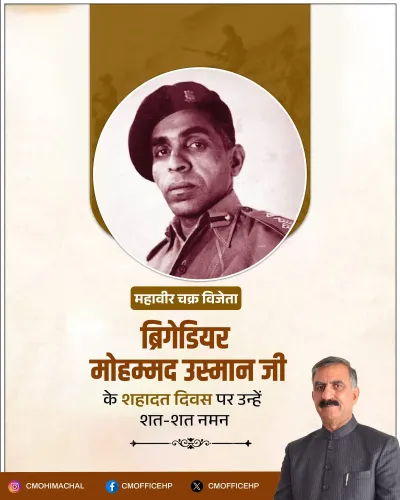
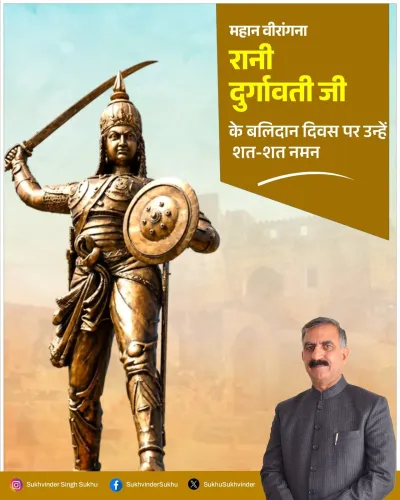
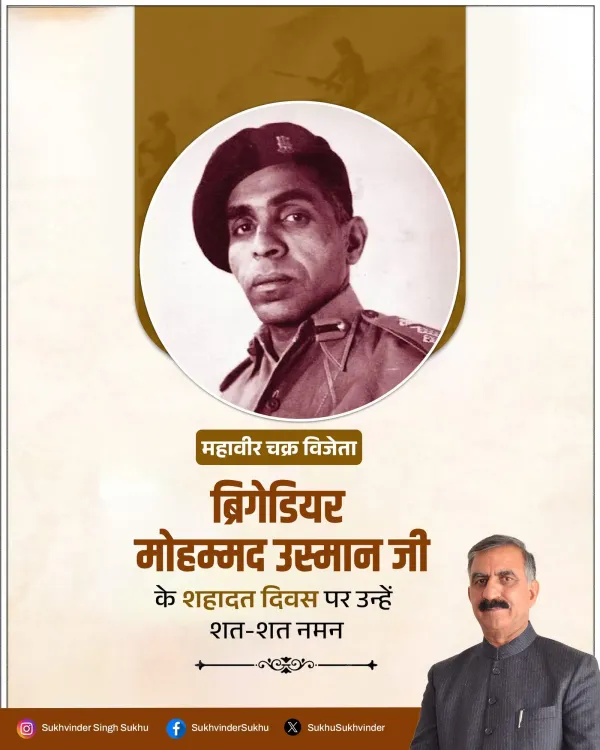
Himachal Pradesh Chief Minister Sukhvinder Singh Sukhu on Friday, 3 July 2026, paid homage to Brigadier Mohammad Usman, the decorated officer known as the 'Lion of Naushera,' on his martyrdom anniversary, honouring his sacrifice in the 1947-48 Indo-Pakistani War.
Posting on X, CM Sukhu wrote: 'नौशेरा के शेर, महावीर चक्र से सम्मानित ब्रिगेडियर मोहम्मद उस्मान जी के शहादत दिवस पर उन्हें सादर नमन' — ('Respectful salute to Brigadier Mohammad Usman, the Lion of Naushera and recipient of the Mahavir Chakra, on his martyrdom day.'). He added that Usman's 'indomitable courage and firm leadership played a decisive role in the defence of Jhangar and Naushera,' and that his 'loyalty to the nation was so unwavering that he rejected even Jinnah's offer and made the supreme sacrifice for the motherland.'
Context
Brigadier Mohammad Usman was killed by Pakistani shellfire on 3 July 1948 while commanding defences in the Jammu and Kashmir theatre during the first Kashmir War. He was posthumously awarded the Mahavir Chakra, India's second-highest wartime gallantry honour, making him one of the most decorated officers of that conflict. His death came just months after his forces had repulsed a series of Pakistani tribal militia attacks on Naushera in early 1948, a stand that earned him the sobriquet 'Lion of Naushera.'
Policy Backdrop
At the time of Partition in 1947, senior Muslim officers of the former British Indian Army were approached to join the newly formed Pakistani military. Muhammad Ali Jinnah, Pakistan's founder, reportedly made such an overture to Brigadier Usman, who declined and chose to serve the Indian Army. This act of allegiance has been cited repeatedly by political leaders across parties as emblematic of inclusive patriotism — the idea that national loyalty transcended religious identity in the founding years of the republic.
Indian political commemorations of the 1947-48 Kashmir operations have grown more prominent in recent years, with leaders invoking figures like Usman to reinforce narratives around military valour and constitutional secularism. Such tributes are often timed around 3 July and 26 October — the latter marking Jammu and Kashmir's accession to India.
Stakeholders and Impact
The tribute resonates most directly with armed forces veterans, their families, and communities in border regions of Jammu and Kashmir where the 1947-48 battles were fought. For younger audiences, CM Sukhu explicitly drew a lesson: Usman's life 'continues to show youth the path of duty, courage, and love for the nation,' he wrote.
Himachal Pradesh has a historically high rate of military enlistment, making such commemorations particularly meaningful to the state's electorate. The tribute also carries significance within the Indian National Congress, which has long positioned itself as the party of inclusive nationalism.
What's Next
Observers will watch whether state governments or the Ministry of Defence organise formal wreath-laying ceremonies at the National War Memorial in New Delhi or at sites in Naushera to mark the anniversary. Proposals to incorporate the stories of 1947-48 heroes into school curricula have been discussed in policy circles and could gain renewed attention following such public tributes by senior political figures.
Point of View
A Congress leader signals the party's longstanding 'inclusive nationalism' brand at a time when that narrative faces sustained contestation. The emphasis on Usman's rejection of Pakistan's overture also subtly reframes the Partition story — not as a binary of religious communities, but as one of individual moral choice. Such commemorations serve both as genuine acts of remembrance and as soft-power positioning ahead of election cycles in a state with deep military roots. The regularity with which leaders across the spectrum invoke 1947-48 heroes suggests these figures have become a shared civic vocabulary for articulating what it means to be Indian.
NationPress
3 Jul 2026
Frequently Asked Questions
Who was Brigadier Mohammad Usman?
Brigadier Mohammad Usman was an Indian Army officer who commanded the defence of Naushera and Jhangar during the 1947-48 Indo-Pakistani War. Known as the 'Lion of Naushera,' he was killed by Pakistani shellfire on 3 July 1948 and was posthumously awarded the Mahavir Chakra, India's second-highest wartime gallantry honour.
Why is Brigadier Usman called the Lion of Naushera?
Brigadier Usman earned the title 'Lion of Naushera' for his role in repulsing multiple Pakistani tribal militia attacks on the town of Naushera in Jammu and Kashmir during the winter of 1947-48, a stand widely regarded as decisive in holding the region.
Did Jinnah offer Brigadier Usman a position in Pakistan's army?
According to widely cited historical accounts, Muhammad Ali Jinnah invited senior Muslim officers of the former British Indian Army, including Brigadier Usman, to join Pakistan's military after Partition. Usman declined the offer and continued to serve the Indian Army until his death on 3 July 1948.
What did CM Sukhu say about Brigadier Usman?
Himachal Pradesh Chief Minister Sukhvinder Singh Sukhu posted a tribute on X on 3 July 2026, calling Usman's courage decisive in the defence of Jhangar and Naushera, praising his rejection of Jinnah's offer, and saying his life continues to guide India's youth toward duty, courage, and patriotism.
What is the Mahavir Chakra?
The Mahavir Chakra is India's second-highest military decoration for acts of conspicuous gallantry in the presence of the enemy, awarded both in wartime and peacetime operations. Brigadier Mohammad Usman received it posthumously for his actions in the 1947-48 Kashmir War.