CM Himanta Shares PM Modi's Digital India at 11 Highlights
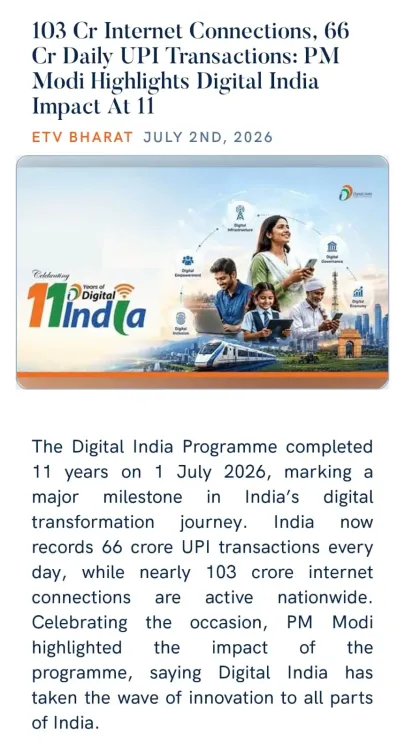
Synopsis
Assam Chief Minister Himanta Biswa Sarma amplified PM Modi's Digital India anniversary address on 3 July 2026, sharing government figures of 103 crore internet connections and 66 crore daily UPI transactions as the flagship programme marks its eleventh year.
Key Takeaways
Digital India completed 11 years on 1 July 2026 , having been launched by PM Narendra Modi on 1 July 2015 .
The government cited 103 crore internet connections as a measure of digital infrastructure growth over the decade.
66 crore daily UPI transactions were highlighted as evidence of mass adoption of real-time digital payments.
UPI was introduced in August 2016 by the National Payments Corporation of India (NPCI) and now underpins India's digital payments ecosystem.
Assam CM Himanta Biswa Sarma shared the figures via the NaMo App , amplifying the anniversary messaging to his social media audience.
Next-phase priorities include the Digital Personal Data Protection Act and 5G/6G rollout targets.
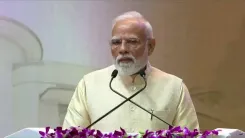
Assam Chief Minister Himanta Biswa Sarma on Friday, 3 July 2026, shared Prime Minister Narendra Modi's remarks on the eleventh anniversary of the Digital India programme, highlighting figures of 103 crore internet connections and 66 crore daily UPI transactions as markers of the initiative's reach across the country.
Context
The Digital India programme was launched on 1 July 2015 by Prime Minister Narendra Modi with the stated aim of building robust digital infrastructure and delivering government services electronically to every citizen. Its eleventh anniversary on 1 July 2026 prompted a fresh round of official statements and data-driven assessments from the government. CM Sarma amplified the Prime Minister's address via the NaMo App, the official mobile platform used by the Prime Minister's Office to disseminate programme updates.
Policy Backdrop
The Unified Payments Interface (UPI), introduced in August 2016 by the National Payments Corporation of India (NPCI), has become the backbone of India's real-time digital payments ecosystem. The figure of 66 crore daily UPI transactions cited by the Prime Minister, if sustained, would represent a dramatic scaling from single-digit crore daily transactions recorded in the programme's early years. Alongside UPI, the government's broader digital stack — combining Aadhaar, direct benefit transfers and e-governance portals — has been consistently presented as the architecture enabling financial inclusion at scale.
Internet connectivity has been a parallel priority. The claim of 103 crore internet connections encompasses mobile broadband, fibre, and other access modes, reflecting a decade of investment in rural and urban digital infrastructure under successive policy frameworks including BharatNet.
Stakeholders and Impact
The primary beneficiaries cited in government messaging are the country's internet users and digital payment users — a population that has expanded dramatically since 2015. For small traders, farmers, and unbanked citizens, UPI and Aadhaar-linked direct transfers have been positioned as tools that reduce intermediary leakage and widen access to formal financial services. Northeast India, where CM Sarma serves as convenor of the North-East Democratic Alliance (NEDA), has historically lagged in digital penetration, making the anniversary messaging particularly resonant for the region's development narrative.
For the ruling Bharatiya Janata Party (BJP), Digital India milestones serve a dual function: they constitute a governance record ahead of electoral cycles and reinforce the party's technology-led development identity.
What's Next
Attention now turns to the next phase of Digital India implementation, including parliamentary deliberations on the Digital Personal Data Protection Act and government targets around 5G and eventual 6G rollouts. As transaction volumes and connectivity figures continue to rise, independent audits and parliamentary oversight will be key to contextualising the headline numbers. The anniversary also sets the stage for fresh policy announcements on rural broadband expansion and digital literacy programmes in states like Assam.
Point of View
Particularly on technology and governance milestones. The headline metrics — 103 crore internet connections and 66 crore daily UPI transactions — are politically potent because they translate abstract infrastructure investment into citizen-scale numbers. For the Northeast, where digital access has historically trailed the national average, such messaging also serves a regional legitimacy function for Sarma's own governance identity. The anniversary comes at a moment when the government faces scrutiny over data privacy legislation and 5G rollout pace, making the celebratory framing a deliberate counter-narrative.
NationPress
1 Oct 2026
Frequently Asked Questions
When was Digital India launched and by whom?
Digital India was launched on 1 July 2015 by Prime Minister Narendra Modi to build digital infrastructure and deliver government services electronically across the country.
What are the Digital India figures highlighted at its 11th anniversary?
At the 11th anniversary, the government cited 103 crore internet connections and 66 crore daily UPI transactions as key indicators of the programme's reach.
What is UPI and who introduced it?
UPI, or Unified Payments Interface, is a real-time inter-bank payment system introduced in August 2016 by the National Payments Corporation of India (NPCI) that enables instant mobile transactions.
Why did Assam CM Himanta Biswa Sarma share the Digital India post?
CM Sarma shared PM Modi's Digital India anniversary highlights via the NaMo App, amplifying the government's milestone messaging to his social media audience as part of broader BJP outreach.
What comes next for Digital India after 11 years?
The next phase is expected to focus on the Digital Personal Data Protection Act, rural broadband expansion under BharatNet, and government targets for 5G and 6G rollouts across India.