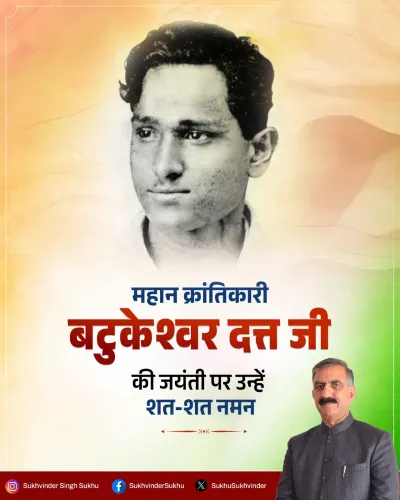
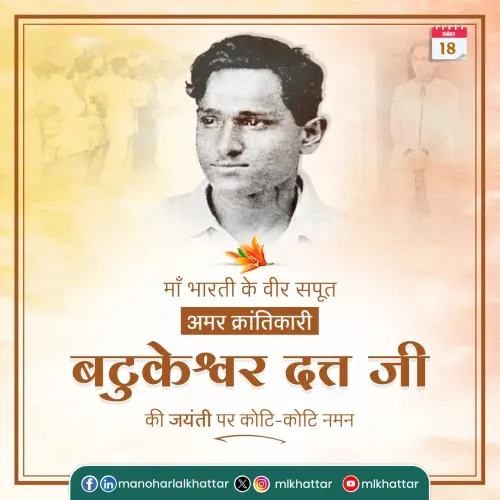
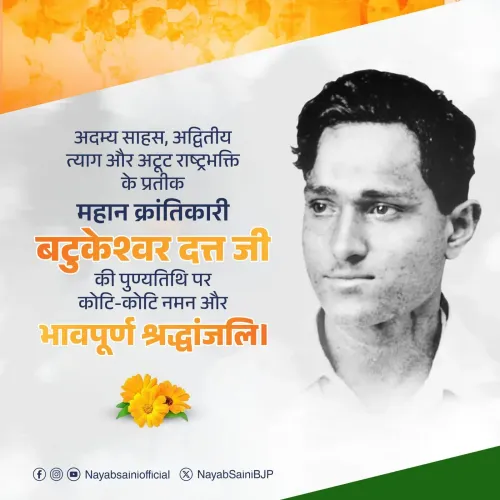
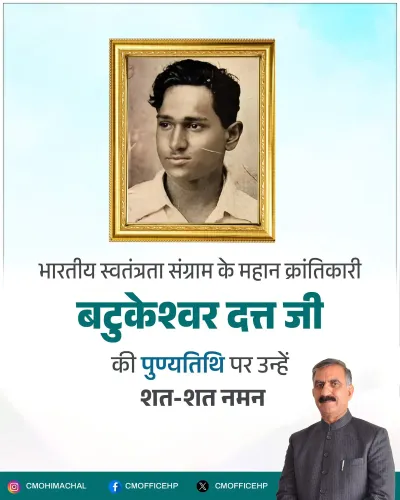
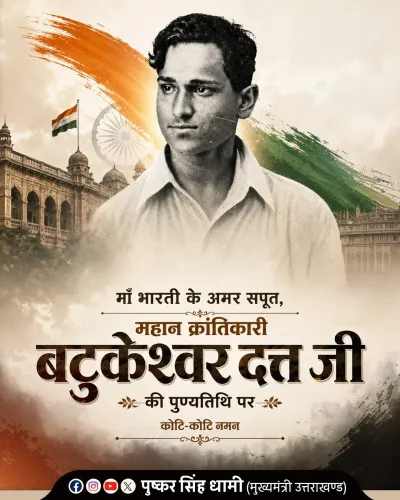
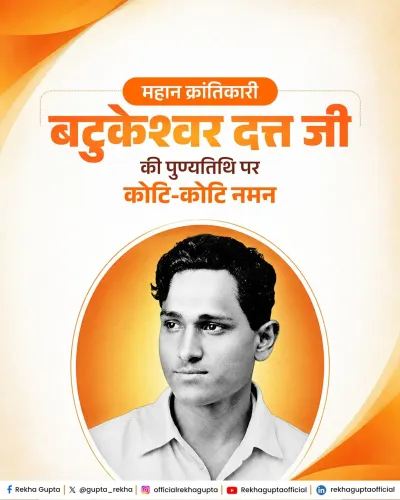
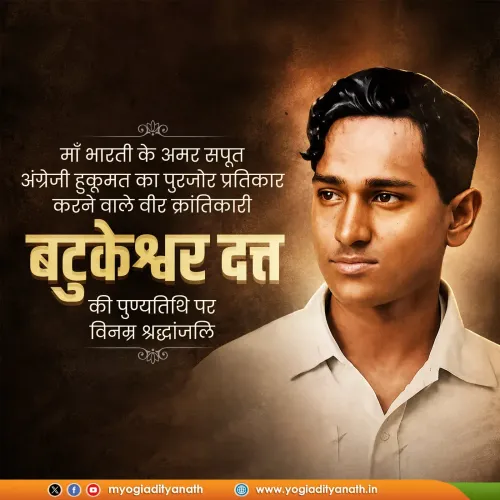
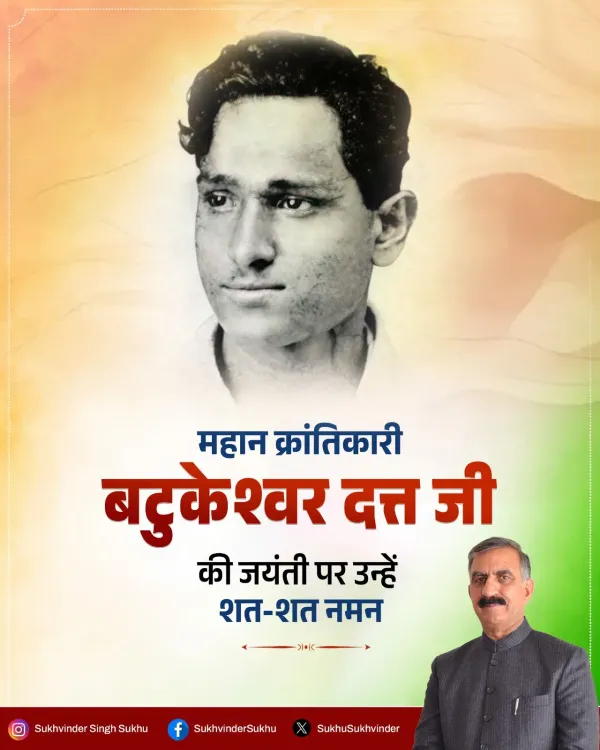
CM Sukhu pays tribute to revolutionary Batukeshwar Dutt on his birth anniversary
Synopsis
HP Chief Minister Sukhvinder Singh Sukhu paid tribute to revolutionary Batukeshwar Dutt on his birth anniversary, recalling Dutt's 1929 protest in the Central Legislative Assembly alongside Bhagat Singh and his life sentence at Cellular Jail.
Key Takeaways
Himachal Pradesh Chief Minister Sukhvinder Singh Sukhu posted a tribute to Batukeshwar Dutt on his birth anniversary on 18 November 2026 .
Batukeshwar Dutt and Bhagat Singh threw smoke bombs inside the Central Legislative Assembly on 8 April 1929 to protest the Public Safety Bill and Trade Disputes Bill.
Both revolutionaries courted arrest, shouting 'Inquilab Zindabad' , and were subsequently convicted and transported for life.
Dutt served time in the Cellular Jail , Andaman and Nicobar Islands , one of the most feared colonial prisons.
CM Sukhu called Dutt's life an enduring inspiration 'to stand against injustice and fulfil duties towards the nation.'
A freedom fighter who once shook the British empire from the floor of its own legislature got his due remembrance on Wednesday. Himachal Pradesh Chief Minister Sukhvinder Singh Sukhu paid tribute to Batukeshwar Dutt on his birth anniversary, calling his struggle for the country's independence something that 'will always be remembered with respect.'
Posting in Hindi, CM Sukhu wrote: 'महान क्रांतिकारी बटुकेश्वर दत्त जी की जयंती पर उन्हें सादर नमन' — 'Respectful salutations to the great revolutionary Batukeshwar Dutt on his birth anniversary.' The Chief Minister added that Dutt's life 'will continue to inspire us to stand against injustice and fulfil our duties towards the nation.'
The man who made the British Parliament listen
Batukeshwar Dutt occupies a singular place in India's independence movement. On 8 April 1929, he and Bhagat Singh threw smoke bombs inside the Central Legislative Assembly in Delhi — not to kill, but to be heard. The act was a deliberate protest against the repressive Public Safety Bill and the Trade Disputes Bill, both designed to suppress organised labour and political dissent. The two revolutionaries did not flee; they courted arrest, chanting 'Inquilab Zindabad' — 'Long live the revolution' — as they were taken into custody. The act sent a message heard far beyond the assembly hall. Dutt was subsequently tried and sentenced to transportation for life, spending years in the Cellular Jail in Andaman and Nicobar Islands — the colonial prison that became a symbol of the independence movement's sacrifice. Even after independence, Dutt faced significant hardship, a contrast that made his story one of quiet, enduring dignity rather than celebrated triumph.A pattern of remembrance across Indian politics
CM Sukhu's tribute fits a well-established practice in Indian political life: leaders across parties mark the birth and death anniversaries of independence-era figures, drawing threads between the freedom struggle's values and present-day governance. The themes Sukhu invoked — resistance to injustice, fulfilment of national duty — are the standard vocabulary of this tradition, but they carry particular resonance when attached to a figure like Dutt, whose commitment cost him decades of liberty with little subsequent recognition. For a Congress leader, invoking Bhagat Singh's closest comrade also carries quiet political weight, connecting the party to a strand of revolutionary nationalism that cuts across ideological lines and commands broad popular respect. Seventy-seven years after independence, Batukeshwar Dutt's story remains a reminder that history's most consequential acts are not always performed by those history chooses to celebrate longest. CM Sukhu's salutation, brief as it is, keeps that account open.Point of View
But the choice of Batukeshwar Dutt is notable — a figure who is widely respected yet rarely centred in mainstream commemoration. For a Congress leader like CM Sukhu, invoking Dutt implicitly claims the broader revolutionary nationalist legacy, one that includes Bhagat Singh and carries cross-partisan appeal. The language of 'standing against injustice' in such tributes often functions as a subtle framing device, connecting historical sacrifice to contemporary political identity. That this tribute emerges from a state CM rather than the national leadership underscores how regional Congress figures are increasingly using historical memory as a tool of political positioning.
NationPress
18 Nov 2026
Frequently Asked Questions
Who was Batukeshwar Dutt?
Batukeshwar Dutt was an Indian revolutionary who, along with Bhagat Singh, threw smoke bombs inside the Central Legislative Assembly in Delhi on 8 April 1929 to protest the Public Safety Bill and Trade Disputes Bill. He was convicted and sentenced to transportation for life, spending years in the Cellular Jail in the Andaman and Nicobar Islands.
Why did Batukeshwar Dutt and Bhagat Singh bomb the Central Legislative Assembly?
The act was a deliberate political protest, not an attempt to cause casualties. The two revolutionaries targeted the assembly to draw attention to the repressive Public Safety Bill and Trade Disputes Bill, which sought to suppress organised labour and political dissent. They courted arrest to maximise the act's impact.
What is the significance of the Cellular Jail in Batukeshwar Dutt's story?
The Cellular Jail in Port Blair, Andaman and Nicobar Islands, was a colonial prison used by the British to isolate Indian political prisoners far from the mainland. Batukeshwar Dutt was transported there after his conviction, as were many other independence movement leaders, making it a powerful symbol of the freedom struggle's sacrifice.
Why did Himachal Pradesh CM Sukhu pay tribute to Batukeshwar Dutt?
CM Sukhvinder Singh Sukhu posted the tribute on the occasion of Batukeshwar Dutt's birth anniversary, stating that Dutt's life is an inspiration to stand against injustice and fulfil national duty. Such commemorations are a common practice among Indian political leaders on birth and death anniversaries of independence-era figures.
What did CM Sukhu say about Batukeshwar Dutt?
CM Sukhu offered 'respectful salutations' to Dutt and stated that his struggle for the country's independence 'will always be remembered with respect.' He added that Dutt's life will continue to inspire people to stand against injustice and fulfil their duties towards the nation.