CM Sukhu pays tribute to C.V. Raman on birth anniversary
Synopsis
Himachal Pradesh Chief Minister Sukhvinder Singh Sukhu honoured Nobel laureate C.V. Raman on his birth anniversary, saluting the Indian physicist's discovery of the Raman Effect in 1928 — a breakthrough that won India its first Nobel Prize in the sciences and inspired India's annual National Science Day on 28 February.
Key Takeaways
CM Sukhvinder Singh Sukhu posted a tribute to Dr.
Raman on his birth anniversary on 7 November 2026 .
Raman announced the Raman Effect on 28 February 1928 , describing inelastic scattering of photons by molecules.
Raman was awarded the Nobel Prize in Physics in 1930 , becoming the first Asian to win a Nobel in science.
The Government of India declared 28 February as National Science Day in 1986 to commemorate the Raman Effect discovery.
Indian leaders routinely issue public tributes to pre-independence scientists to promote scientific temper and national pride.
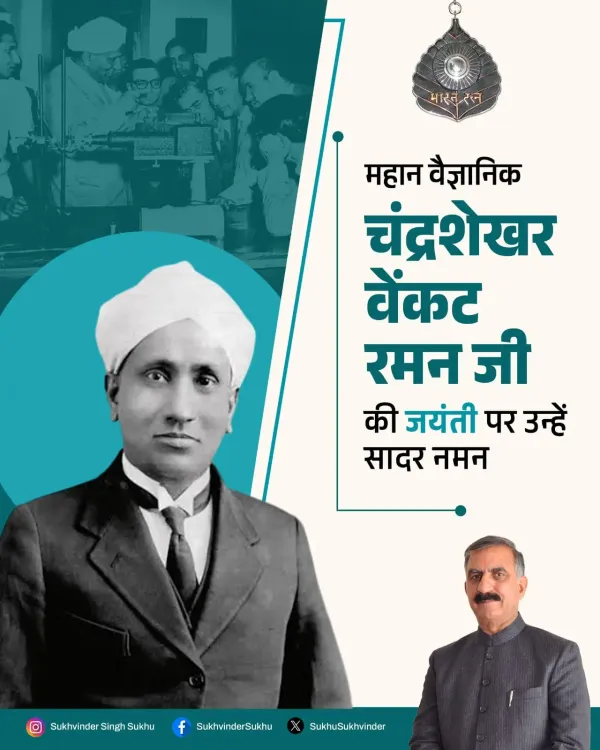
A Nobel laureate whose 1928 discovery rewrote the laws of light — Himachal Pradesh Chief Minister Sukhvinder Singh Sukhu paused on Saturday, 7 November 2026, to honour the birth anniversary of Dr. Chandrasekhara Venkata Raman, the Indian physicist whose work earned India its first Nobel Prize in the sciences.
Posting on X in Hindi, CM Sukhu offered his respectful tribute — 'सादर नमन' (a respectful salute) — to the great scientist, writing: 'Through the discovery of the Raman Effect, he made a vital contribution to the field of science and, with this achievement, enhanced India's glory across the world.'
The discovery that changed how science sees light
C.V. Raman announced the Raman Effect on 28 February 1928 — a landmark finding that describes the inelastic scattering of photons by molecules, revealing that light changes wavelength when it passes through a transparent medium. The discovery became foundational to modern spectroscopy and materials science. Just two years later, in 1930, Raman was awarded the Nobel Prize in Physics, making him the first Asian and the first non-white scientist to win a Nobel in science.
The impact was so profound that the Government of India declared 28 February National Science Day in 1986 — observed every year to commemorate that original announcement and to inspire scientific temper among students and researchers across the country.
A tradition of remembering India's scientific heritage
Indian elected leaders regularly mark the birth and death anniversaries of pre-independence era scientists as a public act of institutional memory — keeping the contributions of figures like Raman, Homi Bhabha, and Srinivasa Ramanujan visible in a 24-hour news cycle that rarely slows down for history. CM Sukhu's tribute follows that pattern, using the platform of elected office to reinforce national pride in indigenous scientific achievement.
For a generation of students in Himachal Pradesh and beyond, the reminder carries weight: one of modern science's most elegant discoveries — elegant enough to win a Nobel — was made not in a European laboratory but in Calcutta, with equipment largely built by hand.
Point of View
Not just political history. It also implicitly reinforces the state's commitment to 'scientific temper', a constitutional value under Article 51A. With India's science and technology ambitions accelerating — from space missions to semiconductor policy — recalling Raman's legacy connects past indigenous brilliance to present-day aspirations. The tribute carries no controversy, but its regularity across party lines reflects a rare consensus: science as soft power is good politics everywhere in India.
NationPress
7 Nov 2026
Frequently Asked Questions
Why is C.V. Raman famous in India?
C.V. Raman is celebrated as the first Indian and first Asian to win a Nobel Prize in science, awarded in 1930 for his discovery of the Raman Effect — the inelastic scattering of light — announced on 28 February 1928 .
What is the Raman Effect in simple terms?
The Raman Effect describes how light changes its wavelength when it passes through a transparent material, because photons interact with the molecules of that material. This discovery is foundational to modern spectroscopy and chemical analysis.
Why is 28 February celebrated as National Science Day in India?
The Government of India declared 28 February as National Science Day in 1986 to mark the anniversary of C.V. Raman's announcement of the Raman Effect in 1928, using the occasion to promote scientific awareness among students and citizens.
Who is Sukhvinder Singh Sukhu?
Sukhvinder Singh Sukhu is the Chief Minister of Himachal Pradesh , in office since December 2022 , and a leader of the Indian National Congress .
When was C.V. Raman born?
C.V. Raman was born on 7 November 1888 in Tiruchirapalli, in present-day Tamil Nadu, which is why his birth anniversary falls on this date and is marked annually across India.