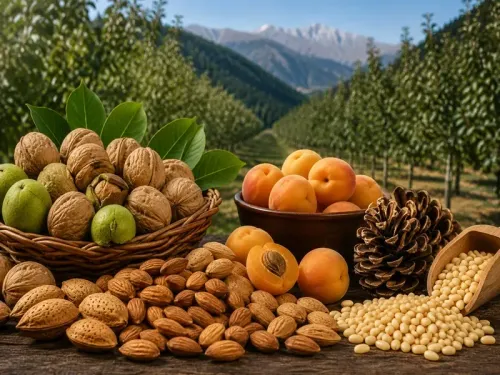
CM Sukhu to Launch High Value Nut Mission 2026–2031 in HP

Synopsis
Himachal Pradesh CM Sukhvinder Singh Sukhu has announced the High Value Nut Mission (2026–2031) to promote scientific and commercial cultivation of walnut, almond, apricot, and chilgoza, aiming to diversify crops, boost farmer incomes, and strengthen the state's rural economy.
Key Takeaways
The High Value Nut Mission will run from 2026 to 2031 , announced by CM Sukhvinder Singh Sukhu on 16 July 2026 .
Target crops are walnut, almond, apricot (khubani), and chilgoza pine nuts — all high-value varieties suited to Himachal's climate.
The mission will promote scientific and commercial farming practices, moving beyond traditional subsistence cultivation.
Key goals include crop diversification, better market prices for farmers, and sustained income growth.
The initiative is expected to strengthen the rural economy of Himachal Pradesh through organised horticulture expansion.
Districts such as Kinnaur and Lahaul-Spiti — already known for premium nuts — stand to be primary beneficiaries.
Himachal Pradesh Chief Minister Sukhvinder Singh Sukhu announced on Thursday, 16 July 2026 that his government will launch the High Value Nut Mission covering the period 2026 to 2031, aimed at strengthening the horticulture sector and boosting farmers' incomes across the state.
Context
Posting on X, CM Sukhu stated — 'बागवानी क्षेत्र को सुदृढ़ बनाने तथा किसानों की आय में वृद्धि के उद्देश्य से हमारी सरकार वर्ष 2026 से 2031 तक हाई वैल्यू नट मिशन शुरू करने जा रही है' ('With the objective of strengthening the horticulture sector and increasing farmers' income, our government is going to launch the High Value Nut Mission from 2026 to 2031'). The mission will promote scientific and commercial cultivation of high-value nut crops including walnut (अखरोट), almond (बादाम), apricot (खुमानी), and chilgoza pine nuts (चिलगोजा).
Himachal Pradesh is one of India's leading horticulture states, with its temperate climate making it naturally suited to nut cultivation. These four crops are traditionally grown across mid- and high-altitude districts such as Kinnaur, Lahaul and Spiti, Shimla, and Kullu, where farmers have long depended on them but often lacked organised market access and scientific support.
Policy Backdrop
The High Value Nut Mission is framed as a five-year intervention designed to shift nut farming from subsistence-level practice to a structured, commercially viable activity. According to CM Sukhu's announcement, the mission will channel scientific methods and commercial frameworks into cultivation, addressing longstanding gaps in post-harvest handling, quality grading, and price realisation for hill farmers.
The initiative aligns with broader national priorities around crop diversification and doubling — or sustainably increasing — farm incomes. For Himachal Pradesh, which earns a significant share of its agricultural revenue from horticulture, expanding beyond the dominant apple economy into high-value nuts represents a deliberate diversification strategy. Walnuts from Kinnaur and chilgoza from Lahaul and Spiti already command premium prices in domestic and export markets, yet grower returns have historically been suppressed by fragmented supply chains.
Stakeholders and Impact
CM Sukhu stated that the mission's implementation will give 'a new direction to crop diversification, expand the horticulture sector, provide better market prices to farmers, and steadily increase their income while also strengthening the rural economy.' The direct beneficiaries will be farming households in the hill districts who cultivate these nut varieties, many of whom belong to economically vulnerable communities in remote terrain.
Beyond individual farmers, the rural economy of Himachal Pradesh stands to gain through downstream activity — storage, processing, packaging, and transport linked to organised nut production. Scientific cultivation support is expected to improve yield quality, making Himachal nuts more competitive in premium domestic and international markets.
What's Next
The mission is slated to commence in 2026 and run through 2031, giving the state government a structured five-year window to roll out implementation guidelines, allocate budgetary resources, and engage with farming communities. Detailed operational frameworks — including subsidy structures, nursery support, and market linkage mechanisms — are expected to be announced as the launch date approaches.
If the mission delivers on its stated goals, it could reposition Himachal Pradesh as a nationally significant supplier of premium nuts, reducing farmer dependence on a single cash crop and building resilience into the state's agricultural economy for the decade ahead.
Point of View
Suggesting the Congress government is betting on long-term rural goodwill in districts where nut farmers have historically been underserved. The emphasis on 'scientific and commercial cultivation' is notable — it implies state investment in extension services and market linkages, not just subsidy disbursement. If implemented with fidelity, this could set a replicable model for other hill states looking to monetise their temperate agro-climatic advantage.
NationPress
16 Jul 2026
Frequently Asked Questions
What is the High Value Nut Mission in Himachal Pradesh?
The High Value Nut Mission is a five-year government scheme (2026–2031) announced by Himachal Pradesh CM Sukhvinder Singh Sukhu to promote the scientific and commercial cultivation of walnut, almond, apricot, and chilgoza pine nuts, with the aim of boosting farmer incomes and diversifying the state's horticulture sector.
Which crops are covered under HP's High Value Nut Mission?
The mission covers four high-value nut crops: walnut (akhrot), almond (badam), apricot (khumani), and chilgoza pine nuts — all of which are well-suited to Himachal Pradesh's temperate and high-altitude climate.
When will the High Value Nut Mission start in Himachal Pradesh?
The mission is set to begin in 2026 and will run through 2031, as announced by CM Sukhvinder Singh Sukhu on 16 July 2026.
How will the Nut Mission benefit Himachal Pradesh farmers?
According to CM Sukhu, the mission will provide farmers with better market prices, promote crop diversification, expand the horticulture sector, and contribute to a sustained increase in farm income and overall rural economic growth.
Which districts in Himachal Pradesh will benefit most from the Nut Mission?
Districts such as Kinnaur and Lahaul and Spiti — already known for premium walnut and chilgoza production — along with Shimla and Kullu, are expected to be primary beneficiaries of the High Value Nut Mission.