Agriculture credit surges 4x to ₹32.50 lakh crore in 11 years: Govt data
Synopsis
India's farm credit has quadrupled in eleven years to ₹32.50 lakh crore — but the real story is structural: 51 per cent of rural households now rely solely on formal credit, over 58 crore Jan-Dhan accounts are live, and 19.83 lakh SHGs are channelling ₹13.28 lakh crore to the rural poor. The numbers suggest a quiet but sweeping transformation in how rural India borrows.
Key Takeaways
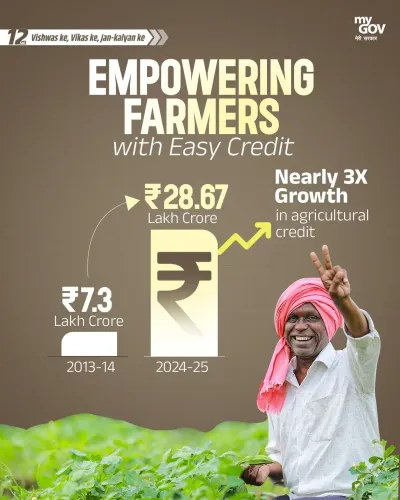
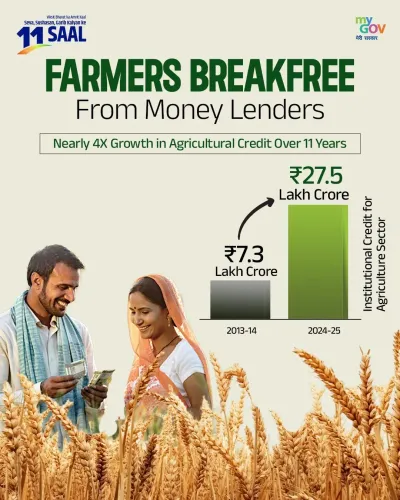
Agriculture ground-level credit reached ₹32.50 lakh crore in FY 2025-26 , up from ₹8 lakh crore in FY 2014-15 — a more than fourfold increase.
Rural credit grew at a compound rate of 13 per cent per year between FY 2014-15 and FY 2023-24.
Rural bank branches rose 35 per cent to 56,193 by July 2025; RRBs cover over 22,000 branches in 700 districts .
Over 58.63 crore Jan-Dhan accounts have been opened as of 24 June 2026 , with deposits exceeding ₹3 lakh crore ; 77.8 per cent are in rural and semi-urban areas.
19.83 lakh SHGs are operational under DAY-NRLM as of 10 July 2026 , with cumulative loan disbursements of ₹13.28 lakh crore since inception.
77.2 per cent of rural households reported higher consumption in NABARD's May 2026 survey, signalling rising rural purchasing power.
India's ground-level credit disbursed to the agriculture sector has surged to ₹32.50 lakh crore in FY 2025-26, marking a more than fourfold rise from ₹8 lakh crore in FY 2014-15, according to an official factsheet released on Thursday, 16 July 2026. The data underscores a structural deepening of rural finance over the past decade, with formal credit channels now reaching households that once depended almost entirely on informal moneylenders.
A Decade of Steady Credit Expansion
Rural credit has grown at a compound annual rate of 13 per cent between FY 2014-15 and FY 2023-24, according to the factsheet. The National Bank for Agriculture and Rural Development (NABARD) has been central to this growth, providing refinance support to banks to supplement their resources for both short-term and long-term lending to agriculture and allied sectors.
The number of scheduled commercial bank branches in rural areas rose by over 35 per cent — from 41,464 in 2014 to 56,193 by July 2025. In addition, Regional Rural Banks (RRBs) maintain a network of over 22,000 branches across 700 districts, extending reach into geographies where commercial banks have historically been absent.
Cooperative Network and Priority Sector Mandates
Cooperative institutions have played a parallel role in expanding institutional credit, particularly in remote areas. According to data from the Reserve Bank of India (RBI) and NABARD, the cooperative network currently includes 1,458 Urban Cooperative Banks, 34 State Co-operative Banks, and 352 District Central Co-operative Banks.
Under the Priority Sector Lending (PSL) framework mandated by the RBI, all banks are required to allocate at least 18 per cent of their Adjusted Net Bank Credit — or the Credit Equivalent of Off-Balance Sheet Exposures, whichever is higher — to the agriculture sector. This regulatory floor has been a key driver of sustained credit flow.
Rural Sentiment and Consumption Trends
NABARD's Rural Economic Conditions and Sentiments Survey (May 2026) found that 77.2 per cent of rural households reported higher consumption levels, pointing to rising purchasing power. On the credit access front, around 51 per cent of rural households now rely exclusively on formal sources, while over 27 per cent access both institutional and non-institutional channels — a significant shift from the informal-credit dependence that characterised rural India a decade ago.
SHGs, Bank Sakhis, and Jan-Dhan Driving Last-Mile Access
The Deendayal Antyodaya Yojana – National Rural Livelihoods Mission (DAY-NRLM) has organised rural poor households into Self-Help Groups (SHGs). As of 10 July 2026, over 19.83 lakh SHGs are operational, with cumulative loan disbursements of ₹13.28 lakh crore recorded since inception.
Around 50,548 Bank Sakhis — community-level banking correspondents — have been deployed to support SHGs in accessing credit. Since 2013-14, these Bank Sakhis have facilitated bank credit of over ₹12.18 lakh crore as of February 2026.
The Pradhan Mantri Jan Dhan Yojana (PMJDY) has also been a foundational enabler. As of 24 June 2026, over 58.63 crore Jan-Dhan accounts have been opened, with total deposits exceeding ₹3 lakh crore. Of these, 32.68 crore accounts — or 55.7 per cent — belong to women, and 45.62 crore accounts (77.8 per cent) are in rural and semi-urban areas, highlighting the programme's reach among historically underserved populations.
With formal rural credit now growing at double-digit rates and last-mile infrastructure deepening, the next policy challenge is ensuring credit quality and repayment support keep pace with disbursement volumes.
Point of View
But the remaining nearly half still straddles informal channels, meaning the last-mile problem is far from solved. The real policy test ahead is not how much credit flows, but whether it reaches tenant farmers and landless labourers — groups that cooperative and SHG networks have historically underserved.
NationPress
16 Jul 2026
Frequently Asked Questions
How much has India's agriculture credit grown in the last 11 years?
India's ground-level credit to agriculture has grown more than fourfold — from ₹8 lakh crore in FY 2014-15 to ₹32.50 lakh crore in FY 2025-26, according to an official factsheet released on 16 July 2026. Rural credit expanded at a compound annual rate of 13 per cent between FY 2014-15 and FY 2023-24.
What role does NABARD play in agriculture credit?
NABARD provides refinance support to banks, supplementing their resources for short-term and long-term lending to agriculture and allied sectors. It also conducts rural sentiment surveys and supports the broader rural credit ecosystem through policy and institutional frameworks.
How many Jan-Dhan accounts have been opened in rural India?
As of 24 June 2026, over 58.63 crore Jan-Dhan accounts have been opened under PMJDY, with deposits exceeding ₹3 lakh crore. Of these, 45.62 crore accounts — 77.8 per cent — are in rural and semi-urban areas, and 32.68 crore accounts belong to women.
What is the Priority Sector Lending mandate for agriculture?
Under RBI's Priority Sector Lending framework, all banks must allocate at least 18 per cent of their Adjusted Net Bank Credit — or the Credit Equivalent of Off-Balance Sheet Exposures, whichever is higher — to the agriculture sector. This mandatory floor ensures a baseline of credit flow regardless of market conditions.
How have Self-Help Groups contributed to rural credit access?
Under DAY-NRLM, over 19.83 lakh SHGs were operational as of 10 July 2026, with cumulative loan disbursements of ₹13.28 lakh crore since inception. Additionally, around 50,548 Bank Sakhis have facilitated bank credit of over ₹12.18 lakh crore to SHGs since 2013-14 as of February 2026.