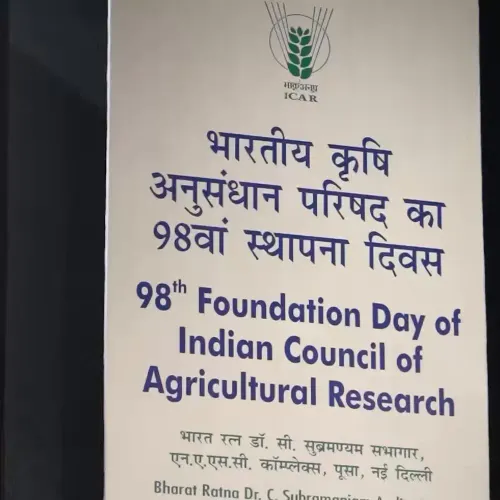
Shivraj sets 7 ICAR goals as centenary nears
Synopsis
On ICAR's 98th Foundation Day, Agriculture Minister Shivraj Singh Chouhan outlined seven institutional goals for the centenary year — including 100 climate-smart villages, a young scientist grant challenge, KVK upgrades, aspirational district adoption, and an open digital platform to reach 10 crore farmers by 2029.
Key Takeaways
Seven centenary commitments were announced by Union Agriculture Minister Shivraj Singh Chouhan on ICAR's 98th Foundation Day, 16 July 2026 .
Goals include 100 Climate-Smart Villages and a 100 Young Scientist Grant Challenge ahead of the 2029 centenary .
Each ICAR institute is proposed to adopt one Aspirational District , embedding agricultural science into the NITI Aayog framework targeting 112 backward districts .
Krishi Vigyan Kendras (KVKs) , district-level farm science centres operating since 1974 , are to be repositioned as Innovation and Technology Centres .
An ICAR Open Digital Knowledge Platform is proposed to make research accessible at scale.
The overarching target is to reach 10 crore farmers with scientific technologies and modern agricultural solutions by the centenary year.
Union Agriculture Minister Shivraj Singh Chouhan on Thursday, 16 July 2026 unveiled seven institutional commitments for the Indian Council of Agricultural Research (ICAR) as the apex agricultural research body approaches its 100th foundation year, pledging to extend the reach of scientific farming solutions to 10 crore farmers by the centenary milestone.
Context
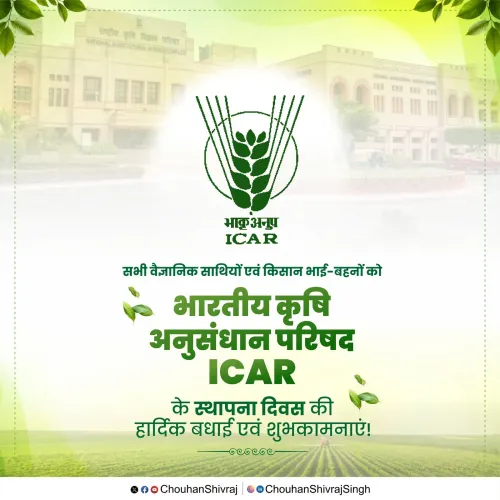
Posting on the occasion of ICAR's 98th Foundation Day — marked by the hashtag #98foundationday — Chouhan called on the institution to take a set of resolves as it counts down to its centenary in 2029. ICAR was established on 16 July 1929 as India's premier body for coordinating agricultural research, education, and extension across the country. The minister framed the seven goals as aspirational targets to be achieved before the centenary, not as immediate policy announcements.
In his post, Chouhan wrote: 'ICAR ke 100ve sthapna varsh ki or badhte hue hum kuch sankalp lein' — 'As we move towards ICAR's 100th foundation year, let us take some resolves.' The seven commitments he listed span climate adaptation, youth-led innovation, institutional adoption of backward districts, and digital outreach.
Policy Backdrop
The seven goals announced by Chouhan are: 100 Climate-Smart Villages; a 100 Young Scientist Grant Challenge; a 'One Institute, One Grand Innovation' initiative; each ICAR institute to adopt one Aspirational District; Krishi Vigyan Kendras (KVKs) to be repositioned as Innovation and Technology Centres; establishment of an ICAR Open Digital Knowledge Platform; and scientific technologies and modern agricultural solutions to reach 10 crore farmers by the centenary year.
Each commitment maps onto an existing policy architecture. KVKs, introduced in 1974, already serve as district-level bridges between ICAR research and farming communities; upgrading them to innovation hubs would expand that mandate. The Aspirational Districts Programme, launched by NITI Aayog in 2018, targets 112 backward districts for convergent development action — ICAR institute adoption would embed agricultural science directly into that framework. The climate-smart villages proposal aligns with the National Mission for Sustainable Agriculture, which has promoted climate-resilient practices since 2011.
Stakeholders and Impact
The commitments, if operationalised, would most directly affect small and marginal farmers, agricultural scientists — particularly early-career researchers who would be targeted by the young scientist grant challenge — and KVK functionaries whose institutional role would be significantly broadened. The proposed open digital knowledge platform signals an intent to make ICAR's research outputs freely accessible, mirroring the Digital India framework's emphasis on open public digital goods.
The adoption of aspirational districts by ICAR institutes could channel scientific resources into some of India's most underserved agricultural regions, potentially improving nutrition, productivity, and income indicators in areas that have historically lagged on development metrics.
What's Next
The immediate focus will be on whether these centenary pledges translate into budgetary allocations, formal programme notifications, or parliamentary commitments. Key milestones to watch include the selection process for the 100 climate-smart villages, the framing of the young scientist grant challenge mechanism, and the signing of adoption agreements between ICAR institutes and aspirational districts. The ICAR Open Digital Knowledge Platform, if launched, would be a measurable deliverable ahead of the 2029 centenary, providing a concrete benchmark against which the minister's vision can be assessed.
Point of View
An election-proximate year. The goals cleverly stitch together existing programmes (Aspirational Districts, Digital India, KVKs) rather than proposing entirely new structures, which limits fiscal risk but also raises questions about additionality. The '10 crore farmers' target is a headline number that will be difficult to verify without a robust monitoring framework, and the absence of funding details leaves the commitments aspirational for now. Whether ICAR's institutional capacity — historically stretched across research, education, and extension — can absorb these expanded mandates simultaneously will be the real test of the vision.
NationPress
14 Oct 2026
Frequently Asked Questions
What is ICAR's 98th Foundation Day and why is it significant in 2026?
ICAR — the Indian Council of Agricultural Research — was established on 16 July 1929 , making 16 July 2026 its 98th Foundation Day . The occasion is significant because it marks the beginning of the final two-year countdown to ICAR's centenary in 2029 , prompting the government to outline long-term institutional goals.
What are the 7 goals Shivraj Singh Chouhan announced for ICAR?
The seven goals are: 100 Climate-Smart Villages ; a 100 Young Scientist Grant Challenge ; a 'One Institute, One Grand Innovation' initiative; each ICAR institute to adopt an Aspirational District ; KVKs to become Innovation and Technology Centres ; an ICAR Open Digital Knowledge Platform ; and reaching 10 crore farmers with scientific solutions by the centenary year.
What are Krishi Vigyan Kendras (KVKs) and what is their new proposed role?
Krishi Vigyan Kendras (KVKs) are district-level farm science centres established in 1974 under ICAR to transfer location-specific agricultural technologies to farmers. Agriculture Minister Chouhan has proposed repositioning them as Innovation and Technology Centres , significantly broadening their mandate beyond technology transfer to active innovation.
How does ICAR's Aspirational District adoption plan work?
The proposal calls for each ICAR institute to formally adopt one of the 112 Aspirational Districts identified under the NITI Aayog Aspirational Districts Programme launched in 2018 . This would embed dedicated agricultural research and extension support into India's most backward districts, targeting improvements in farming productivity, nutrition, and rural income.
What is the ICAR Open Digital Knowledge Platform?
The ICAR Open Digital Knowledge Platform is a proposed digital public good announced by Agriculture Minister Shivraj Singh Chouhan that would make ICAR's research outputs, technologies, and agricultural solutions freely accessible to farmers and other stakeholders. It aligns with the broader Digital India framework and is intended to support the goal of reaching 10 crore farmers by 2029 .