PM Modi marks 12 years of Kisan Samriddhi, cites ₹4.28 lakh crore farm transfers
Synopsis
Twelve years in, the Modi government's farm welfare scorecard includes ₹4.28 lakh crore in direct transfers to 9.5 crore families, crop insurance payouts of ₹1.92 lakh crore, and a jump in foodgrain output from 265 to 358 million tonnes — but structural challenges like input costs and MSP coverage gaps mean the headline numbers only tell part of the story.
Key Takeaways
PM Modi reaffirmed farmer welfare commitments as the NDA government completed 12 years in office on 11 June 2025 .
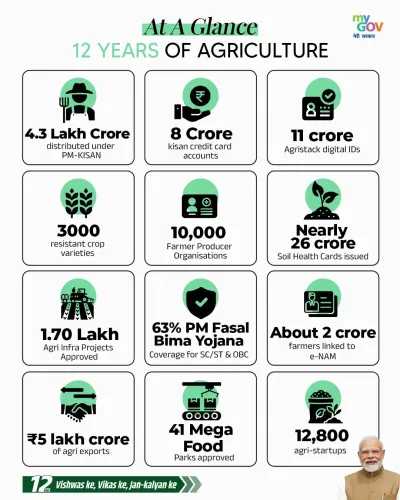
PM-KISAN has transferred over ₹4.28 lakh crore to nearly 9.5 crore farmer families since launch.
Pradhan Mantri Fasal Bima Yojana has paid out approximately ₹1.92 lakh crore in crop insurance claims to nearly 23 crore farmers .
India's foodgrain production rose from 265 million tonnes (2013-14) to around 358 million tonnes (2024-25).
India has reportedly become the world's largest rice producer, surpassing China with output exceeding 154 million tonnes .
Nearly 26 crore Soil Health Cards have been issued since 2014-15 .
Prime Minister Narendra Modi on Thursday, 11 June 2025, reaffirmed his government's commitment to farmer welfare as the National Democratic Alliance (NDA) completed 12 years in office, highlighting a string of agricultural schemes that have, according to official figures, transferred over ₹4.28 lakh crore directly to nearly 9.5 crore farmer families across India.
Modi's Message on Farmer Welfare
Taking to social media platform X under the hashtag #12YearsOfKisanSamriddhi, Modi said, 'Our farmer brothers and sisters are the pillars of the nation's food security, nutrition, and prosperity. Our government is leaving no stone unturned to make their lives as easy as possible.'
In a second post, the Prime Minister highlighted the role of Kisan Credit Cards, describing them as 'extremely useful to farmers, livestock farmers, and fishermen, providing easy access to low-interest loans for their agricultural needs.' He also cited the government's 'Seed to Market' initiative as a mechanism for ensuring fair crop prices.
Key Schemes and What They Cover
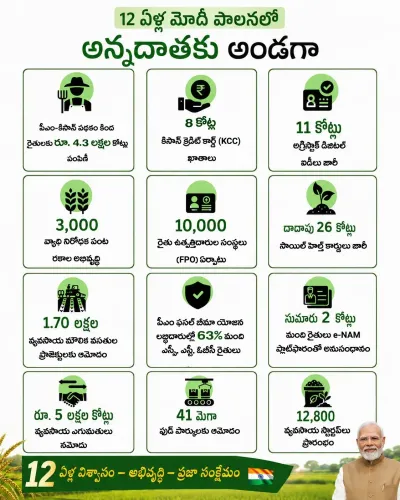
The centrepiece of the government's farm welfare architecture is the Pradhan Mantri Kisan Samman Nidhi (PM-KISAN), under which eligible farmers receive ₹6,000 annually in direct bank transfers. According to official data, cumulative disbursements under the scheme have crossed ₹4.28 lakh crore since its launch.
The Pradhan Mantri Fasal Bima Yojana (crop insurance) has settled claims worth approximately ₹1.92 lakh crore for nearly 23 crore farmers. Meanwhile, the Pradhan Mantri Kisan Maandhan Yojana provides a monthly assured pension of ₹3,000 to small and marginal farmers, offering post-retirement income security.
On the infrastructure side, the PM Krishi Sinchayee Yojana has expanded irrigation coverage, while the Soil Health Card Scheme has issued nearly 26 crore cards since 2014-15 up to March this year. The PM-KUSUM scheme has extended solar energy access to farms, reducing input costs. Additional income streams for farmers have been created through the PM Matsya Sampada Yojana and the National Livestock Mission.
Production Milestones
India's foodgrain output has climbed from 265 million tonnes in 2013-14 to approximately 358 million tonnes in 2024-25, according to government data. Notably, India has emerged as the world's largest rice producer, reportedly surpassing China with a record output of more than 154 million tonnes.
The government has also fixed the Minimum Support Price (MSP) at 1.5 times the cost of production for major crops, a benchmark it says provides farmers with more predictable returns.
Broader Context and What Comes Next
The 12-year milestone arrives against a backdrop of persistent farmer distress in several states, with debt, input costs, and erratic monsoons remaining structural concerns that policy schemes alone have not fully resolved. Critics have in the past questioned whether MSP coverage is broad enough and whether PM-KISAN's annual outlay keeps pace with rising farm input costs.
This comes amid renewed political focus on rural constituencies ahead of state assembly cycles, making the government's messaging on agrarian welfare particularly pointed. Whether the next phase of farm policy deepens existing schemes or introduces new frameworks is likely to be a central question in the months ahead.
Point of View
000 annual outlay has not kept pace with input inflation, and MSP coverage remains limited to a fraction of actual farm produce. The record rice output figure, meanwhile, reflects procurement-driven incentives that have deepened water stress in Punjab and Haryana. Twelve years of schemes is a story; twelve years of outcomes is a different one.
NationPress
19 Sept 2026
Frequently Asked Questions
What is PM-KISAN and how much has been disbursed under it?
The Pradhan Mantri Kisan Samman Nidhi (PM-KISAN) is a direct income support scheme that provides eligible farmers with ₹6,000 annually in three instalments, transferred directly to their bank accounts. According to official figures, over ₹4.28 lakh crore has been disbursed to nearly 9.5 crore farmer families since the scheme's launch.
How many farmers have benefited from crop insurance under Pradhan Mantri Fasal Bima Yojana?
Nearly 23 crore farmers have received crop insurance claim settlements amounting to approximately ₹1.92 lakh crore under the Pradhan Mantri Fasal Bima Yojana. The scheme is designed to protect farmers against crop losses due to natural calamities, pests, and diseases.
What is the significance of India becoming the world's largest rice producer?
India has reportedly surpassed China to become the world's largest rice producer, with a record output of more than 154 million tonnes. This milestone reflects a broader rise in total foodgrain production, which climbed from 265 million tonnes in 2013-14 to around 358 million tonnes in 2024-25.
What is the PM-KUSUM scheme and how does it help farmers?
The PM-KUSUM (Pradhan Mantri Kisan Urja Suraksha evam Uttham Mahabhiyan) scheme provides solar energy infrastructure for agricultural use, including solar-powered irrigation pumps. According to the government, the scheme has made solar energy accessible for farming and helped reduce agricultural input costs.
What pension support is available for small and marginal farmers?
The Pradhan Mantri Kisan Maandhan Yojana provides a monthly assured pension of ₹3,000 to eligible small and marginal farmers upon reaching the age of 60. The scheme is intended to provide financial security during old age for farmers who may lack other retirement income.