Kishan Reddy Highlights 12 Years of Farm Reforms Under Modi
Synopsis
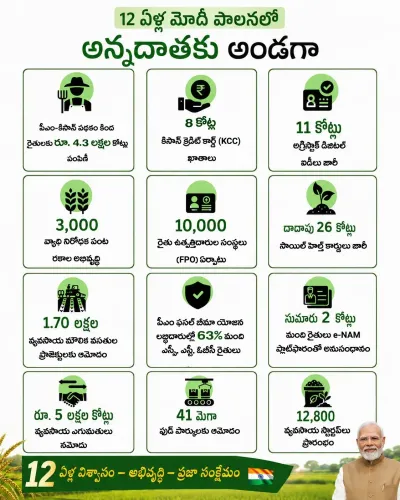
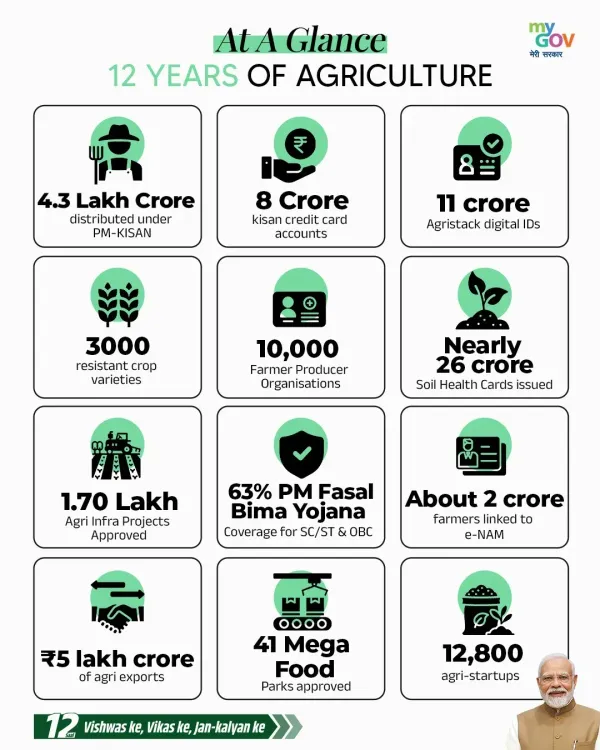
Union Minister G. Kishan Reddy has highlighted over a decade of agricultural reforms under PM Modi, citing ₹4.3 lakh crore in PM-KISAN transfers, 11 crore Agristack digital IDs, 26 crore Soil Health Cards, and 12,800 agri-startups as markers of structural change in India's farm sector.
Key Takeaways
₹4.3 lakh crore transferred directly to farmers under the PM-KISAN income support scheme.
8 crore Kisan Credit Card accounts created to expand institutional credit access for farmers.
11 crore Agristack digital IDs issued to farmers as part of a national agricultural data ecosystem.
Nearly 26 crore Soil Health Cards distributed to promote scientific, balanced fertiliser use.
10,000 Farmer Producer Organisations formed to strengthen collective bargaining and market linkages.
Agricultural exports valued at ₹5 lakh crore and 12,800 agri-startups cited as indicators of value-chain integration.
Union Coal and Mines Minister and BJP Telangana state president G. Kishan Reddy on Thursday, June 11, 2026, catalogued a series of agricultural welfare milestones attributed to the decade-plus tenure of Prime Minister Narendra Modi, marking the occasion under the hashtag #12YearsOfKisanSamriddhi — broadly translating to '12 Years of Farmer Prosperity.'
Context
Reddy's post arrives as the BJP marks over twelve years of the Modi government's agricultural policy record. The minister listed seven headline figures spanning direct cash transfers, credit access, digital identity, soil science, collective farming, export value, and agri-entrepreneurship. The enumeration is framed as evidence of a structural shift in India's farm economy rather than a single scheme announcement.
The post states that ₹4.3 lakh crore has been transferred directly to farmers under the PM-KISAN scheme, which provides an annual income support of ₹6,000 per eligible landholding family. It also cites 8 crore Kisan Credit Card accounts as expanding institutional credit access for cultivators.
Policy Backdrop
The PM-KISAN scheme was launched in February 2019 and operates as a central sector programme with direct benefit transfers to farmer families. The Kisan Credit Card scheme, originally introduced in 1998, received renewed saturation drives after 2014 to bring more farmers under formal credit coverage.
The Soil Health Card programme, rolled out nationally in 2015, aims to promote balanced fertiliser use by issuing individual soil nutrient reports to farmers. Reddy's post cites nearly 26 crore such cards issued to date. The Agristack initiative — which seeks to build a digital ecosystem using farmer data for targeted service delivery and credit linkage — is credited with generating 11 crore digital IDs for farmers.
The Central Sector Scheme for formation and promotion of 10,000 Farmer Producer Organisations (FPOs) was approved in 2020 to improve smallholder bargaining power and market access. Reddy's post includes this among the completed milestones. The post also references ₹5 lakh crore worth of agricultural exports and 12,800 agri-startups as indicators of deeper value-chain integration.
Stakeholders and Impact
The measures cited span the full spectrum of India's farming community — from smallholders receiving direct income support under PM-KISAN to collectives organised under FPOs and entrepreneurs operating across the agri-startup ecosystem. Successive policy layers — cash transfers, digital IDs, soil cards, and credit instruments — are designed to reduce leakages and connect farmers to both domestic and global markets.
Agri-startups, numbering 12,800 according to the post, represent a newer constituency that benefits from digital infrastructure like Agristack, which provides a data backbone for precision lending and targeted input delivery. Parliamentary scrutiny of Agristack data protection rules remains an area to watch as the programme scales.
What's Next
The #12YearsOfKisanSamriddhi campaign signals that the BJP intends to consolidate its agricultural welfare narrative ahead of future electoral cycles, particularly in states like Telangana where Reddy leads the party organisation. Performance reviews of the 10,000 FPO target and updates on Agristack data governance rules in upcoming ministry reports will be closely watched by both policymakers and farm advocacy groups. The breadth of schemes cited suggests the government's strategy is to present agriculture not as a single-intervention sector but as a digitally integrated, export-linked economy in transformation.
Point of View
Credit, digital identity, soil science, collectives, exports and startups — reflects a deliberate BJP effort to present agricultural welfare not as a single flagship scheme but as an interlocking policy architecture. The timing under #12YearsOfKisanSamriddhi suggests the party is building a consolidated rural governance narrative for use in Telangana and other agrarian states. The inclusion of Agristack and agri-startups alongside traditional instruments like Soil Health Cards signals an attempt to frame the Modi government as having modernised, not merely subsidised, Indian farming. Whether the figures cited translate into measurable income gains for smallholders will remain the central question for opposition parties and farm unions.
NationPress
26 Oct 2026
Frequently Asked Questions
What is PM-KISAN and how much has been transferred under it?
PM-KISAN is a central government scheme launched in February 2019 that provides annual direct income support of ₹6,000 to eligible landholding farmer families. Minister G. Kishan Reddy cited ₹4.3 lakh crore as the total amount transferred to farmers under the scheme as of June 2026.
What is Agristack and how many farmers have digital IDs?
Agristack is a government initiative to build a digital ecosystem using farmer data for targeted service delivery and credit linkage. According to Kishan Reddy's post, 11 crore Agristack digital IDs have been issued to farmers across India.
How many Soil Health Cards have been issued in India?
Nearly 26 crore Soil Health Cards have been issued under the national programme launched in 2015, according to figures cited by Union Minister G. Kishan Reddy. The cards provide soil nutrient status reports and fertiliser recommendations to individual farmers.
What is the 10,000 FPO scheme?
The Central Sector Scheme for formation and promotion of 10,000 Farmer Producer Organisations was approved in 2020 to improve smallholder bargaining power, input access and market linkages. Kishan Reddy listed the scheme among key agricultural milestones of the Modi government.
What does #12YearsOfKisanSamriddhi mean?
#12YearsOfKisanSamriddhi is a BJP campaign hashtag marking over twelve years of the Modi government's agricultural policy, with 'Kisan Samriddhi' translating broadly to 'farmer prosperity.' The hashtag was used by Minister G. Kishan Reddy in a June 2026 post listing farm welfare achievements.