CM Sukhu to Set Up Research Dept at IGMC Shimla
Synopsis
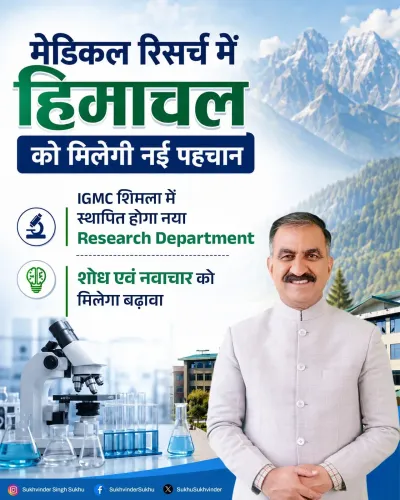
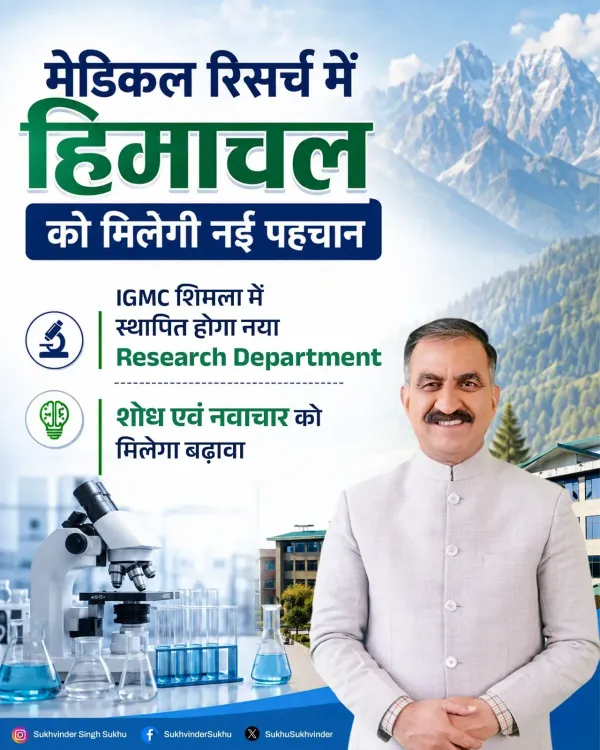
Chief Minister Sukhvinder Singh Sukhu has announced a dedicated Research Department at IGMC Shimla, aiming to advance medical research, foster innovation, and improve treatment of serious diseases in Himachal Pradesh, aligning with national health policy directives.
Key Takeaways
CM Sukhvinder Singh Sukhu announced a new Research Department at IGMC Shimla on 8 August 2026 .
IGMC , established in 1966 , is Himachal Pradesh's oldest and largest government medical institution.
The department aims to provide advanced research facilities for doctors, medical researchers, and students.
The initiative targets better treatment of serious diseases and more effective healthcare delivery in the hill state.
The announcement aligns with the National Health Policy 2017 directive to strengthen research infrastructure in state medical colleges.
Budget allocations and potential ICMR partnerships remain key indicators of implementation progress.
Himachal Pradesh Chief Minister Sukhvinder Singh Sukhu has announced that his government will establish a dedicated Research Department at Indira Gandhi Medical College (IGMC), Shimla — a move that could reshape how the hill state approaches medical science and patient care.
Posting on 8 August 2026, Sukhu wrote in Hindi: 'हमारी सरकार IGMC शिमला में रिसर्च डिपार्टमेंट स्थापित करने जा रही है।' ('Our government is going to establish a Research Department at IGMC Shimla.') He added that the initiative would accelerate medical research, innovation, and modern medical technologies in Himachal Pradesh, while opening advanced research facilities and new opportunities for doctors, researchers, and medical students. Critically, he framed it as a push toward better treatment of serious diseases and more effective healthcare delivery.
IGMC Shimla: Six Decades of Serving the Hills
IGMC Shimla, established in 1966, is the oldest and largest government medical institution in Himachal Pradesh. For generations, it has served as the primary tertiary-care anchor for a state defined by difficult mountain terrain and dispersed populations. Despite its scale, a standalone research department — the kind that drives clinical trials, region-specific disease studies, and translational medicine — has not been a formal feature of its structure. That gap is what Sukhu's announcement targets. The significance is not just institutional. Himachal Pradesh's geography creates health challenges that are distinctly its own: altitude-related conditions, limited specialist access in remote districts, and a patient population that often reaches IGMC only after long journeys. Research rooted in that context could generate insights no Delhi or Mumbai lab would naturally prioritise.Where This Fits in India's Medical Research Push
Sukhu's announcement tracks a wider national pattern. Several Indian states have moved to embed dedicated research units within government medical colleges, riding the momentum of ICMR grant frameworks and the National Medical Commission's academic research directives. The National Health Policy 2017 explicitly called on states to strengthen research infrastructure inside existing medical colleges — a directive that many states are only now acting on at scale. For Himachal Pradesh, the next concrete markers to watch will be the state budget allocation earmarked for the new department and whether the government formalises partnerships with national bodies like ICMR in an upcoming assembly session. The announcement is a clear policy signal; the architecture and funding that back it will determine its reach. A research department at IGMC is not just a facility upgrade — it is a statement that a Himalayan state intends to generate its own medical knowledge, not merely receive it.Point of View
Not merely service delivery — a meaningful distinction for a state where terrain limits specialist access. It fits a broader pattern of Congress-led state governments investing in institutional upgrades to legacy healthcare infrastructure as a visible governance differentiator. The critical question is whether this moves beyond a policy declaration: formal ICMR partnerships and a ring-fenced budget line in the next assembly session will be the real test. If funded and structured properly, a research unit embedded in a high-altitude tertiary hospital could yield clinically relevant data on conditions that national research bodies rarely prioritise.
NationPress
8 Aug 2026
Frequently Asked Questions
What is the new Research Department at IGMC Shimla?
It is a proposed dedicated department for medical research and innovation at Indira Gandhi Medical College and Hospital in Shimla, announced by Chief Minister Sukhvinder Singh Sukhu on 8 August 2026.
What is IGMC Shimla?
IGMC, or Indira Gandhi Medical College and Hospital, established in 1966, is the oldest and largest government medical institution in Himachal Pradesh, serving as the state's primary tertiary-care centre.
How will the IGMC research department benefit patients in Himachal Pradesh?
The department is intended to promote research into serious diseases, advance modern medical technologies, and improve the effectiveness of healthcare services, particularly relevant given the state's challenging mountain terrain.
Is this connected to any national health policy?
Yes. The National Health Policy 2017 directed states to strengthen medical research infrastructure within existing medical colleges, and the announcement aligns with that framework as well as ICMR's academic research push.
What should we watch for next on this announcement?
Key indicators include the state budget allocation for the new department and any formal agreements with national research bodies like ICMR, expected to be clearer in an upcoming assembly session.