CM Vijay announces up to 20% extra pay for Tamil Nadu PSU workers
Synopsis
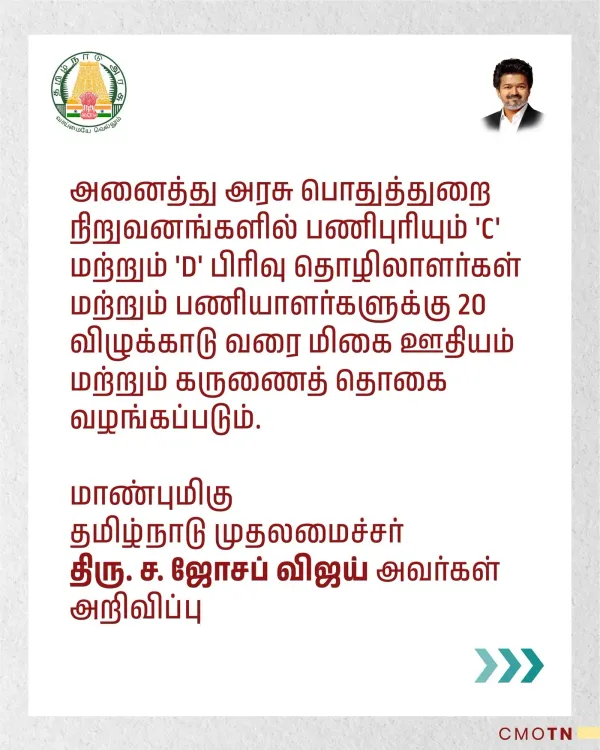
Chief Minister Joseph Vijay has announced up to 20 percent enhanced salary and compassionate allowance for Category C and D employees across all Tamil Nadu government public sector undertakings, directly benefiting the state's lowest-paid PSU workforce.
Key Takeaways
Up to 20 percent enhanced pay and compassionate allowance announced for Tamil Nadu PSU workers.
The benefit covers Category C and D employees — the lowest-paid tiers — across all state government public sector undertakings .
Two components are included: a mikai ūdhiyam (enhanced salary) and a karuṇait tokai (compassionate allowance).
The announcement was made by Chief Minister Joseph Vijay on 27 October 2026 .
Implementation orders from the state finance and labour departments and corresponding budget allocations are now awaited.
A direct wage boost for the workers who keep Tamil Nadu's public enterprises running — Chief Minister Joseph Vijay has announced that employees in Category C and D positions across all state government public sector undertakings will receive an enhanced pay and compassionate allowance of up to 20 percent, effective from the announcement made on Tuesday, 27 October 2026.
The Chief Minister's Office posted the announcement in Tamil, stating: 'அனைத்து அரசு பொதுத்துறை நிறுவனங்களில் பணிபுரியும் C மற்றும் D பிரிவு தொழிலாளர்கள் மற்றும் பணியாளர்களுக்கு 20 விழுக்காடு வரை மிகை ஊதியம் மற்றும் கருணைத் தொகை வழங்கப்படும்' — meaning: 'Workers and employees in Category C and D across all government public sector undertakings will be provided with an enhanced salary and compassionate allowance of up to 20 percent.'
Who benefits — and why it matters
Category C and D employees form the backbone of Tamil Nadu's public sector workforce — clerks, technical assistants, drivers, sanitation workers, and a wide range of support staff spread across dozens of state-owned enterprises. They are typically the lowest-paid tier in the PSU hierarchy, and any percentage-based enhancement translates directly into tangible monthly relief for tens of thousands of households.
The move covers both a mikai ūdhiyam (enhanced or excess salary component) and a karuṇait tokai (compassionate allowance) — two distinct financial instruments that together address both regular wage gaps and welfare-specific needs of the workforce.
Tamil Nadu's pattern of PSU wage revisions
Tamil Nadu governments have periodically revised pay for state employees and public sector staff, often benchmarking against central pay commission cycles or responding to rising cost-of-living pressures. Announcements targeting lower-category workers — the Group C and D tier — are especially significant in states with large PSU footprints, where union representation is strong and wage stagnation is a persistent grievance.
The timing — coming ahead of potential budget deliberations — fits a familiar pattern of welfare-signalling that also has fiscal implications. All eyes now shift to the state finance and labour departments for implementation orders and any corresponding budget allocation that must underpin the enhanced pay structure.
Point of View
And historically a key constituency in state politics. A percentage-based wage enhancement rather than a flat amount signals an intent to proportionally address wage gaps across a diverse range of PSUs. Coming outside a formal pay commission cycle, the move also tests the fiscal bandwidth of the state government, making the finance department's implementation order the real measure of the commitment's depth. For CM Vijay, it consolidates a welfare-centred governance identity at a moment when labour sentiment in public sector unions can shape both political capital and industrial relations.
NationPress
27 Oct 2026
Frequently Asked Questions
What is the salary hike announced for Tamil Nadu PSU workers in 2026?
Chief Minister Joseph Vijay announced up to 20 percent enhanced salary and compassionate allowance for Category C and D employees across all Tamil Nadu government public sector undertakings on 27 October 2026.
Who are Category C and D employees in Tamil Nadu PSUs?
Category C and D employees are the lower-tier workforce in public sector undertakings — including clerical, technical support, drivers, and sanitation staff — who form the bulk of PSU headcount and are typically the lowest-paid tier.
What is a compassionate allowance in Tamil Nadu government pay structure?
A compassionate allowance (karuṇait tokai) is a welfare-oriented financial benefit provided to lower-category government and PSU employees to support them during hardship, separate from their regular salary component.
When will the Tamil Nadu PSU pay hike be implemented?
The announcement has been made by CM Joseph Vijay, but formal implementation orders from the state finance and labour departments — along with any corresponding budget allocation — are still awaited.
Does this pay hike apply to all Tamil Nadu government employees or only PSU workers?
As announced, the enhanced pay and compassionate allowance specifically covers Category C and D workers and employees in all state government public sector undertakings (PSUs), not the broader state government service cadre.