CM Vijay Approves Rs 17.99 Cr GPS, Panic Button Fit-Out for TN Buses
Synopsis
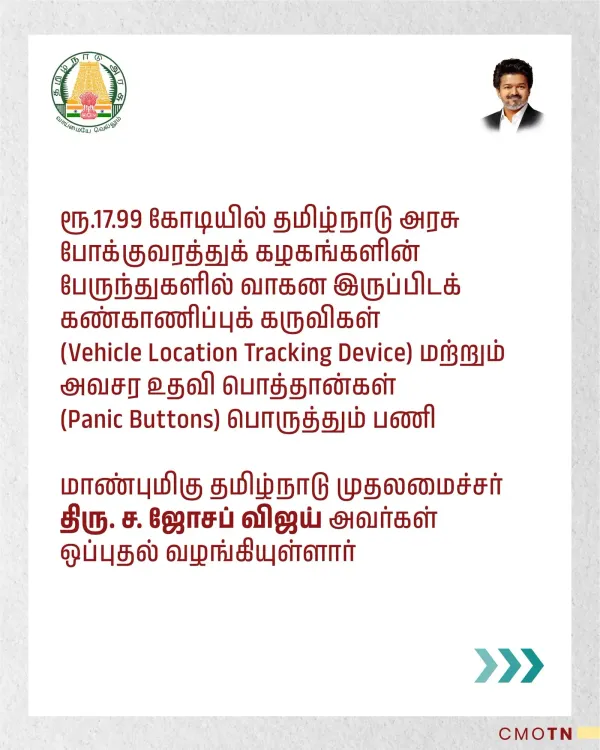
Chief Minister C. Joseph Vijay has approved Rs 17.99 crore to fit Vehicle Location Tracking Devices and Panic Buttons on Tamil Nadu State Transport Corporation buses, fulfilling a long-standing national safety mandate and strengthening protection for millions of daily commuters.
Key Takeaways
Rs 17.99 crore sanctioned by CM C.
Joseph Vijay for bus safety hardware across Tamil Nadu state transport fleets.
Devices include Vehicle Location Tracking Devices (VLTDs) for real-time GPS monitoring and Panic Buttons for passenger emergency alerts.
Operated by the Tamil Nadu State Transport Corporations , the buses serve millions of commuters — including a large share of women — across all districts.
The project fulfils a central government directive issued after the 2012 Nirbhaya case requiring GPS and panic-button fitment in public transport.
Implementation timelines, phased rollout details, and control-room readiness remain to be announced.
Every woman boarding a Tamil Nadu state bus will soon have an emergency button within arm's reach — the Chief Minister's Office of Tamil Nadu announced on Monday, 9 November 2026 that Chief Minister C. Joseph Vijay has approved a Rs 17.99 crore project to install Vehicle Location Tracking Devices (VLTDs) and Panic Buttons across the fleet of Tamil Nadu State Transport Corporations.
What Rs 17.99 Crore Buys on Tamil Nadu's State Buses
The approved outlay covers the procurement and installation of two critical safety systems: GPS-linked vehicle location tracking devices that allow transport authorities to monitor bus positions in real time, and panic buttons that passengers — especially women — can trigger to alert control rooms in an emergency. Together, they transform each bus from a passive vehicle into a monitored, responsive safety corridor.
The Tamil Nadu State Transport Corporations operate thousands of buses across the state's districts, making them the backbone of affordable mobility for millions of daily commuters. Equipping this entire network with both tracking and emergency-alert hardware is a significant operational undertaking, and the Rs 17.99 crore sanction signals that the government is moving from intent to execution.
A Mandate Rooted in the Nirbhaya Directive
This approval does not emerge from a vacuum. Following the 2012 Nirbhaya case, the central government issued directives requiring all states to fit GPS tracking and panic buttons in public transport vehicles as a baseline safety standard. The mandate was designed to deter attacks, enable faster emergency response, and give passengers — particularly women travelling alone — a direct line to help.
More than a decade later, Indian states have been implementing these requirements at different paces. Tamil Nadu's fresh sanction places it squarely within a national push to close remaining gaps in public-transport safety infrastructure.
Women Commuters and the Last-Mile Safety Gap
The human stakes are concrete. State transport buses in Tamil Nadu carry a large share of women workers, students, and daily wage earners travelling long inter-district routes — often late at night or in the early hours. A panic button that connects directly to a control room, combined with live location data for law enforcement, compresses response time in a way that manual reporting cannot.
What to watch now: the phased installation timeline across individual corporations, the command-and-control infrastructure that will receive panic-button alerts, and whether periodic performance audits are mandated to ensure devices remain functional rather than dormant.
Fourteen years after a tragedy changed how India thinks about women's safety in public transport, Tamil Nadu is spending Rs 17.99 crore to make the answer to 'is anyone watching?' a firm yes — on every state bus, on every route.
Point of View
And several states have already completed similar rollouts. The political significance lies in the signal: a new chief minister choosing women's transit safety as an early, visible approval aligns with a proven voter-attention strategy in Tamil Nadu, where women's welfare schemes have historically driven electoral goodwill. The harder test will come in execution — panic buttons and GPS trackers in Indian public transport have a documented history of being installed but poorly maintained. If the state pairs this hardware push with real-time monitoring protocols and mandatory audits, the investment meaningfully raises the safety floor; without that layer, it risks becoming another headline that fades before the devices are even switched on.
NationPress
9 Nov 2026
Frequently Asked Questions
What are the Vehicle Location Tracking Devices approved for Tamil Nadu buses?
They are GPS-based devices fitted on buses that allow transport authorities to monitor the real-time position of each vehicle, enabling faster emergency response and better fleet management.
What is the panic button on Tamil Nadu state transport buses?
A panic button is an in-bus emergency alert device that passengers — particularly women — can press to instantly notify a central control room of a threat or distress situation aboard the bus.
How much has Tamil Nadu approved for bus safety tracking and panic buttons?
Chief Minister C. Joseph Vijay has approved Rs 17.99 crore for installing VLTDs and panic buttons across Tamil Nadu State Transport Corporation buses.
Why are GPS trackers and panic buttons mandatory on Indian public transport buses?
Following the 2012 Nirbhaya case , the central government directed all states to equip public transport vehicles with GPS tracking and panic buttons as a minimum passenger safety standard, particularly to protect women commuters.
Which buses will get the panic buttons and GPS devices in Tamil Nadu?
The devices will be installed on buses operated by the Tamil Nadu State Transport Corporations , the state-run bodies that run public bus services across Tamil Nadu's districts. Phased rollout details are yet to be announced.