CM Vijay flags off 300 new Tamil Nadu govt buses worth Rs 127 cr
Synopsis
Chief Minister Joseph Vijay flagged off 300 new buses for Tamil Nadu's state transport corporations on 25 June 2026, marking a Rs 127.21 crore fleet expansion aimed at improving public connectivity across the state's urban and rural routes.
Key Takeaways
300 new buses have been formally inducted into service across Tamil Nadu State Transport Corporations.
The total procurement cost stands at Rs 127.21 crore .
Chief Minister Joseph Vijay personally flagged off the buses on 25 June 2026 .
The move benefits daily commuters , particularly rural and semi-urban passengers dependent on state-run services.
The procurement follows Tamil Nadu's established practice of phased fleet modernisation to replace ageing vehicles.
Route allocations for the new buses are yet to be publicly detailed.
The Chief Minister's Office of Tamil Nadu announced on Thursday, 25 June 2026, that Chief Minister Joseph Vijay flagged off 300 new buses procured for the Tamil Nadu State Transport Corporations at a cost of Rs 127.21 crore, expanding the state's public bus fleet across its network of district-level transport bodies.
Context
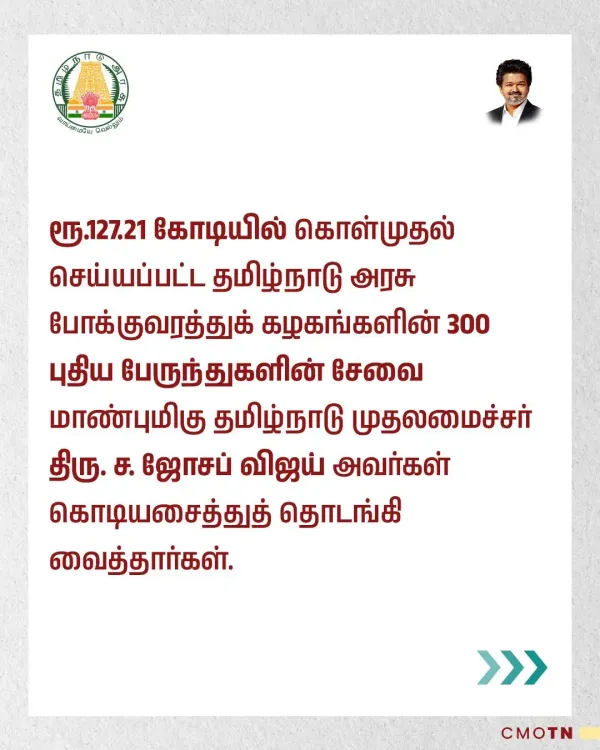
The Tamil Nadu government's official post stated: 'ரூ.127.21 கோடியில் கொள்முதல் செய்யப்பட்ட தமிழ்நாடு அரசு போக்குவரத்துக் கழகங்களின் 300 புதிய பேருந்துகளின் சேவை மாண்புமிகு தமிழ்நாடு முதலமைச்சர் திரு. ச. ஜோசப் விஜய் அவர்கள் கொடியசைத்துத் தொடங்கி வைத்தார்கள்.' In translation: '300 new buses of the Tamil Nadu government transport corporations, procured at Rs 127.21 crore, were flagged off into service by the Honourable Chief Minister of Tamil Nadu, Mr Joseph Vijay.' The flag-off marks the formal induction of these vehicles into active passenger service across the state.
Policy Backdrop
Tamil Nadu operates one of India's larger state-run bus networks through multiple district-level transport corporations serving both urban and rural commuters. Successive state governments have periodically inducted new buses in phases to replace ageing fleets, with several procurement batches approved across recent years to address rising passenger demand and ensure service reliability. The current procurement of 300 buses at Rs 127.21 crore follows this established pattern of phased fleet modernisation.
State transport corporations across India face the dual challenge of maintaining operational efficiency while managing ageing rolling stock. Fresh inductions help reduce breakdowns, lower maintenance costs over time, and improve the overall commuter experience, particularly on rural and semi-urban routes where private alternatives are limited.
Stakeholders and Impact
The primary beneficiaries are daily commuters — including workers, students, and rural passengers — who depend on state-run buses as an affordable mode of transport. New vehicles typically translate into more reliable schedules, improved fuel efficiency, and better passenger comfort compared to older fleet segments. The procurement also supports ancillary industries including bus body fabrication and component supply chains within the state.
Rural passengers stand to gain most directly, as state transport corporations often serve routes that are commercially unviable for private operators. The induction of newer buses on such routes can meaningfully improve last-mile connectivity for communities with fewer transport options.
What's Next
Attention will now turn to the allocation of these 300 buses across specific routes and corporations, with commuters and transport observers watching whether priority is given to high-density corridors or underserved rural stretches. Any follow-up fleet expansion proposals in the next state budget cycle will indicate the scale of the government's longer-term public transport ambitions. The flag-off sets a benchmark for subsequent procurement rounds as Tamil Nadu works to sustain and grow its public bus network.
Point of View
Using a visible, high-impact public event to underscore its infrastructure credentials. For CM Joseph Vijay, whose political profile carries significant public attention, associating with a tangible public-service delivery moment serves both governance and optics. The scale — 300 buses in a single induction — is substantial but not unprecedented for Tamil Nadu, placing this squarely within a long-running state tradition rather than a dramatic departure. The real test will be in route allocation: whether the new fleet reaches underserved rural corridors or is concentrated on already-serviced urban arteries will determine the actual equity dividend of this investment.
NationPress
24 Sept 2026
Frequently Asked Questions
How many new buses did Tamil Nadu launch on 25 June 2026?
Tamil Nadu launched 300 new buses for its state transport corporations on 25 June 2026, flagged off by Chief Minister Joseph Vijay.
How much did Tamil Nadu spend on the 300 new buses?
The 300 new buses were procured at a total cost of Rs 127.21 crore for the Tamil Nadu State Transport Corporations.
Who flagged off the new Tamil Nadu government buses?
Chief Minister Joseph Vijay flagged off the 300 new buses into service on behalf of the Tamil Nadu government.
Which organisation operates these new buses in Tamil Nadu?
The buses are operated by the Tamil Nadu State Transport Corporations , state-owned entities running public bus services across the state's districts.
Who benefits from the new Tamil Nadu bus fleet expansion?
The primary beneficiaries are daily commuters — including workers, students, and rural passengers — who rely on affordable state-run bus services, especially in areas with limited private transport options.