CM Vijay Launches ₹3,000 Cr SHG Credit Drive in Erode
Synopsis
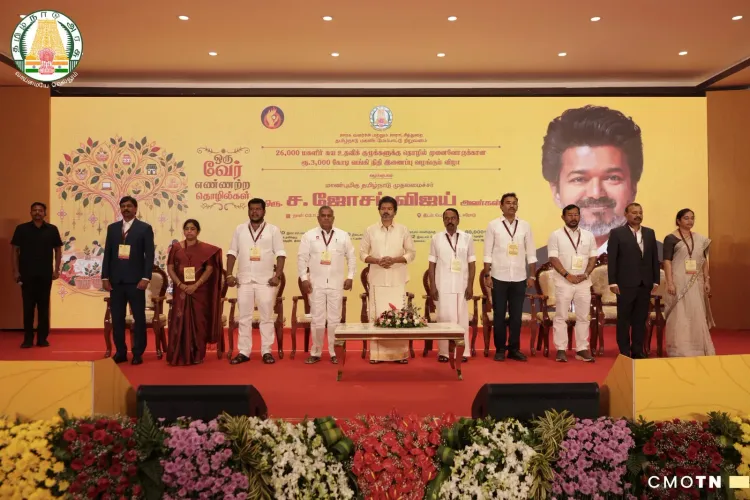
Chief Minister C. Joseph Vijay launched a ₹3,000 crore bank credit linkage programme for 26,000 Women SHGs in Tamil Nadu on 3 November 2026, distributing ₹1,110 crore to 9,000 groups at a Perundurai event, along with retail outlet approvals and youth skill-training sanctions.
Key Takeaways
₹3,000 crore total credit linkage programme announced for 26,000 Women Self-Help Groups statewide.
Initial tranche of ₹1,110 crore disbursed to 9,000 SHGs at Perundurai, Erode district on 3 November 2026 .
Event organised by the Tamil Nadu Corporation for Development of Women under the Rural Development and Panchayat Raj department.
CM Vijay also issued sanction orders for youth skill-training programmes and approvals for SHG product retail outlets .
Programme builds on Tamil Nadu's SHG policy lineage stretching back to the Mahalir Thittam initiative of the late 1990s.
Remaining ₹1,890 crore in credit linkages yet to be disbursed to the balance 17,000 SHGs.
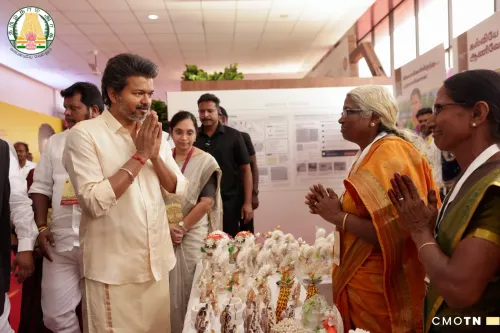
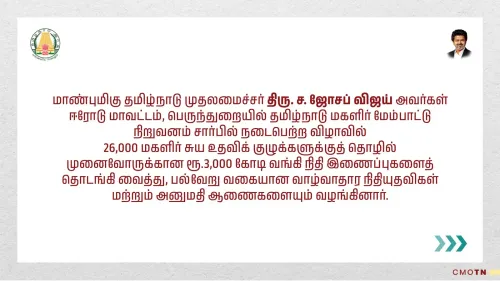
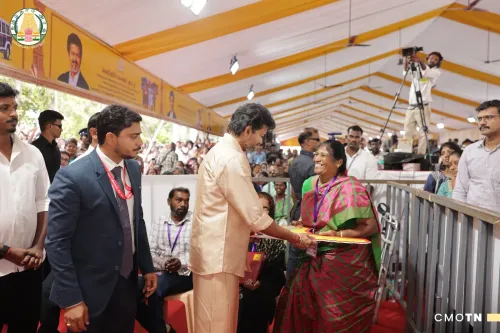
Three thousand crore rupees — directed at 26,000 Women Self-Help Groups across Tamil Nadu in a single day. Chief Minister C. Joseph Vijay kickstarted the state's largest single-event SHG credit linkage programme on 3 November 2026, handing over initial bank-credit orders worth ₹1,110 crore to 9,000 SHGs at a function in Perundurai, Erode district — organised by the Tamil Nadu Corporation for Development of Women under the Rural Development and Panchayat Raj department.
₹1,110 Crore in Hand — and ₹1,890 Crore Still to Flow
The ceremony was the opening act of a fuller rollout. Of the ₹3,000 crore total credit linkage programme targeting entrepreneurship across 26,000 SHGs statewide, Tuesday's event delivered the first tranche — ₹1,110 crore to 9,000 groups. The remaining linkages are expected to follow as the programme scales out to the full beneficiary count. Each credit order connects a self-help group directly to a bank, replacing the informal lending arrangements that have historically trapped rural women in high-interest debt cycles.
Beyond the headline credit figure, CM Vijay also distributed a package of complementary supports: livelihood assistance funds, sanction orders for youth skill-training programmes, and approvals for establishing dedicated retail outlets for SHG products. That last element — formal market access — is often where micro-enterprise ambitions stall, and its inclusion signals an intent to close the value chain, not just open a credit tap.
Decades of SHG Policy Behind One Afternoon in Perundurai
Tamil Nadu's relationship with women's self-help groups runs deep. The state pioneered the Mahalir Thittam programme in the late 1990s, one of India's earliest systematic SHG-bank linkage initiatives. The Tamil Nadu Corporation for Development of Women has since expanded that architecture, weaving it into the national DAY-NRLM (Deendayal Antyodaya Yojana — National Rural Livelihoods Mission) framework to leverage both state and central funds. The result is a layered infrastructure — savings, credit, skill-building, market linkage — designed to carry rural women from basic thrift groups into functioning micro-enterprises.
Tuesday's programme sits inside that long continuum but marks a step-change in ambition: the ₹3,000 crore figure and the 26,000-group target are among the largest single-programme credit pushes the state has announced. The retail-outlet approvals and youth skill-training orders expand the model beyond credit into the harder problem of sustained livelihoods.
What the Retail Outlet Approvals Actually Mean
Getting credit is one thing; selling what you produce is another. SHG members across Tamil Nadu manufacture a wide range of goods — food products, handicrafts, textiles, agro-processed items — but distribution has historically been ad hoc. The sanction orders for SHG product retail outlets issued at Perundurai aim to formalise that last mile, giving groups a predictable channel to convert production into income. Paired with the youth skill-training approvals, the package suggests a broader vision: a rural enterprise ecosystem with credit at the base, trained young workers feeding it, and organised retail pulling product through.
With the first ₹1,110 crore disbursed and the remaining ₹1,890 crore still to be linked, Erode district has hosted the opening chapter of what Tamil Nadu is betting will be a transformative rural-economy story — and the next chapter will be written in the 17,000 SHGs still waiting for their orders.
Point of View
000 crore SHG credit push is the largest single-event bank linkage announcement in Tamil Nadu's recent memory, reflecting a state that has consistently used women's self-help infrastructure as its primary rural-economy lever. By pairing credit with retail outlet approvals and youth skill-training sanctions, the programme attempts to address the structural gap between access to finance and sustainable enterprise — a shift that mirrors national DAY-NRLM ambitions but is being executed at state scale. For CM Vijay, the Perundurai event is also a political signal: directing significant economic resource allocation toward rural women early in the electoral cycle builds a visible constituency in districts like Erode that have historically been competitive ground. The real test will be how swiftly the remaining ₹1,890 crore reaches the 17,000 SHGs still awaiting their linkages.
NationPress
4 Nov 2026
Frequently Asked Questions
What is the Tamil Nadu ₹3,000 crore SHG credit linkage programme?
It is a statewide entrepreneurship credit programme launched by CM C. Joseph Vijay on 3 November 2026, channelling ₹3,000 crore in bank credit to 26,000 Women Self-Help Groups across Tamil Nadu. An initial ₹1,110 crore was disbursed to 9,000 SHGs at the Perundurai, Erode launch event.
What is the Tamil Nadu Corporation for Development of Women?
It is a state government agency under the Rural Development and Panchayat Raj department responsible for promoting Women Self-Help Groups and livelihood programmes in Tamil Nadu. It organised the Perundurai event and administers SHG-bank linkage initiatives.
What else did CM Vijay distribute at the Perundurai event?
Beyond the ₹1,110 crore in credit linkage orders, CM Vijay distributed livelihood assistance funds, issued sanction orders for youth skill-training programmes, and approved the establishment of retail outlets to sell SHG products.
How many SHGs are yet to receive credit under this programme?
Of the 26,000 SHGs targeted, 9,000 received credit orders worth ₹1,110 crore at the launch. The remaining 17,000 SHGs — representing ₹1,890 crore in linkages — are expected to receive their orders in the subsequent rollout phases.
What is Tamil Nadu's history with SHG bank linkage programmes?
Tamil Nadu was among India's earliest adopters of SHG-bank linkage, launching the Mahalir Thittam programme in the late 1990s. The state subsequently expanded the model through the Tamil Nadu Corporation for Development of Women and integrated it with the national DAY-NRLM framework to scale rural women's micro-enterprises.