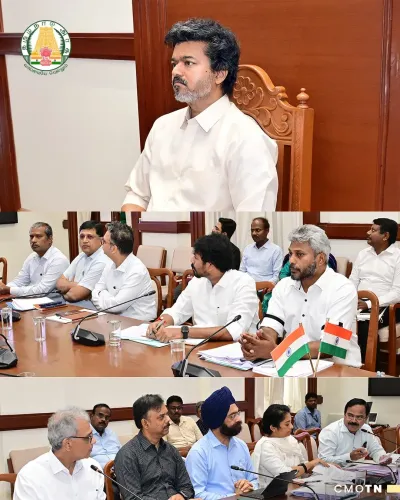
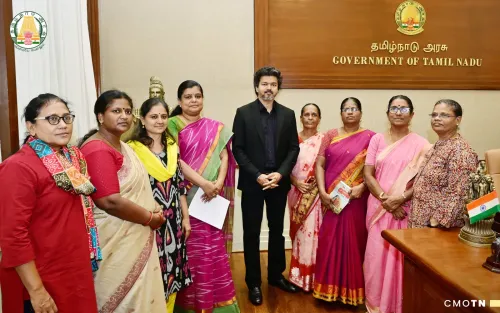
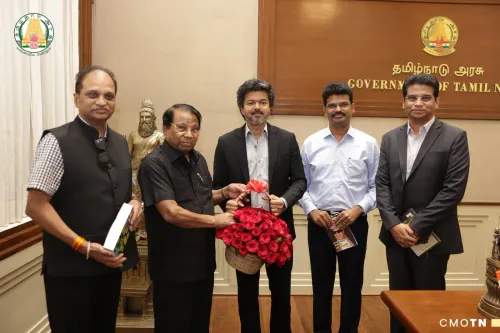
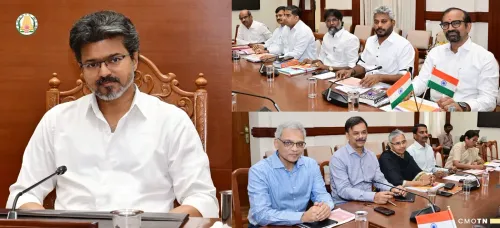
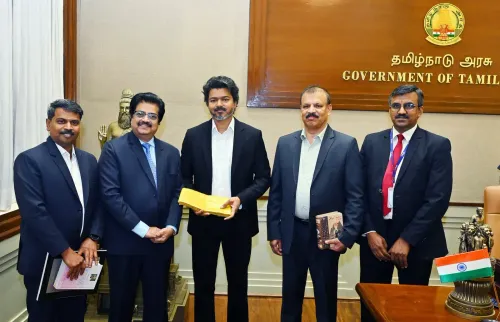
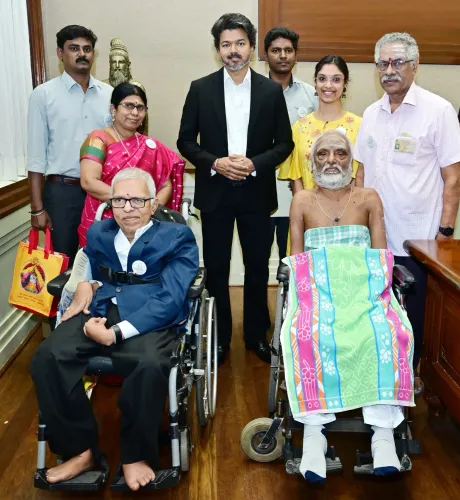
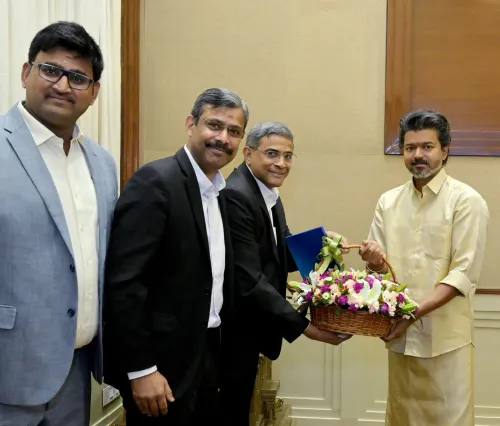
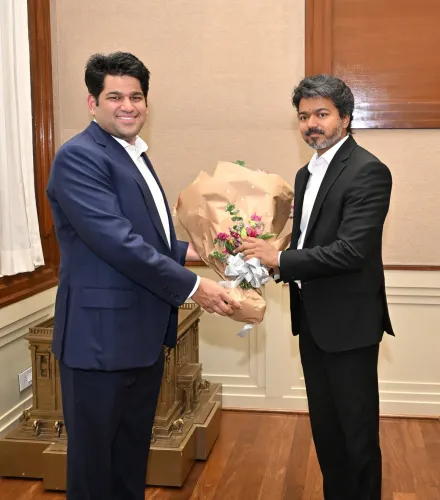
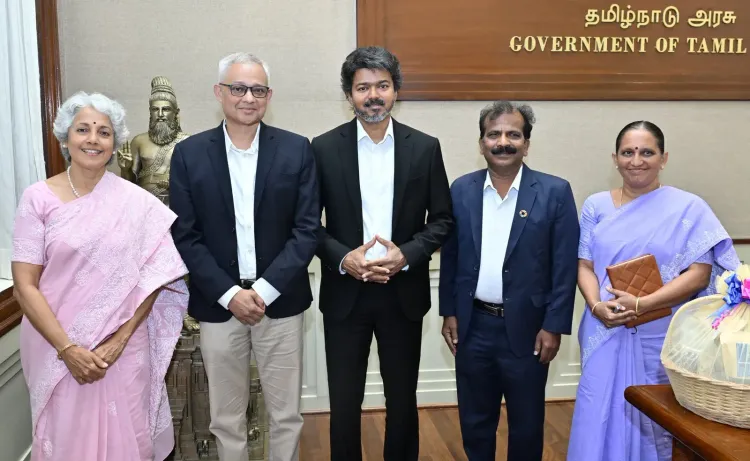
CM Joseph Vijay meets MSSRF chief Dr Soumya Swaminathan
Synopsis
Tamil Nadu Chief Minister Joseph Vijay met MSSRF Chairperson Dr Soumya Swaminathan and executives at the Chennai Secretariat on 25 May 2026, signalling a potential state-science collaboration on sustainable agriculture and nutrition security.
Key Takeaways
CM Joseph Vijay held a meeting with Dr Soumya Swaminathan , Chairperson of MSSRF, and senior executives at the Tamil Nadu Secretariat on 25 May 2026 .
Swaminathan Research Foundation is a Chennai-based non-profit founded in 1988 focused on sustainable agriculture, food security, and rural development.
Dr Soumya Swaminathan previously served as Chief Scientist at the World Health Organization before chairing MSSRF.
Tamil Nadu has a long history of engaging scientific institutions to shape state policy on agriculture and nutrition.
Potential follow-up areas include millet promotion , coastal ecosystem restoration , and nutrition programmes in the 2026-27 budget .
The Chief Minister's Office of Tamil Nadu announced on Monday, 25 May 2026 that Chief Minister C. Joseph Vijay held a meeting at the Tamil Nadu Secretariat, Chennai, with Dr Soumya Swaminathan, Chairperson of the M.S. Swaminathan Research Foundation (MSSRF), and senior executives of the institution.
Context
The Chief Minister's Office posted on X confirming that Dr Soumya Swaminathan and MSSRF executives called on CM Joseph Vijay at the Tamil Nadu Secretariat on 25 May 2026. The meeting signals a formal engagement between the state government and one of India's most respected agricultural and nutrition science institutions.
Dr Soumya Swaminathan is a prominent Indian paediatrician and public health expert who previously served as Chief Scientist at the World Health Organization before returning to chair the MSSRF, the Chennai-based foundation established by her father, the late Dr M.S. Swaminathan.
Policy Backdrop
The M.S. Swaminathan Research Foundation was established in 1988 in Chennai to advance sustainable agriculture, food security, and rural development through science-based community programmes. Its work spans millet promotion, coastal ecosystem restoration, and nutrition security — all areas of active policy interest in Tamil Nadu.
Dr M.S. Swaminathan, the foundation's late founder, is widely credited with leading India's Green Revolution in the 1960s and 1970s, transforming agricultural productivity across the country, including in Tamil Nadu, through the introduction of high-yielding wheat and rice varieties. The institution carries that legacy into contemporary challenges such as climate-resilient farming and community nutrition.
Tamil Nadu governments have periodically engaged scientific institutions such as MSSRF to shape state-level policies. Such consultations are consistent with a long-standing pattern of state-science collaboration characteristic of welfare-oriented governance in the state.
Stakeholders and Impact
The primary beneficiaries of any MSSRF-Tamil Nadu collaboration would be small and marginal farmers, rural communities, and nutrition-vulnerable populations across the state. MSSRF's ongoing programmes in areas such as millet revival, coastal livelihoods, and biofortification are directly relevant to Tamil Nadu's agrarian and coastal districts.
For Dr Soumya Swaminathan and the MSSRF, a formal state partnership would provide institutional backing and scale for research programmes that currently operate largely through grants and community outreach. The meeting at the secretariat — rather than a field visit — underscores the institutional seriousness of the engagement.
What's Next
Observers will watch for follow-up announcements on possible joint MSSRF-Tamil Nadu projects, particularly in millet promotion, coastal ecosystem restoration, and nutrition programmes that could find expression in the 2026-27 state budget or through dedicated government orders. The meeting may also lay groundwork for MSSRF expertise to feed into Tamil Nadu's agricultural extension services and school nutrition schemes.
As Tamil Nadu navigates pressures from climate variability on its farming sector, institutionalising ties with a body of MSSRF's standing could give the state access to cutting-edge research on crop resilience and food systems — with implications for millions of farmers and consumers across the state.
Point of View
And engaging MSSRF fits squarely in that mould. With climate stress mounting on the state's farming sector and millet revival gaining national momentum, a formal MSSRF partnership could give the government both scientific credibility and implementation infrastructure. The meeting's timing, early in the government's tenure, suggests policy intent rather than routine protocol.
NationPress
20 Sept 2026
Frequently Asked Questions
Who is Dr Soumya Swaminathan and why did she meet Tamil Nadu CM?
Dr Soumya Swaminathan is a senior Indian public health expert and paediatrician who chairs the M.S. Swaminathan Research Foundation. She met Tamil Nadu Chief Minister Joseph Vijay at the Chennai Secretariat on 25 May 2026 along with MSSRF executives, signalling a potential collaboration between the state and the foundation on agriculture and nutrition policy.
What is the M.S. Swaminathan Research Foundation?
The M.S. Swaminathan Research Foundation (MSSRF) is a Chennai-based non-profit established in 1988 by the late agricultural scientist Dr M.S. Swaminathan. It works on sustainable agriculture, food security, millet promotion, coastal livelihoods, and rural nutrition programmes.
What could come out of the Tamil Nadu CM and MSSRF meeting?
Possible outcomes include joint projects on millet promotion, coastal ecosystem restoration, and nutrition security programmes, which could be reflected in Tamil Nadu's 2026-27 budget or through dedicated government orders.
Who was M.S. Swaminathan and what is his connection to Tamil Nadu?
Dr M.S. Swaminathan was a renowned agricultural scientist credited with leading India's Green Revolution in the 1960s and 1970s. He founded the MSSRF in Chennai, and his work on high-yielding crop varieties significantly boosted Tamil Nadu's agricultural productivity.
What is CM Joseph Vijay's role in Tamil Nadu?
C. Joseph Vijay is the Chief Minister of Tamil Nadu, and the meeting with MSSRF was held at the Tamil Nadu Secretariat in Chennai on 25 May 2026, as confirmed by the official Chief Minister's Office account on X.