CM Mohan Yadav calls Guru Purnima a mass movement for Indian knowledge

Synopsis
MP Chief Minister Dr. Mohan Yadav has called Guru Purnima a mass movement — framed as 'Maharshi Sandipani Shraddha Parv' — to carry India's knowledge tradition, guru-shishya values, and cultural heritage to every citizen, anchoring the drive to Ujjain's ancient Sandipani Ashram.
Key Takeaways
Mohan Yadav posted on 28 July 2026 calling Guru Purnima a jan-andolan (people's movement).
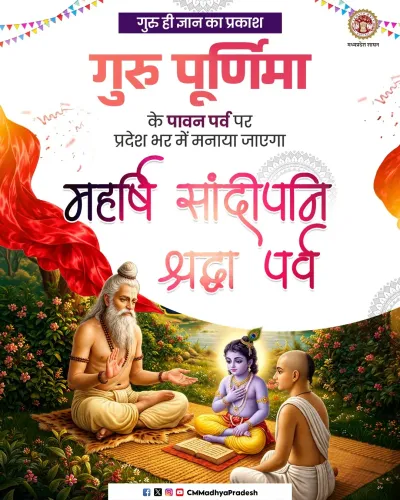
The initiative is branded 'Maharshi Sandipani Shraddha Parv' , named after the Vedic sage whose ashram is in Ujjain .
The stated goal is to spread India's knowledge tradition, the guru-shishya bond, and cultural values to every citizen.
The campaign aligns with the National Education Policy 2020 's directive to integrate Indian Knowledge Systems into public life.
Teachers and students are the primary stakeholders, though the 'mass movement' framing targets the broader public.
Ujjain serves as the symbolic and likely logistical centre of the observance.
Madhya Pradesh Chief Minister Dr. Mohan Yadav on Tuesday, 28 July 2026 invoked the spirit of the ancient sage Maharshi Sandipani to frame Guru Purnima as a people's movement for reviving India's classical learning traditions, the guru-shishya bond, and cultural values.
Context
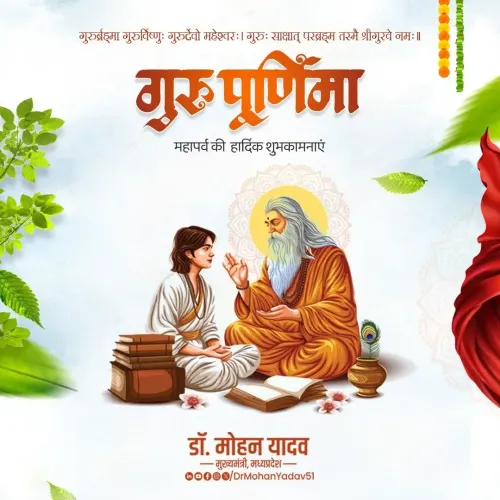
In his post, Chief Minister Yadav described the occasion as 'Maharshi Sandipani Shraddha Parv' — a reverent observance in the name of the Vedic sage — and declared that Guru Purnima should become a 'jan-andolan' (people's movement) to carry 'Bharatiya gyan parampara, guru-shishya parampara aur saanskritik mulyon' (India's knowledge tradition, the guru-disciple tradition, and cultural values) to every citizen. The post was accompanied by a video, underlining the government's intent to give the message a broad digital reach.
Guru Purnima falls on the full moon day of the Hindu month of Ashadha and is observed annually across India as a day to honour teachers and the lineage of learning they represent. Maharshi Sandipani is the revered Vedic sage whose ashram in Ujjain, Madhya Pradesh, is traditionally regarded as the site where Lord Krishna and Balarama received their education.
Policy Backdrop
The framing of Guru Purnima as a cultural mass movement sits within a wider policy direction. The National Education Policy 2020 explicitly directed the integration of Indian Knowledge Systems — including classical texts, traditional pedagogy, and the guru-shishya model — into formal education at every level. State governments have since been encouraged to develop programmes that give these directives a grassroots expression.
Ujjain, which houses the Sandipani Ashram, has increasingly served as a symbolic anchor for such initiatives in Madhya Pradesh. By naming the observance after Maharshi Sandipani, the state government connects a living festival to one of India's most storied centres of ancient learning, lending the campaign both religious resonance and historical depth.
Stakeholders and Impact
The primary audiences for this initiative are teachers and students across Madhya Pradesh, though the language of a 'jan-andolan' signals an ambition to reach ordinary citizens beyond the school system. Cultural organisations, religious institutions associated with Ujjain, and local administration are likely to be enlisted in organising events on the ground.
BJP-governed states have in recent years used festivals as platforms to promote classical Indian traditions, positioning such observances as acts of cultural reclamation rather than routine celebration. The Madhya Pradesh government's approach follows that broader pattern, using the moral authority of the guru figure to build public engagement around ideas of knowledge, discipline, and heritage.
What's Next
State government programmes and school-level activities around the Guru Purnima observance in Ujjain will be the immediate markers of how far this call to action translates into organised events. The extent to which the 'Maharshi Sandipani Shraddha Parv' framework is institutionalised — whether as an annual calendar fixture or a one-time campaign — will determine its longer-term cultural footprint. If the initiative gains traction, it could serve as a template for similar state-level programmes linking ancient learning sites to contemporary education outreach.
Point of View
Dr. Mohan Yadav is deploying festival politics in a form that has become a signature of BJP-governed states — converting a religious calendar date into a vehicle for cultural messaging with mass reach. Anchoring the initiative to Maharshi Sandipani and Ujjain gives it historical legitimacy while reinforcing Madhya Pradesh's identity as a custodian of Hindu civilisational heritage. The move also dovetails neatly with the National Education Policy 2020's push for Indian Knowledge Systems, allowing the state to present a cultural campaign as an extension of federal education policy. Whether the initiative produces durable institutional change or remains a high-visibility annual moment will be the real test of its stated ambitions.
NationPress
26 Oct 2026
Frequently Asked Questions
What is Maharshi Sandipani Shraddha Parv?
'Maharshi Sandipani Shraddha Parv' is a cultural observance named after the ancient Vedic sage Maharshi Sandipani, whose ashram is in Ujjain, Madhya Pradesh. Chief Minister Dr. Mohan Yadav has framed it as part of Guru Purnima celebrations aimed at spreading India's knowledge and guru-shishya tradition to every citizen.
When is Guru Purnima 2026?
Guru Purnima falls on the full moon day of the Hindu month of Ashadha. In 2026, Chief Minister Dr. Mohan Yadav's post marking the occasion was made on 28 July 2026, indicating the festival falls around that date.
Who was Maharshi Sandipani?
Maharshi Sandipani was an ancient Vedic sage traditionally regarded as the guru of Lord Krishna and Balarama. His ashram, located in Ujjain, Madhya Pradesh, is considered one of India's most significant sites of classical learning.
What is the guru-shishya tradition in India?
The guru-shishya tradition is the ancient Indian system of learning in which a student receives knowledge, values, and wisdom directly from a teacher (guru) through a close personal bond. It is one of the foundations of India's classical educational heritage and is celebrated on Guru Purnima every year.
How does the National Education Policy 2020 relate to Indian Knowledge Systems?
The National Education Policy 2020 directed the integration of Indian Knowledge Systems — including classical texts, traditional pedagogy, and the guru-shishya model — into formal education at every level, encouraging state governments to develop programmes that give these directives a grassroots expression.