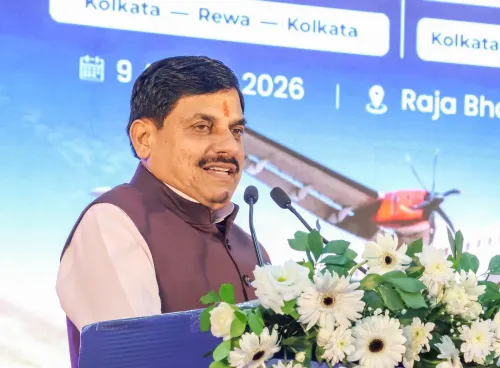
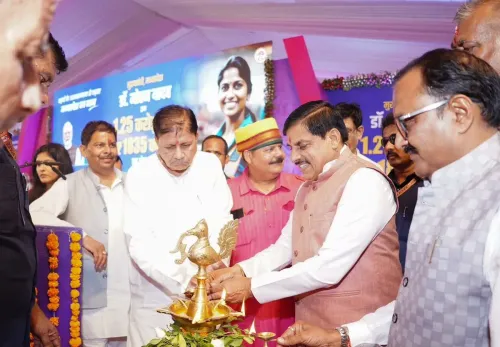
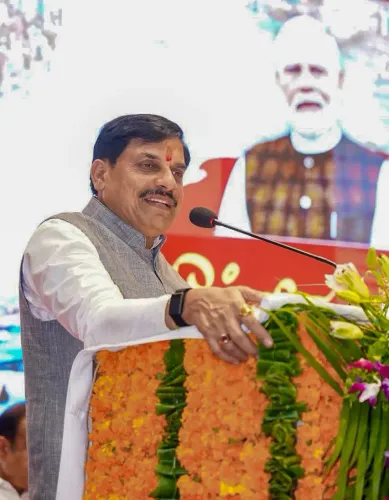
CM Mohan Yadav to Transfer Rs 1,835 Cr to 1.25 Cr Ladli Behna Women
Synopsis
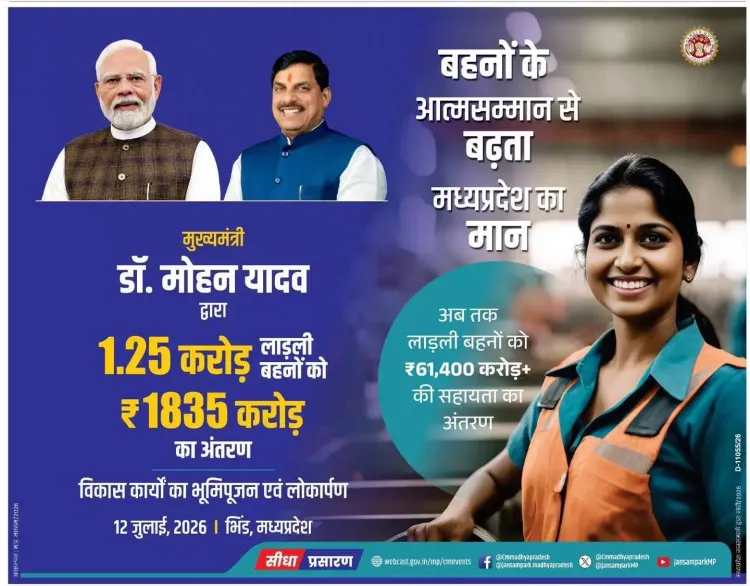
Chief Minister Dr. Mohan Yadav will transfer over Rs 1,835 crore to 1.25 crore Ladli Behna Yojana beneficiaries on 12 July 2026 at Lahar in Bhind district, reaffirming Madhya Pradesh's commitment to monthly direct cash support for women from economically weaker households.
Key Takeaways
Rs 1,835 crore will be transferred in a single disbursement cycle under the Ladli Behna Yojana on 12 July 2026 .
1.25 crore women beneficiaries across Madhya Pradesh will receive the funds directly into their bank accounts.
Mohan Yadav will preside over the event at Lahar, district Bhind .
The Ladli Behna Yojana was originally launched in March 2023 by former CM Shivraj Singh Chouhan with an initial monthly transfer of Rs 1,000 per beneficiary.
The Women and Child Development Department, MP is the nodal agency overseeing beneficiary verification and fund disbursement.
The Bhind event signals outreach to the Chambal region, historically underserved on development metrics.
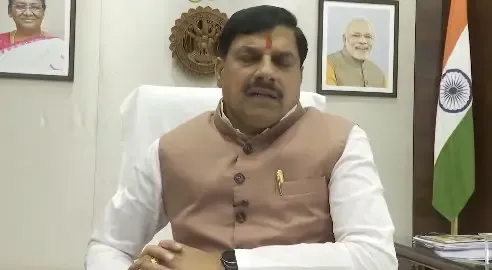
The Chief Minister's Office of Madhya Pradesh announced on Sunday, 12 July 2026 that Chief Minister Dr. Mohan Yadav will transfer more than Rs 1,835 crore into the accounts of 1.25 crore beneficiaries of the Ladli Behna Yojana at an event in Lahar, district Bhind.
Context
The official post, shared in Hindi, reads: 'बहनों के आत्मसम्मान से बढ़ता मध्यप्रदेश का मान' — 'Madhya Pradesh's honour grows with the self-respect of its sisters.' The announcement confirms that Dr. Mohan Yadav will personally preside over the disbursement at Lahar in the Bhind district of the state, underscoring the political and symbolic weight the government attaches to the monthly transfer.
The Women and Child Development Department of Madhya Pradesh (@mp_wcdmp) is the nodal agency for the scheme, coordinating beneficiary verification and direct bank transfers each month.
Policy Backdrop
The Ladli Behna Yojana was launched in March 2023 by the then Chief Minister Shivraj Singh Chouhan to provide monthly cash support to women aged 21 to 60 from economically weaker households. The scheme initially offered Rs 1,000 per month per beneficiary, with the government signalling periodic revisions to the transfer amount over subsequent cycles.
Madhya Pradesh has built one of the country's more extensive direct-benefit-transfer ecosystems for women, with the Ladli Behna scheme sitting at its centre. When Dr. Mohan Yadav assumed office in December 2023, continuity of the programme was among the earliest policy commitments made by the new administration, reflecting a cross-tenure consensus on women-targeted welfare spending.
Stakeholders and Impact
The 1.25 crore women set to receive funds span rural and semi-urban households across Madhya Pradesh, making the scheme one of the largest state-level cash-transfer programmes for women in India by beneficiary count. For many recipient families, the monthly credit represents a predictable, government-backed income supplement that supports household expenditure on nutrition, education, and health.
The choice of Lahar, Bhind — a district in the Chambal region historically associated with agrarian stress — as the venue for this transfer event signals an intent to highlight outreach in areas that have traditionally lagged on development indicators. District-level disbursement events also serve as direct administrative touchpoints, allowing officials to address grievances from beneficiaries on the ground.
What's Next
Observers will watch whether this transfer cycle is accompanied by any revision to the per-beneficiary monthly amount or an expansion of the eligibility age band — two parameters the government has adjusted in earlier cycles. The Women and Child Development Department is expected to publish updated beneficiary lists and transfer confirmations through its official portal after the event concludes.
Broader questions around the fiscal sustainability of large-scale direct-benefit transfers and their integration with complementary livelihood programmes are likely to shape the policy conversation around Ladli Behna in the months ahead.
Point of View
835 crore reaching 1.25 crore women in one cycle — illustrates how direct-benefit transfers have become the dominant instrument of welfare politics in large Hindi-belt states. By holding the event in Bhind, the Yadav administration is making a visible push into the Chambal belt ahead of what is likely to be a competitive local political calendar. The continuity of the scheme across the Chouhan-to-Yadav transition also signals that women-targeted cash transfers now enjoy a degree of programmatic stability unusual for flagship welfare schemes in India. The key policy question going forward is whether the state can layer skilling and livelihood components onto the cash-transfer base, or whether fiscal pressure will force a recalibration of the monthly amount.
NationPress
10 Oct 2026
Frequently Asked Questions
What is the Ladli Behna Yojana in Madhya Pradesh?
The Ladli Behna Yojana is a Madhya Pradesh government scheme that provides monthly cash transfers directly to the bank accounts of eligible women aged 21 to 60 from economically weaker households. It was launched in March 2023.
How much money will be transferred under Ladli Behna in July 2026?
Chief Minister Dr. Mohan Yadav will transfer more than Rs 1,835 crore to 1.25 crore beneficiaries on 12 July 2026 at an event in Lahar, Bhind.
Who launched the Ladli Behna Yojana?
The scheme was launched by then Chief Minister Shivraj Singh Chouhan in March 2023. It has continued under the current Chief Minister Dr. Mohan Yadav, who took office in December 2023.
Where is the July 2026 Ladli Behna transfer event being held?
The disbursement event is being held at Lahar in Bhind district of Madhya Pradesh on 12 July 2026.
Who is eligible for the Ladli Behna Yojana?
Women aged 21 to 60 from economically weaker sections in Madhya Pradesh are eligible. The Women and Child Development Department manages beneficiary registration and verification.