CM Yogi: 95,000 homes, 3.5 lakh toilets built in Sant Kabir Nagar
Synopsis
The Chief Minister's Office of Uttar Pradesh says Sant Kabir Nagar district received 95,000 homes under PMAY, 3.5 lakh household toilets under Swachh Bharat Mission, and PM-KISAN income support for over 3 lakh farmers across nine years of scheme implementation.
Key Takeaways
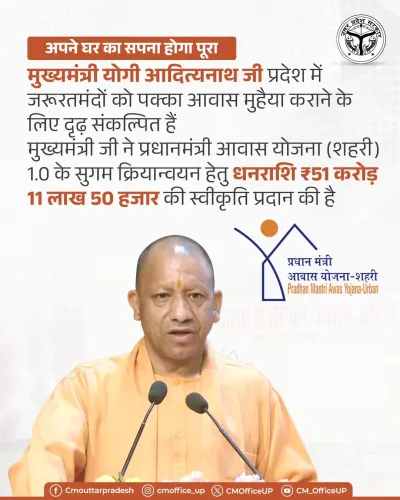
95,000 families in Sant Kabir Nagar have been provided housing over nine years, linked to the Pradhan Mantri Awas Yojana launched in 2015 .
3.5 lakh poor families in the district have received household toilets under the Swachh Bharat Mission, launched in October 2014 .
More than 3 lakh farmers in Sant Kabir Nagar receive ₹6,000 annually under PM-KISAN.
Chief Minister Yogi Adityanath has led Uttar Pradesh since March 2017 ; the nine-year window cited covers both central scheme launches and his government's tenure.
The post signals a district-level accountability approach, naming Sant Kabir Nagar — one of eastern UP's more economically vulnerable districts — as the unit of measurement.
In one of eastern Uttar Pradesh's most underserved districts, the numbers are stark and specific: 95,000 families housed, 3.5 lakh households equipped with toilets, and over 3 lakh farmers receiving direct cash support — all in the span of nine years. The Chief Minister's Office of Uttar Pradesh cited these figures on Tuesday, August 11, 2026, attributing them to Chief Minister Yogi Adityanath and framing them as the measurable dividend of sustained welfare delivery in Sant Kabir Nagar.
What nine years of scheme delivery looks like on the ground
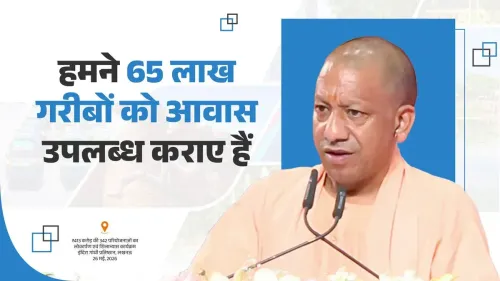
The post quotes CM Yogi directly: 'विगत 9 वर्षों में जनपद संत कबीर नगर में 95 हजार परिवारों को आवास और 3.5 लाख गरीब परिवारों के घरों में शौचालय उपलब्ध कराए गए हैं' — 'In the past 9 years, 95,000 families in Sant Kabir Nagar district have been provided housing, and 3.5 lakh poor families have been given toilets in their homes.' The claim ties together two flagship national programmes: the Pradhan Mantri Awas Yojana, launched in 2015 to build pucca houses for the rural poor, and the Swachh Bharat Mission, launched in October 2014 to end open defecation through household toilet construction.
Sant Kabir Nagar — a predominantly rural district in eastern UP — has historically ranked among the state's more economically vulnerable regions. Citing district-specific figures, rather than state-wide aggregates, is a deliberate communication choice: it makes the scale of delivery tangible for local audiences and harder to dismiss as abstract policy talk.
₹6,000 a year, 3 lakh farmers at a time
The third data point in the post concerns agriculture. Under the PM Kisan Samman Nidhi (PM-KISAN) scheme — introduced in February 2019 — eligible landholding farmer families receive ₹6,000 annually in three direct bank transfers. The CM's Office states that more than 3 lakh farmers in Sant Kabir Nagar are currently benefiting from this support every year. The scheme operates as a direct benefit transfer, bypassing intermediaries — a design choice that has made it one of the more politically visible rural welfare instruments of the past decade.
Eastern UP's welfare push as political messaging
The Yogi Adityanath government has made a consistent practice of publicising district-level implementation data for central schemes, particularly across eastern UP — a region that historically lagged in development indices but carries enormous electoral weight. Housing, sanitation, and farmer income support form the core of this narrative: three schemes, three visible outcomes, three numbers a voter in Sant Kabir Nagar can check against their own experience.
The post does not announce a new programme or a fresh allocation. Its signal is consolidation — that delivery, measured in houses built and toilets constructed, has been the defining work of the past nine years in this district.
Whether the numbers hold up to independent audit is a separate question. What is clear is that the Yogi government has chosen to stake its legacy in eastern UP on the granular, district-by-district scorecard — and Sant Kabir Nagar is today's exhibit.
Point of View
And credibility in rural eastern UP is built one household at a time. Citing Sant Kabir Nagar by name signals that the BJP's eastern UP outreach is now granular enough to be ward-level accountable, not just slogan-level aspirational. This kind of data-forward messaging also pre-empts opposition narratives about rural neglect by anchoring the debate in named numbers. The broader arc is clear: the state is building an audit trail of delivery that it intends to take into the next electoral cycle.
NationPress
11 Aug 2026
Frequently Asked Questions
How many houses were built in Sant Kabir Nagar under PM Awas Yojana?
According to the Chief Minister's Office of Uttar Pradesh, 95,000 families in Sant Kabir Nagar have been provided housing over the past nine years under schemes including the Pradhan Mantri Awas Yojana.
How many toilets were constructed in Sant Kabir Nagar under Swachh Bharat Mission?
The CM's Office stated that 3.5 lakh poor families in Sant Kabir Nagar have received household toilets, in line with the Swachh Bharat Mission's goal of ending open defecation.
How many farmers in Sant Kabir Nagar benefit from PM-KISAN?
More than 3 lakh farmers in Sant Kabir Nagar receive ₹6,000 annually under the PM Kisan Samman Nidhi scheme, according to the Chief Minister's Office.
What is PM-KISAN and how does it work?
PM-KISAN, launched in February 2019 , is a central government scheme that provides eligible landholding farmer families with ₹6,000 per year in three equal direct bank transfers, bypassing intermediaries.
Why is CM Yogi highlighting Sant Kabir Nagar specifically?
Sant Kabir Nagar is a predominantly rural, economically vulnerable district in eastern Uttar Pradesh. The Yogi government has made a pattern of citing district-specific welfare data in this region, which carries significant rural and electoral weight.