CM Yogi at RMLNLU's 5th Convocation in Lucknow
Synopsis
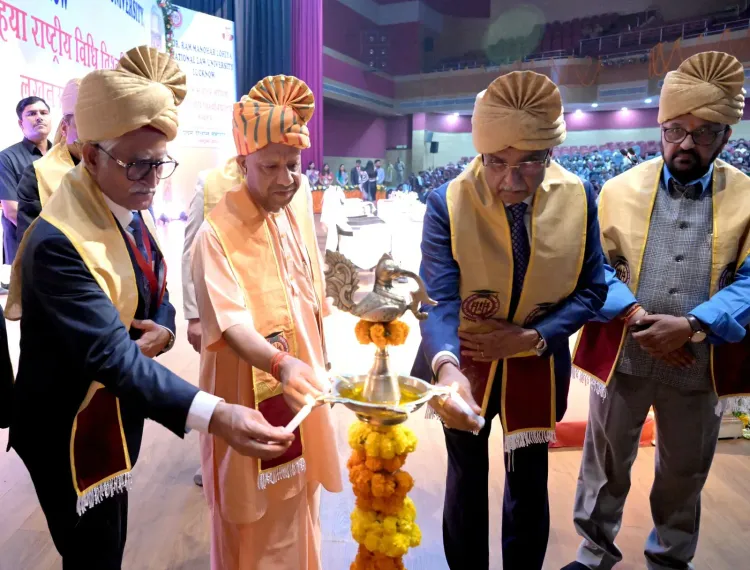
Chief Minister Yogi Adityanath attended the fifth convocation of Dr. Ram Manohar Lohia National Law University in Lucknow, honouring meritorious students alongside Supreme Court Justice Vikram Nath and Allahabad HC Chief Justice Arun Bhansali, invoking the Constitution as the bedrock of 'Viksit Bharat.'
Key Takeaways
CM Yogi Adityanath attended the fifth convocation of Dr.
Ram Manohar Lohia National Law University, Lucknow on 17 October 2026 .
Justice Vikram Nath (Supreme Court) and Justice Arun Bhansali (Chief Justice, Allahabad High Court) were present on the dais.
Meritorious students were awarded medals and commendation certificates at the ceremony.
CM Yogi framed Viksit Bharat and Ek Bharat, Shreshtha Bharat as goals rooted in the Indian Constitution.
The Chief Minister stated that the UP government has implemented 'rule of law' with 'complete honesty and commitment' since 2017 .
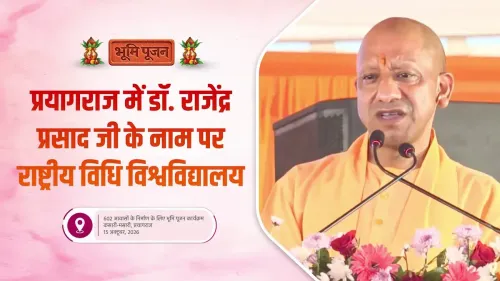
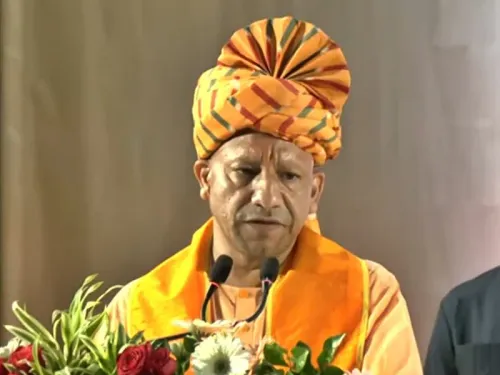
Law graduates collected medals and certificates of merit at Dr. Ram Manohar Lohia National Law University (RMLNLU) in Lucknow on Saturday, 17 October 2026 — and the Chief Minister's Office of Uttar Pradesh made clear this was more than a ceremony. Chief Minister Yogi Adityanath attended the university's fifth convocation, flanked by two of the country's most senior judicial figures, to deliver a pointed message about law, the Constitution, and the state's self-declared record on governance.
A convocation bench that drew attention
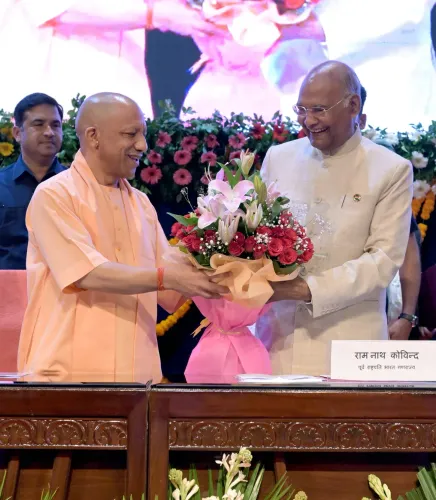
Seated alongside the Chief Minister were Justice Vikram Nath of the Supreme Court of India and Justice Arun Bhansali, Chief Justice of the Allahabad High Court — a rare convergence of executive and judicial authority on a single dais. Their presence lent the occasion a gravitas well beyond a routine prize-giving. Talented students were formally honoured with medals and commendation certificates in front of the assembled gathering.
The Constitution as the cornerstone of 'Viksit Bharat'
CM Yogi used the platform to anchor two of the central government's signature aspirations — 'Ek Bharat, Shreshtha Bharat' (One India, Superior India) and 'Viksit Bharat' (Developed India) — squarely in constitutional language. 'The most important foundation for realising the vision of a developed and unified India is India's Constitution,' he said, according to the official post. He added that his government had implemented the 'rule of law' across Uttar Pradesh 'with complete honesty and commitment, in keeping with the spirit of the Constitution.'
The framing was deliberate. Viksit Bharat is the Government of India's long-range development vision targeting 2047 — the centenary of Independence — and state governments have increasingly used institutional platforms like convocations to signal alignment with that agenda. For a law university, the constitutional hook was the most direct one available.
UP's law-and-order narrative, carried into the lecture hall
Since 2017, the Yogi administration has made 'rule of law' one of its defining political claims, repeatedly citing improvements in law-and-order as a governance benchmark. Delivering that message inside a national law university — to the next generation of lawyers and jurists, in the presence of sitting judges — was a strategic choice. It transforms a ceremonial occasion into a statement of institutional continuity: the executive, the judiciary, and the academy, sharing one stage.
For the graduates walking off that stage with their degrees, the subtext is hard to miss. The state wants them to see themselves not just as professionals in a competitive legal market, but as agents of a constitutional project that their own government claims to embody.
The next convocation cycle at RMLNLU — and any state moves on legal education infrastructure — will show whether the rhetoric translates into resources.
Point of View
A pattern seen across BJP-governed states. For legal academia, the challenge is whether such alignment opens policy doors for law universities or quietly narrows the space for independent constitutional scholarship.
NationPress
17 Oct 2026
Frequently Asked Questions
What is Dr. Ram Manohar Lohia National Law University?
Dr. Ram Manohar Lohia National Law University (RMLNLU) is a national law university located in Lucknow, Uttar Pradesh, established to provide quality legal education and research in India.
Who attended RMLNLU's fifth convocation in 2026?
Chief Minister Yogi Adityanath attended, along with Supreme Court Justice Vikram Nath and Allahabad High Court Chief Justice Arun Bhansali, who graced the ceremony as distinguished guests.
What did CM Yogi say at the RMLNLU convocation?
CM Yogi said that India's Constitution is the most important foundation for realising the visions of 'Ek Bharat, Shreshtha Bharat' and 'Viksit Bharat,' and that his government has implemented the rule of law with honesty and commitment.
What is Viksit Bharat?
Viksit Bharat is the Government of India's vision for transforming India into a fully developed nation by 2047, the centenary of Indian independence, and is frequently cited by both central and state governments as a policy goal.
Which judges were present at the RMLNLU convocation?
Justice Vikram Nath of the Supreme Court of India and Justice Arun Bhansali, Chief Justice of the Allahabad High Court, were both present at the fifth convocation of RMLNLU.