CM Yogi: Every UP City With 5 Lakh Population to Get Bypass
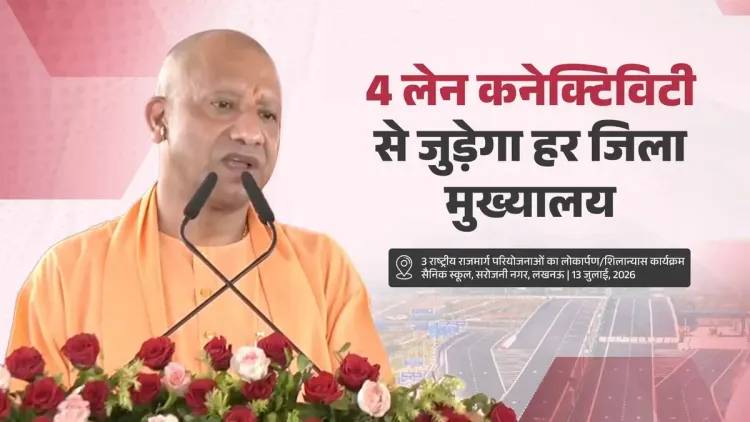
Synopsis
Chief Minister Yogi Adityanath has announced that every city in Uttar Pradesh with a population of five lakh or more will get a bypass road, setting a uniform population-based threshold for urban road infrastructure entitlement across the state.
Key Takeaways
The Chief Minister's Office of Uttar Pradesh announced on 13 July 2026 that every city with a population of five lakh or more will receive a bypass road.
CM Yogi Adityanath made the declaration, quoted directly in the post under the #YogiInfraDrive campaign hashtag.
The policy sets a uniform, population-based eligibility threshold rather than a case-by-case project approval model.
The announcement extends Uttar Pradesh's existing expressway and highway agenda into urban-tier connectivity.
Key next steps include tendering, land acquisition, and budget allocation for qualifying cities across the state's 75 districts .
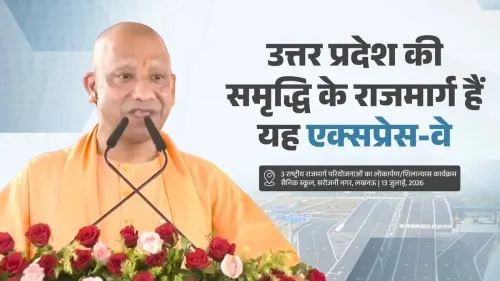
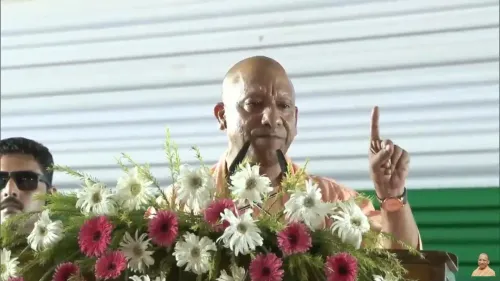
The Chief Minister's Office of Uttar Pradesh announced on Monday, 13 July 2026 that Chief Minister Yogi Adityanath has declared every city in the state with a population of five lakh or more will be provided a dedicated bypass road, signalling a significant expansion of urban infrastructure policy across Uttar Pradesh.
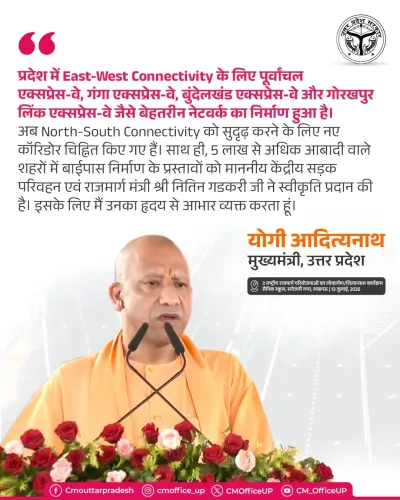
The post, shared under the hashtag #YogiInfraDrive, quoted the Chief Minister directly: 'अब 5 लाख की आबादी वाले हर शहर में एक बाईपास होगा' — translated as, 'Now every city with a population of five lakh will have a bypass.'
Context
Uttar Pradesh is India's most populous state, home to dozens of cities that have crossed or are approaching the five-lakh population mark. Urban congestion has been a persistent challenge in these rapidly growing centres, where arterial roads often double as transit corridors for inter-city freight and passenger movement, creating bottlenecks that affect daily commuters and commercial transport alike.
The announcement sets a clear, population-based threshold — five lakh residents — as the qualifying criterion for bypass entitlement, offering a uniform policy benchmark across all qualifying cities rather than a project-by-project approach.
Policy Backdrop
Since 2017, the Yogi Adityanath government has pursued an ambitious road and expressway agenda in Uttar Pradesh, including the Purvanchal Expressway, Bundelkhand Expressway, and the Ganga Expressway, positioning the state as a leader in highway infrastructure among large Indian states. Bypass construction has been part of this broader connectivity drive, aimed at decongesting urban cores and improving freight movement.
This announcement extends that logic deeper into the urban tier, moving beyond inter-city expressways to address intra-regional connectivity. It aligns with a wider national pattern in which state governments are coordinating with the Ministry of Road Transport and Highways to upgrade urban periphery roads as cities expand.
Stakeholders and Impact
City residents in qualifying towns stand to benefit from reduced traffic congestion in urban cores, while road transport operators — particularly truckers and logistics companies — would gain faster, unimpeded routes around populated centres. Businesses on existing arterial roads that currently bear heavy through-traffic may also see changed commercial dynamics once bypass routes divert that load.
The policy, if implemented uniformly, could affect a significant number of cities across Uttar Pradesh's 75 districts, given the state's population density and the number of urban agglomerations that meet or are near the five-lakh threshold.
What's Next
The key milestones to watch will be the initiation of tendering processes and land acquisition notifications for cities that qualify under the new threshold, as well as corresponding state budget allocations for road infrastructure in the coming fiscal cycle. Detailed project timelines and the list of cities covered under this policy are yet to be formally notified.
The announcement, made under the #YogiInfraDrive campaign, suggests the government intends to frame bypass construction as a systematic, rights-based entitlement for cities of a certain size — a framing that could set a precedent for how urban road infrastructure is planned and prioritised in Uttar Pradesh going forward.
Point of View
Using population size as an automatic trigger — a politically legible formula that is easy to communicate to voters across Uttar Pradesh's dense urban belt. By branding it under #YogiInfraDrive, the Chief Minister's Office is clearly building a campaign-ready infrastructure narrative ahead of future electoral cycles. The policy also signals an intent to extend the state's well-publicised expressway momentum into smaller cities that have so far been peripheral to the flagship project announcements. Whether implementation matches the ambition will depend heavily on land acquisition speed and budgetary follow-through, both of which have historically been pressure points for large-scale road projects in the state.
NationPress
13 Jul 2026
Frequently Asked Questions
Which cities in Uttar Pradesh will get a bypass under CM Yogi's new announcement?
Every city in Uttar Pradesh with a population of five lakh or more will be eligible for a bypass road under the policy announced by Chief Minister Yogi Adityanath on 13 July 2026. A formal list of qualifying cities has not yet been notified.
What is the YogiInfraDrive hashtag about?
'YogiInfraDrive' is a campaign hashtag used by the Chief Minister's Office of Uttar Pradesh to aggregate infrastructure-related announcements made by or attributed to Chief Minister Yogi Adityanath.
Why does Uttar Pradesh need bypasses for cities with five lakh population?
Cities of this size in Uttar Pradesh frequently experience severe traffic congestion because inter-city freight and passenger transport passes through urban cores. Bypasses redirect through-traffic around city centres, easing congestion for residents and improving logistics efficiency.
When will construction of these bypasses begin in Uttar Pradesh?
No specific construction timeline has been announced. The next steps to watch are tendering processes, land acquisition notifications, and state budget allocations for the identified cities.
How does this bypass policy fit into Uttar Pradesh's broader road infrastructure plans?
Since 2017, the Yogi Adityanath government has built or initiated several major expressways across the state. This bypass policy extends that infrastructure push to urban-tier cities, applying a population-based threshold to systematise road connectivity upgrades.