CM Yogi Extends Two Farmer Safety Schemes to 2030
Synopsis
Uttar Pradesh CM Yogi Adityanath's office approved a five-year extension of two farmer accident relief schemes through June 2030 and cleared interest-free working capital for cooperatives under the Price Support Scheme to strengthen pulse and oilseed procurement.
Key Takeaways
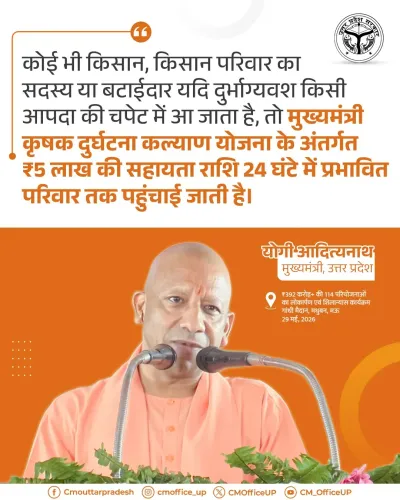
Mukhyamantri Krishak Durghatna Sahayata Yojana extended from 1 July 2025 to 30 June 2030 , ensuring uninterrupted accident relief for farmers and families.
Mukhyamantri Khet-Khalihan Agnikand Durghatna Sahayata Yojana similarly extended to cover fire losses in fields and storage areas through 2030 .
Cooperative institutions will receive interest-free working capital to strengthen pulse and oilseed procurement under the Price Support Scheme .
CM Yogi Adityanath reviewed compliance with previous board decisions and directed officials to complete all farmer-welfare works on time and with quality.
Both scheme extensions and the procurement capital proposals were approved at a single board meeting on 31 July 2026 .
Two of Uttar Pradesh's most critical farmer welfare nets just got a five-year lease on life. The Chief Minister's Office of Uttar Pradesh announced on 31 July 2026 that a board meeting chaired by Chief Minister Yogi Adityanath approved the extension of two accident relief schemes for farmers — stretching their coverage from 1 July 2025 to 30 June 2030.
Two schemes, one safety net for UP's farmers
The Mukhyamantri Krishak Durghatna Sahayata Yojana and the Mukhyamantri Khet-Khalihan Agnikand Durghatna Sahayata Yojana — the first covering general farm accidents, the second targeting fire losses in fields and storage areas — will now run through the end of the decade. The announcement confirmed that farmers and their families will continue to receive 'time-bound financial assistance' (samayabaddh aarthik sahayata) when disaster strikes, without a gap in coverage.
For a state where millions of smallholder families depend on a single harvest, an accident or a field fire can be financially catastrophic. These schemes exist precisely to absorb that shock — and the five-year renewal signals the government's intent to make that protection structural, not seasonal.
Interest-free capital for cooperative pulse and oilseed procurement
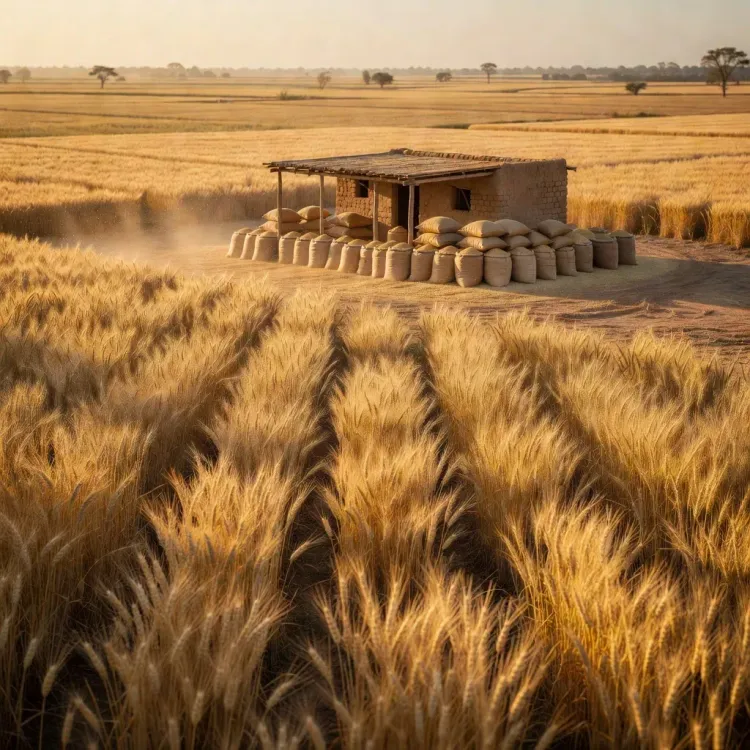
The same meeting approved a second set of proposals: interest-free working capital for cooperative institutions engaged in the procurement of pulses and oilseeds under the Price Support Scheme. The move is designed to make the procurement machinery more effective — giving cooperatives the liquidity they need to buy directly from growers at remunerative prices, without the drag of borrowing costs.
Pulses and oilseeds are among the most price-volatile crops in India's agricultural basket. When procurement falters, it is the grower — not the trader — who absorbs the loss. Interest-free working capital removes one structural barrier that has historically slowed cooperative buying operations.
CM Yogi's compliance review: no decision left on paper
Chief Minister Yogi Adityanath used the meeting to review implementation of decisions taken at the previous board session, directing officials to complete all farmer-welfare and development works 'within the stipulated timeframe and with quality' (nidhaarit samay-seema mein gunavattapoorn dhang se). The directive signals that the government is tracking execution, not just approvals.
Uttar Pradesh has maintained a pattern of periodic reviews and renewals of agricultural welfare mechanisms — integrating direct accident relief with procurement-side support to build a more complete coverage architecture for its farming population.
With schemes now locked in through 2030 and cooperatives set to receive interest-free capital, the question shifts from policy design to delivery — and CM Yogi made clear that the administration intends to hold itself to that standard.
Point of View
Though actual delivery to beneficiaries will be the true measure of intent.
NationPress
15 Sept 2026
Frequently Asked Questions
What is the Mukhyamantri Krishak Durghatna Sahayata Yojana?
It is a Uttar Pradesh state scheme that provides time-bound financial assistance to farmers and their families in the event of accidents. The scheme has now been extended to run from 1 July 2025 to 30 June 2030 .
What does the Mukhyamantri Khet-Khalihan Agnikand Durghatna Sahayata Yojana cover?
This UP scheme offers financial compensation to farmers who suffer losses due to fire incidents in their fields or storage areas. It has been extended alongside the accident scheme through 30 June 2030 .
Why is interest-free working capital being given to cooperatives in UP?
The interest-free working capital is meant to help cooperative institutions buy pulses and oilseeds more efficiently under the Price Support Scheme , removing borrowing costs that have historically slowed procurement and hurt growers.
When were these decisions approved?
The decisions were approved at a board meeting chaired by CM Yogi Adityanath on 31 July 2026 , as announced by the Chief Minister's Office of Uttar Pradesh.
What did CM Yogi direct officials at the meeting?
CM Yogi reviewed compliance with decisions from the previous board meeting and directed all officials to complete farmer-welfare and development works within the stipulated timeframe and with quality.