CM Yogi: UP Provides Free Ration to 15 Cr, Health Cover to 10 Cr
Synopsis
The Chief Minister's Office of Uttar Pradesh states that 15 crore poor families are receiving free ration and 10 crore people are covered under Ayushman Bharat's ₹5 lakh health insurance in the state, highlighting the scale of welfare delivery under CM Yogi Adityanath.
Key Takeaways
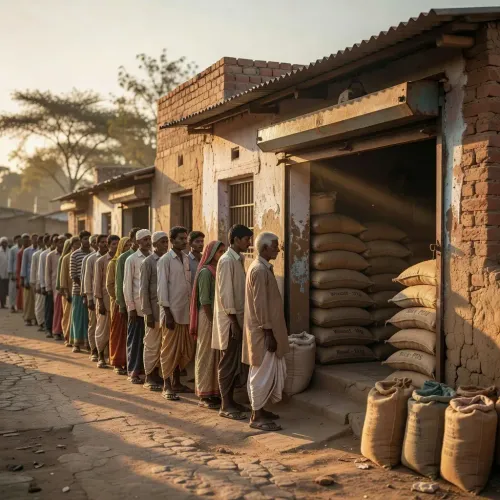
15 crore poor families in Uttar Pradesh are currently receiving free ration under the state's food security delivery system.
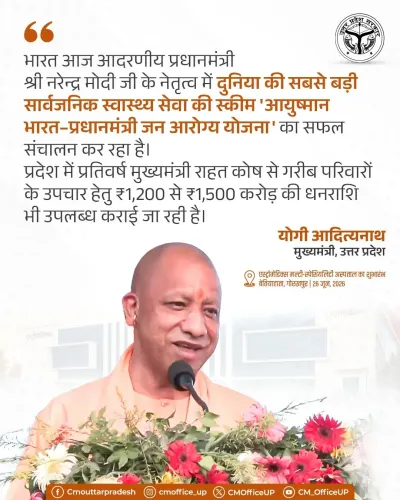
10 crore people in UP are covered under Ayushman Bharat Pradhan Mantri Jan Arogya Yojana with a health cover of up to ₹5 lakh .
The announcement was made by the Chief Minister's Office of Uttar Pradesh , quoting CM Yogi Adityanath , on 7 July 2026 .
Free ration delivery is linked to the Pradhan Mantri Garib Kalyan Anna Yojana , a central scheme first launched in 2020 .
Ayushman Bharat PM-JAY was launched nationally in 2018 , with Uttar Pradesh among its largest implementing states.
State budget allocations for 2026-27 and central decisions on PMGKAY extension will determine continuity of these benefits.
The Chief Minister's Office of Uttar Pradesh, citing Chief Minister Yogi Adityanath, announced on Tuesday, 7 July 2026 that the state is currently providing free ration to 15 crore poor families and health insurance cover of ₹5 lakh to 10 crore people under the Ayushman Bharat scheme.
Context
The post, shared from the official CMO handle, quotes CM Yogi Adityanath directly: 'आज उत्तर प्रदेश में 15 करोड़ गरीब परिवारों को फ्री में राशन सुविधा का लाभ व 10 करोड़ लोगों को आयुष्मान भारत योजना के अंतर्गत ₹5 लाख का स्वास्थ्य कवर उपलब्ध कराया जा रहा है' ['Today in Uttar Pradesh, 15 crore poor families are being provided free ration and 10 crore people are being given ₹5 lakh health cover under the Ayushman Bharat scheme']. The statement underscores the scale at which Uttar Pradesh, India's most populous state, is implementing centrally sponsored welfare programmes.
Policy Backdrop
The free ration delivery draws on the Pradhan Mantri Garib Kalyan Anna Yojana (PMGKAY), a central scheme launched in 2020 during the COVID-19 pandemic to provide free food grains to beneficiaries under the National Food Security Act (NFSA). The scheme was extended in successive phases through 2024, with state governments including Uttar Pradesh integrating it into their existing public distribution infrastructure.
On the health side, Ayushman Bharat Pradhan Mantri Jan Arogya Yojana (PM-JAY) was launched nationally in 2018, offering cashless secondary and tertiary hospitalisation cover of up to ₹5 lakh per family per year to economically weaker households. Uttar Pradesh has been among the largest implementing states since the scheme's inception, given the sheer size of its eligible population.
Stakeholders and Impact
The primary beneficiaries are NFSA-listed families and Ayushman Bharat-eligible households across Uttar Pradesh's 75 districts. For rural and peri-urban households with limited income, access to free staple grains reduces monthly expenditure pressure, while the ₹5 lakh health cover can prevent catastrophic out-of-pocket medical spending. Together, the two programmes represent a significant component of the state's social safety net for economically weaker sections.
Uttar Pradesh has consistently positioned itself as a high-volume implementer of centrally sponsored welfare schemes, aligning state-level delivery systems with national priorities on nutrition security and universal health coverage. This pattern is visible across multiple BJP-governed states that have emphasised direct benefit delivery to lower-income groups.
What's Next
Attention will now turn to state budget allocations for welfare scheme continuation in 2026-27 and any central government decisions regarding further extension or restructuring of PMGKAY timelines. The sustainability of health coverage under Ayushman Bharat will also depend on reimbursement rates negotiated between the state, empanelled hospitals, and the National Health Authority. How Uttar Pradesh manages last-mile delivery of both programmes in its most underserved districts will be a key indicator of on-ground effectiveness.
Point of View
Timed to reinforce the Yogi administration's positioning as an effective implementer of both central and state-level social protection programmes. Citing two headline numbers — 15 crore ration beneficiaries and 10 crore health cover recipients — in a single statement is a communications strategy that ties state governance credentials to nationally visible schemes ahead of potential electoral cycles. The pattern fits a broader BJP-ruled-state playbook of converting central scheme delivery into state-level political capital. Whether the figures translate into verified, on-ground coverage will be the measure that policy analysts and opposition parties are likely to scrutinise.
NationPress
6 Oct 2026
Frequently Asked Questions
How many people in Uttar Pradesh get free ration?
According to the Chief Minister's Office of Uttar Pradesh, 15 crore poor families in the state are currently receiving free ration, linked to the central Pradhan Mantri Garib Kalyan Anna Yojana and the National Food Security Act framework.
How many people are covered under Ayushman Bharat in UP?
The CMO of Uttar Pradesh states that 10 crore people in the state are covered under Ayushman Bharat Pradhan Mantri Jan Arogya Yojana , which provides up to ₹5 lakh in cashless health insurance per year.
What is the Ayushman Bharat scheme and who is eligible?
Ayushman Bharat PM-JAY , launched in 2018 , provides up to ₹5 lakh per family per year for secondary and tertiary hospitalisation at empanelled hospitals. Eligibility is based on socio-economic criteria drawn from the Socio-Economic Caste Census, targeting economically weaker and vulnerable households.
What is PMGKAY and is it still active in 2026?
Pradhan Mantri Garib Kalyan Anna Yojana (PMGKAY) is a central scheme that began in 2020 to provide free food grains to NFSA beneficiaries. It was extended multiple times through 2024 ; the status of its continuation in 2026 depends on central government decisions, which remain a key policy watch point.
What welfare schemes is CM Yogi Adityanath implementing in UP?
CM Yogi Adityanath has highlighted two major welfare programmes: free ration delivery to 15 crore poor families under the food security framework, and health cover of ₹5 lakh to 10 crore people under Ayushman Bharat . These are among the flagship central schemes being implemented at scale in Uttar Pradesh .