CM Yogi Highlights Ayushman Bharat, UP Relief Fund for Poor
Synopsis
The Chief Minister's Office of Uttar Pradesh, quoting CM Yogi Adityanath, highlighted India's AB-PMJAY as the world's largest public health scheme and stated that UP provides ₹1,200–₹1,500 crore annually from the CM Relief Fund for poor families' treatment, underscoring the state's dual-track healthcare safety net.
Key Takeaways
Ayushman Bharat–PMJAY , launched in September 2018 , provides up to ₹5 lakh annual health insurance per family for secondary and tertiary care to economically weaker sections.
CM Yogi Adityanath 's office stated that Uttar Pradesh allocates ₹1,200 crore to ₹1,500 crore annually from the Chief Minister's Relief Fund for treatment of poor families.
The scheme is described as the world's largest public health insurance initiative, operating under Prime Minister Narendra Modi 's leadership.
Uttar Pradesh , India's most populous state, is one of the largest implementation bases for AB-PMJAY .
The state's relief fund spending supplements the central scheme, reflecting a federal model of layered health welfare.
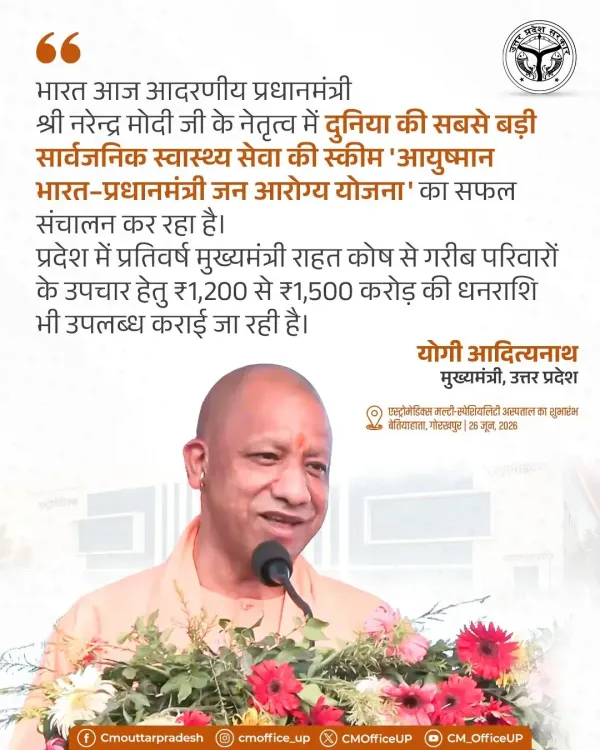
The Chief Minister's Office of Uttar Pradesh, citing Chief Minister Yogi Adityanath, on Friday, 26 June 2026, underscored the reach of Ayushman Bharat–Pradhan Mantri Jan Arogya Yojana (AB-PMJAY) and stated that the state annually channels ₹1,200 crore to ₹1,500 crore from the Chief Minister's Relief Fund for the treatment of poor families in Uttar Pradesh.
Context
The post, attributed to CM Yogi Adityanath, describes AB-PMJAY as the world's largest public health insurance scheme, operating under the leadership of Prime Minister Narendra Modi. Translated from Hindi, the statement reads: 'Bharat aaj aadaraniya Pradhan Mantri Shri Narendra Modi ji ke netritva mein duniya ki sabse badi saarvajanik swasthya seva ki scheme Ayushman Bharat–Pradhan Mantri Jan Arogya Yojana ka safal sanchalan kar raha hai' — 'India today, under the respected leadership of Prime Minister Narendra Modi, is successfully running the world's largest public health service scheme, Ayushman Bharat–Pradhan Mantri Jan Arogya Yojana.' The statement also notes a separate, parallel state-level commitment: an annual allocation from the Chief Minister's Relief Fund to cover treatment costs for economically weaker families.
Policy Backdrop
Ayushman Bharat–PMJAY was launched nationally in September 2018 as a flagship welfare initiative of the Modi government, providing up to ₹5 lakh annual health insurance coverage per family for secondary and tertiary hospitalisation. The scheme targets economically weaker sections and was designed to cover over 10 crore poor and vulnerable families across India. Uttar Pradesh, as the country's most populous state, represents one of the largest implementation footprints for the scheme.
Beyond the central entitlement, states across India have increasingly supplemented AB-PMJAY with their own allocations — either through state insurance top-ups or discretionary relief funds — to address gaps in coverage and reduce out-of-pocket healthcare expenditure. The CM Yogi Adityanath government's stated annual commitment of ₹1,200 crore to ₹1,500 crore from the Chief Minister's Relief Fund represents this federal welfare model in practice, layering state spending atop the central scheme.
Stakeholders and Impact
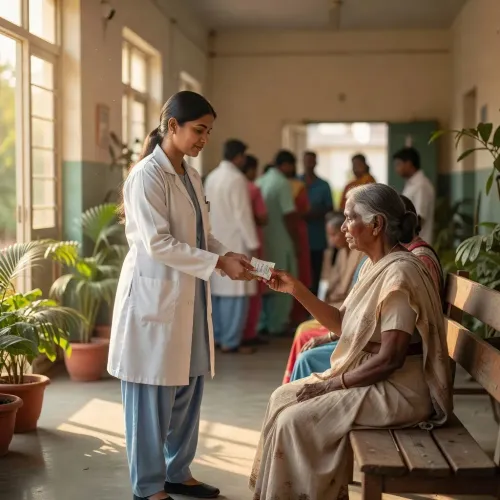
The primary beneficiaries of both mechanisms are poor families in Uttar Pradesh who face high out-of-pocket costs for hospitalisation. AB-PMJAY provides a cashless, paperless entitlement at empanelled hospitals, while the CM Relief Fund channel offers discretionary support for cases that may fall outside the central scheme's ambit or exceed its limits. Together, the two streams are positioned as a comprehensive safety net for healthcare access in the state.
For the broader healthcare ecosystem in Uttar Pradesh — including district hospitals, private empanelled facilities, and community health centres — the sustained state allocation signals continued government engagement with publicly funded health delivery. Families in rural and semi-urban districts, where private healthcare costs can be catastrophic, stand to benefit most directly from these combined interventions.
What's Next
Observers and policy analysts will watch Uttar Pradesh's annual budget documents for formal confirmation of the CM Relief Fund allocation figures cited in the post. Any revisions to AB-PMJAY empanelment criteria, claim limits, or beneficiary lists at the state level will also shape how effectively these twin mechanisms reach the intended population. The statement, made in the context of ongoing national health policy discourse, signals that CM Yogi Adityanath intends to keep healthcare spending for the poor as a visible political and administrative priority heading into the next budget cycle.
Point of View
Generous partner in India's flagship health welfare architecture — not merely a passive implementer. By citing a specific annual range of ₹1,200–₹1,500 crore from the CM Relief Fund, the communication attempts to demonstrate state-level ownership of healthcare outcomes beyond what the central entitlement provides. This fits a broader pattern among large BJP-governed states of visibly co-branding central welfare schemes while layering their own contributions to reinforce the party's welfare credentials. With assembly politics always in the background in Uttar Pradesh, such statements also serve as a reminder to voters that the state government is independently investing in their health security.
NationPress
25 Sept 2026
Frequently Asked Questions
What is Ayushman Bharat–PMJAY and who benefits from it?
Ayushman Bharat–Pradhan Mantri Jan Arogya Yojana is India's central government health insurance scheme launched in September 2018. It provides up to ₹5 lakh annual coverage per family for secondary and tertiary hospitalisation, targeting economically weaker sections, with the scheme designed to cover over 10 crore poor and vulnerable families nationally.
How much does Uttar Pradesh spend from the CM Relief Fund on healthcare for the poor?
According to a post by the Chief Minister's Office of Uttar Pradesh attributed to CM Yogi Adityanath, the state allocates ₹1,200 crore to ₹1,500 crore annually from the Chief Minister's Relief Fund for the treatment of poor families in the state.
Is Ayushman Bharat available in Uttar Pradesh?
Yes, Uttar Pradesh implements Ayushman Bharat–PMJAY as one of the largest states in India. The state government has also stated it supplements the central scheme with its own annual allocations from the CM Relief Fund to support poor families' treatment costs.
What is the CM Relief Fund in Uttar Pradesh used for?
The Chief Minister's Relief Fund in Uttar Pradesh is a state-level discretionary fund. According to the CM's office, it is used among other purposes to provide financial assistance for the medical treatment of poor families, with an annual stated allocation of ₹1,200–₹1,500 crore for this purpose.
Who launched Ayushman Bharat and when?
Ayushman Bharat–PMJAY was launched by the government of Prime Minister Narendra Modi in September 2018 as a flagship public health insurance initiative to reduce out-of-pocket healthcare costs for India's economically weaker sections.