CM Yogi Launches 'Ek Ped Maa Ke Naam' Drive from Gorakhpur

Synopsis
Uttar Pradesh Chief Minister Yogi Adityanath launched the 'Ek Ped Maa Ke Naam' Vriksharopan Mahayagya-2026 from Gorakhpur on 12 July, targeting 35 crore saplings planted in a single day across 26 state departments, with carbon-credit certificates for participating farmers.
Key Takeaways
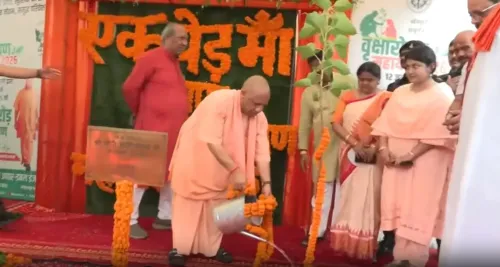
Chief Minister Yogi Adityanath launched the 'Ek Ped Maa Ke Naam' Mahayagya-2026 from Gorakhpur on 12 July 2026 .
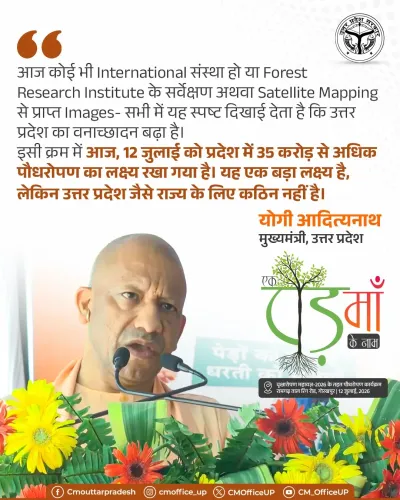
The drive targets 35 crore saplings to be planted in a single day, up from 25 crore in the 2021 edition.
26 state government departments are coordinating the campaign simultaneously across Uttar Pradesh.
Farmers participating in the drive will receive carbon-credit certificates , marking a novel economic incentive for smallholders.
The campaign includes planting of the sacred Triveni cluster, establishment of Vikas Vatikas , and planting of Maulshri saplings.
The launch is anchored at the Gorakhnath Math in Gorakhpur, the spiritual seat headed by the Chief Minister himself.
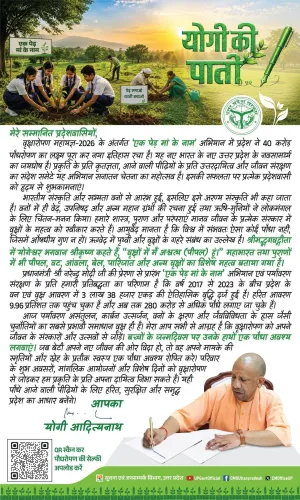
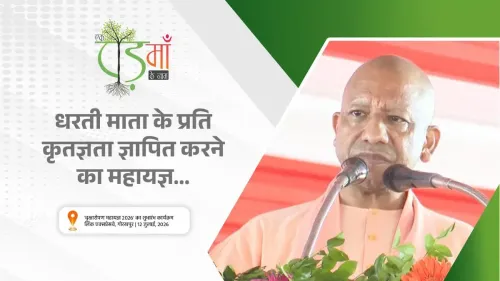
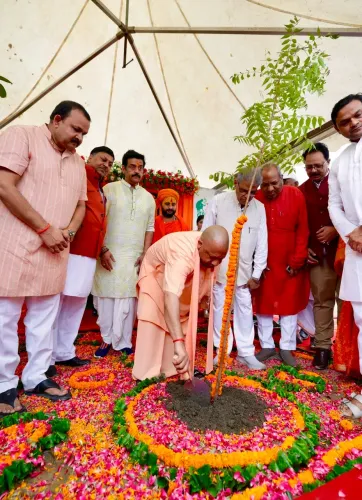
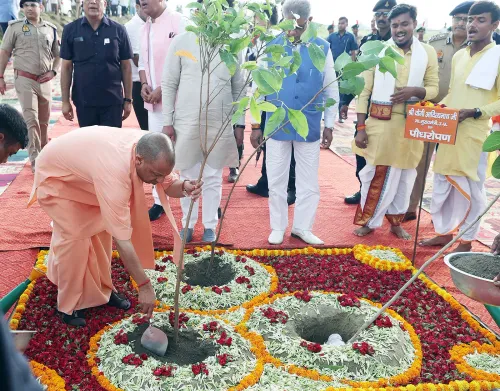
Uttar Pradesh Chief Minister Yogi Adityanath on Sunday, 12 July 2026, announced the launch of the 'Ek Ped Maa Ke Naam' Vriksharopan Mahayagya-2026 from Gorakhpur, describing the campaign as a sacred civic duty and calling on citizens across the state to participate in what he termed a 'Jan-Mahayagya' for a greener Uttar Pradesh.
Context
Posting in Hindi on 12 July 2026, Chief Minister Adityanath wrote: 'Vriksharopan Eshwariya karya hai' ['Tree plantation is a divine act']. He described the drive as 'a resolve for the service of creation, the worship of humanity, and the protection of the future.' The campaign is being launched from Gorakhpur, the city that houses the Gorakhnath Math — the ancient seat of the Nath yogic lineage and the spiritual institution that Adityanath heads as its Mahant.
The campaign takes its name and moral framing from the idea of planting a tree in one's mother's honour, blending environmental action with familial and devotional sentiment. The Chief Minister invited citizens to 'become part of this Jan-Mahayagya by planting one tree in your mother's name.'
Policy Backdrop
The 2026 drive targets the plantation of 35 crore saplings in a single day, coordinated across 26 state government departments. According to the post, the campaign will include the planting of a sacred Triveni — a cluster of three religiously significant trees — the establishment of Vikas Vatikas (development gardens), the distribution of carbon-credit certificates to farmers, and the planting of Maulshri saplings.
Uttar Pradesh has built a track record of large-scale, single-day plantation drives, having coordinated a 25-crore sapling drive in 2021 across multiple departments. These campaigns draw on the institutional framework of India's National Afforestation Programme, operational since the 1980s, and align with India's Nationally Determined Contribution (NDC) commitments to expand forest and tree cover. The 2016-17 Van Mahotsav campaigns in the state established the model of linking religious sites with mass afforestation drives.
The inclusion of carbon-credit certificates for farmers marks a notable policy experiment, signalling the state's intent to connect smallholder agriculture with emerging voluntary carbon markets.
Stakeholders and Impact
The campaign directly involves farmers, who stand to receive carbon-credit certificates as an economic incentive for planting and nurturing trees on their land. Urban citizens are also addressed in the Chief Minister's call to action, broadening the drive beyond rural or forest-department-led planting.
The religious framing — launching from the tапобхуми (tapobhoomi, 'land of austerity') of Shiv-avatari Mahayogi Guru Shri Gorakhnath Ji — is designed to mobilise participation through cultural resonance, a pattern that has characterised Uttar Pradesh's environmental campaigns in recent years. The involvement of 26 state departments indicates a whole-of-government administrative push rather than a single-ministry initiative.
What's Next
Attention will now turn to post-campaign verification: official reports on the number of saplings actually planted and their survival rates will be the key metric by which the drive's success is measured. The first round of carbon-credit certificate distributions to farmers will also be closely watched as a pilot for scaling such mechanisms across the state.
If the 35-crore target is achieved and documented, it would represent a significant escalation over the 2021 benchmark and could position Uttar Pradesh as a reference model for large-scale afforestation coordination among Indian states.
Point of View
Reinforcing a political brand built on the convergence of faith and governance. The addition of carbon-credit certificates for farmers is the most substantively new policy element, signalling an attempt to plug state-level afforestation into global climate finance mechanisms. How rigorously the sapling survival data is tracked and published will determine whether this drive is remembered as a landmark environmental initiative or a well-organised single-day mobilisation.
NationPress
10 Oct 2026
Frequently Asked Questions
What is the 'Ek Ped Maa Ke Naam' campaign in Uttar Pradesh?
'Ek Ped Maa Ke Naam' is a Uttar Pradesh government tree-plantation campaign that encourages citizens to plant a sapling in honour of their mothers. The 2026 edition, launched on 12 July from Gorakhpur, targets 35 crore saplings planted in a single day across 26 state departments.
How many trees will be planted in UP's 2026 plantation drive?
The 2026 'Ek Ped Maa Ke Naam' drive targets 35 crore (350 million) saplings to be planted in a single day, coordinated across 26 state government departments simultaneously.
What are carbon-credit certificates for farmers in UP?
As part of the 2026 plantation drive, Uttar Pradesh will distribute carbon-credit certificates to farmers who participate in tree planting. These certificates are intended to connect smallholder farmers with voluntary carbon markets, offering an economic incentive for environmental action.
Why is the 2026 tree plantation drive launched from Gorakhpur?
Gorakhpur is the site of the Gorakhnath Math, the ancient seat of the Nath yogic lineage and the institution headed by Chief Minister Yogi Adityanath. The launch from this location frames the campaign within a spiritual and cultural context significant to the Nath tradition.
What is a Triveni planting and why is it part of the UP drive?
A Triveni refers to the planting of three religiously significant trees together, symbolising sacred confluence. Its inclusion in the 2026 drive blends environmental goals with Hindu devotional practice, a pattern seen in Uttar Pradesh's afforestation campaigns since at least 2016-17.