CM Yogi on World Youth Skills Day: Shared Future Needs Shared Opportunity
Synopsis
On World Youth Skills Day 2026, CM Yogi Adityanath's office invoked UNESCO's 'Skills for a Shared Future' theme, arguing that a shared future requires shared opportunities — and a government with the vision to deliver them.
Key Takeaways
World Youth Skills Day is observed on 15 July every year, established by a UN General Assembly resolution in 2014 .
UNESCO's theme for this year is 'Skills for a Shared Future' ( साझा भविष्य के लिए कौशल ).
CM Yogi Adityanath stated that a shared future is only possible when opportunities are shared, and that requires a government with the right vision.
Uttar Pradesh operates the UP Skill Development Mission (established 2013), aligned with the national Pradhan Mantri Kaushal Vikas Yojana .
The statement reinforces the state government's positioning as the institutional enabler of equitable access to vocational training across 75 districts .
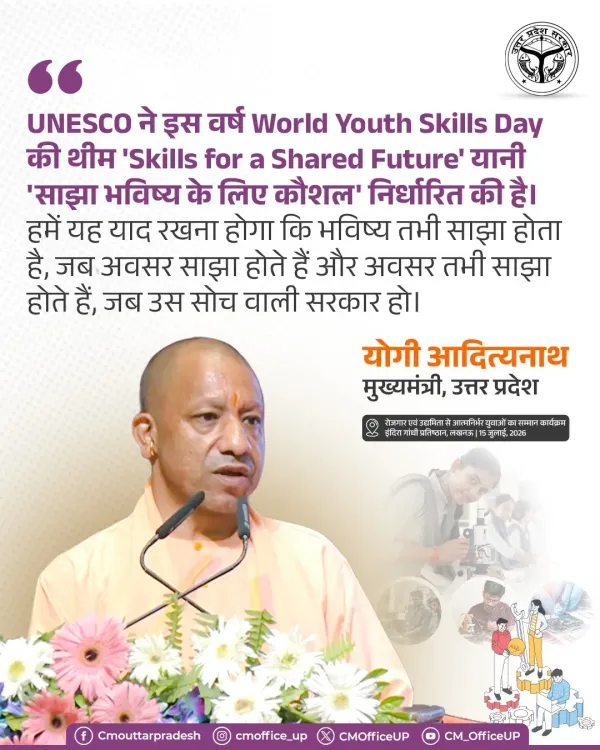
The Chief Minister's Office of Uttar Pradesh, on Wednesday, 15 July 2026, shared a statement by Chief Minister Yogi Adityanath marking World Youth Skills Day, invoking UNESCO's theme for the year — 'Skills for a Shared Future' ('साझा भविष्य के लिए कौशल') — to argue that equitable opportunity is the foundation of any shared future, and that only a government with the right vision can deliver it.
Context
World Youth Skills Day is observed every year on 15 July, a date established by a United Nations General Assembly resolution in 2014 to spotlight the importance of technical and vocational skills in reducing youth unemployment worldwide. UNESCO anchors the annual observance with a global theme that guides messaging by member states and their governments. This year's theme — 'Skills for a Shared Future' — frames skills not merely as individual assets but as instruments of collective economic progress.
CM Yogi Adityanath quoted directly in the post: 'हमें यह याद रखना होगा कि भविष्य तभी साझा होता है, जब अवसर साझा होते हैं और अवसर तभी साझा होते हैं, जब उस सोच वाली सरकार हो' — translated: 'We must remember that the future becomes shared only when opportunities are shared, and opportunities are shared only when there is a government with that vision.'
Policy Backdrop
The statement arrives against a well-established policy architecture. At the national level, the Skill India Mission, launched in 2015, and the flagship Pradhan Mantri Kaushal Vikas Yojana (PMKVY) have aimed to provide short-term, industry-linked training to millions of young Indians. Uttar Pradesh, as the country's most populous state, carries an outsized share of that demographic responsibility.
The state has operated the Uttar Pradesh Skill Development Mission since 2013, progressively aligning its programmes with national sector skill councils and certification standards under the current government. The mission targets youth trainees across vocational institutes spread through the state's 75 districts, seeking to convert the state's demographic scale into a productive economic dividend rather than a liability.
Stakeholders and Impact
The primary beneficiaries of skill-development policy in Uttar Pradesh are young people — particularly those from semi-urban and rural backgrounds who may lack access to formal higher education but can gain industry-ready certification through vocational pathways. Vocational training institutes, sector skill councils, and industry partners are the institutional stakeholders that translate policy commitments into on-ground outcomes.
The Chief Minister's framing — tying shared opportunity explicitly to the character of the governing administration — carries a political dimension as well, positioning the state government as the enabler of equitable access to skills and, by extension, to economic mobility. This kind of messaging is consistent with how state governments use global observance days to reinforce domestic policy narratives.
What's Next
Observers will watch for concrete follow-through: updated enrolment and certification targets under the Uttar Pradesh Skill Development Mission, announcements of new industry partnerships or training centre expansions, and the state's participation in national review meetings on vocational education reform. The alignment of UNESCO's global theme with state-level programming will be tested by whether Uttar Pradesh translates the rhetoric of shared opportunity into measurable gains for its youth population in the months ahead.
Point of View
The Chief Minister's Office frames the state administration as the indispensable bridge between aspiration and opportunity. The implicit contrast drawn — between a government 'with that vision' and one without — is a well-worn but effective rhetorical device ahead of any electoral cycle. More substantively, the statement keeps Uttar Pradesh visible in the national skills conversation at a moment when states are competing to demonstrate implementation credentials under centrally sponsored schemes. Whether the messaging translates into accelerated enrolment or certification numbers under the UP Skill Development Mission will determine its lasting policy weight.
NationPress
15 Jul 2026
Frequently Asked Questions
What is World Youth Skills Day and when is it observed?
World Youth Skills Day is a global observance held every year on 15 July , established by the United Nations General Assembly in 2014 to highlight the importance of equipping young people with skills for employment and entrepreneurship.
What is UNESCO's theme for World Youth Skills Day 2026?
UNESCO designated 'Skills for a Shared Future' ( साझा भविष्य के लिए कौशल ) as the theme for World Youth Skills Day this year, emphasising collective economic progress through skills development.
What did CM Yogi Adityanath say on World Youth Skills Day 2026?
CM Yogi Adityanath said that a future becomes shared only when opportunities are shared, and opportunities are shared only when there is a government with the right vision — linking equitable skill access directly to governance quality.
What is the Uttar Pradesh Skill Development Mission?
The Uttar Pradesh Skill Development Mission was established in 2013 to provide vocational training to youth across the state, aligned with national sector skill councils and the Pradhan Mantri Kaushal Vikas Yojana .
How does Skill India relate to World Youth Skills Day?
India's Skill India Mission , launched in 2015 , including the Pradhan Mantri Kaushal Vikas Yojana , directly supports the goals of World Youth Skills Day by funding short-term, industry-linked training for millions of young Indians, with states like Uttar Pradesh implementing programmes at scale.