CM Yogi Pays Tribute to Ratan Tata on His Death Anniversary

Synopsis
On Ratan Tata's first death anniversary, Uttar Pradesh Chief Minister Yogi Adityanath paid tribute on X, calling the industrialist's life an exemplary legacy of hard work, humility, and service — a union of industry, innovation, and social responsibility.
Key Takeaways
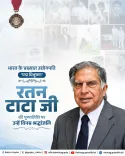
UP CM Yogi Adityanath posted a tribute to Padma Vibhushan Ratan Tata on his death anniversary on October 9, 2026 .
The tribute was written in Hindi and described Tata's life as an 'exemplary legacy of hard work, humility, and service.' CM Yogi specifically highlighted the combination of industry, innovation, and social responsibility as the defining pillars of Tata's heritage.
Ratan Tata led the Tata Group as chairman for over two decades and was awarded the Padma Vibhushan , India's second-highest civilian honour.
Tributes from across the political spectrum reflect Tata's rare status as a non-partisan national icon.
A year after India lost one of its most admired industrialists, Uttar Pradesh Chief Minister Yogi Adityanath paused on Friday, October 9, 2026 to honour the memory of Padma Vibhushan Ratan Tata — a man who built an empire without losing his humanity.
In a post on X, CM Yogi offered his tribute in Hindi: 'Bharat ke mahan udyogapati... unka jeevan parishram, vinmrata aur seva ki anukarneey virasat hai' — 'The life of India's great industrialist is an exemplary legacy of hard work, humility, and service.' He described Tata's journey as one that held together industry, innovation, and social responsibility in rare, equal measure.
The man being remembered: Ratan Tata's enduring stature
Ratan Naval Tata, who led the Tata Group as its chairman for over two decades, transformed what was already India's largest conglomerate into a globally recognised name. He steered acquisitions — Jaguar Land Rover and Corus Steel among the most consequential — that announced Indian industry's arrival on the world stage. Yet he was perhaps equally celebrated for the culture of ethical capitalism and deep philanthropy he embedded into Tata's DNA.
Tata was awarded the Padma Vibhushan, India's second-highest civilian honour, in recognition of his extraordinary contribution to trade and industry. Beyond balance sheets, he was known for his genuine warmth — a rare public figure who earned admiration that crossed every line of politics, region, and generation.
Why this anniversary resonates across political lines
That a BJP chief minister leading India's most populous state chose to mark Ratan Tata's death anniversary speaks to the singular space Tata occupied in the national imagination. He was not a partisan figure. His legacy — rooted in nation-building enterprise, ethical leadership, and the Tata Trusts' vast charitable work — commands respect that no political boundary contains.
CM Yogi's tribute is brief but precise: it singles out the union of 'udyog, navachar evam samajik uttardayitva' — industry, innovation, and social responsibility — as the core of Tata's heritage. That framing matters. It is a reminder that India's most admired business leaders are measured not only by the wealth they created, but by the values they refused to abandon while creating it.
Ratan Tata's first death anniversary arrives as India debates the kind of capitalism it wants — and the kind of industrialists it wants to celebrate. His name, invoked quietly on a Friday morning, carries the weight of that whole conversation.
Point of View
Though brief, is politically telling — it positions BJP governance as aligned with ethical, nation-building capitalism at a time when India's industrial policy is under scrutiny. By foregrounding social responsibility alongside industry and innovation, the CM frames Tata's model as aspirational, not merely historical. The tribute also underscores how Tata's legacy transcends political ownership — no single party can claim him, which is itself a measure of his stature. For a chief minister governing India's largest state economy, invoking Tata is simultaneously a cultural gesture and a policy signal.
NationPress
9 Oct 2026
Frequently Asked Questions
When did Ratan Tata pass away?
Ratan Tata passed away in October 2025, and his first death anniversary falls on October 9, 2026, which is when CM Yogi Adityanath posted this tribute.
Why did CM Yogi Adityanath pay tribute to Ratan Tata?
CM Yogi paid tribute on Ratan Tata's death anniversary, honouring his legacy of combining industry, innovation, and social responsibility — qualities the CM described as an exemplary inheritance for India.
What was Ratan Tata's highest civilian honour?
Ratan Tata was awarded the Padma Vibhushan , India's second-highest civilian honour, for his extraordinary contribution to trade and industry.
What did CM Yogi say about Ratan Tata on X?
CM Yogi wrote in Hindi that Ratan Tata's life — rooted in industry, innovation, and social responsibility — is an exemplary legacy of hard work, humility, and service to the nation.
What is Ratan Tata known for beyond the Tata Group?
Beyond leading the Tata Group to global prominence through acquisitions like Jaguar Land Rover, Ratan Tata was celebrated for his deep philanthropy through the Tata Trusts and his reputation for ethical, humble leadership.