CM Yogi Pitches UP as India's Logistics Powerhouse
Synopsis
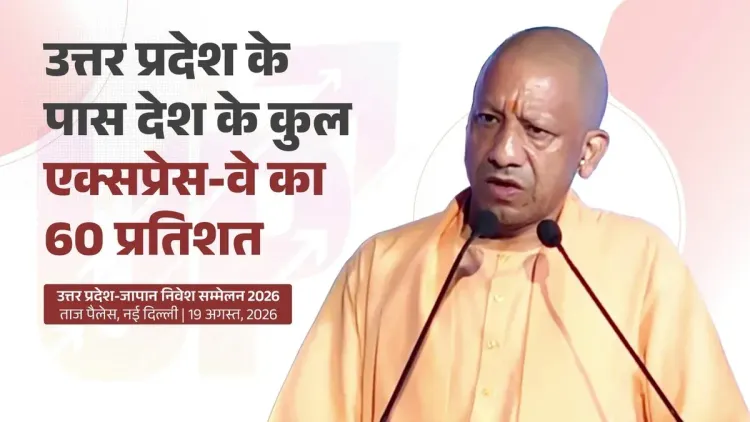
Chief Minister Yogi Adityanath declares Uttar Pradesh holds 60% of India's expressways, 17 airports, metro networks in 7 cities, the country's first rapid rail and inland waterway, and 2 Dedicated Freight Corridors — positioning the state as India's premier multimodal logistics destination.
Key Takeaways
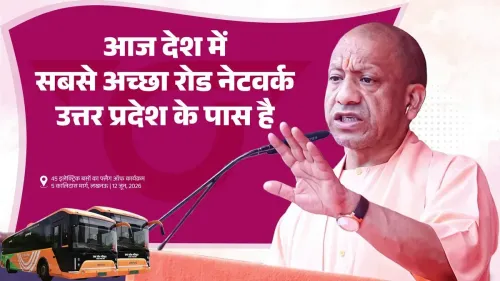
Uttar Pradesh claims 60% of India's total expressway length, the largest share of any state.
The state has 17 airports and metro networks operational or under development in 7 cities .
The Delhi-Meerut Regional Rapid Transit System , India's first rapid rail corridor, opened in 2023 .
Two Dedicated Freight Corridors , including the Eastern DFC, run through UP, cutting cargo transit times.
National Waterway-1 on the Ganga river adds an inland freight route to the state's multimodal stack.
The pitch aligns with national programmes PM Gati Shakti and the National Infrastructure Pipeline to attract industrial investment.
Sixty percent of India's expressways pass through a single state. That state is Uttar Pradesh — and Chief Minister Yogi Adityanath wants every investor, logistics company, and policymaker to know it.
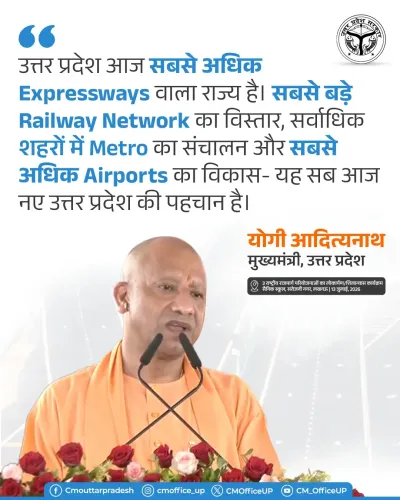
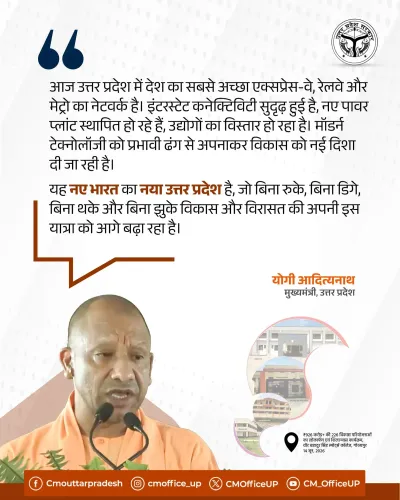
On Wednesday, 19 August 2026, the Chief Minister's Office of Uttar Pradesh quoted CM Yogi Adityanath laying out the state's multimodal infrastructure stack in striking terms: 17 airports, India's largest rail network, metro connectivity across 7 cities, the country's first rapid rail and inland waterway, and 2 Dedicated Freight Corridors — all converging to offer what he called 'global-standard, seamless connectivity.'
From Expressways to Waterways: What UP's Network Actually Covers
The expressway claim sits at the heart of the pitch. Uttar Pradesh has built or expanded multiple high-speed corridors since 2017 — the Agra-Lucknow Expressway and the Purvanchal Expressway among the most prominent — stitching together a state the size of many countries. Paired with the Eastern Dedicated Freight Corridor, one of two major freight rail arteries running through UP, the network is designed to take pressure off passenger lines while dramatically cutting cargo transit times.
The inland waterway reference points to National Waterway-1, the Ganga river route that the state has promoted as a low-cost freight alternative. And the rapid rail milestone is concrete: the Delhi-Meerut Regional Rapid Transit System became India's first such corridor when it opened in 2023, a flagship of the state's connectivity ambitions.
The Investment Case CM Yogi Is Building
This is not a routine infrastructure update — it is a competitive positioning statement. Uttar Pradesh, India's most populous state, has long been seen as a logistics bottleneck rather than a hub. The current administration has worked to flip that narrative, aligning state projects with national programmes such as PM Gati Shakti and the National Infrastructure Pipeline to attract industrial and warehousing investment.
The audience is clear: logistics companies weighing distribution footprints, manufacturers scouting factory locations, and global investors comparing large Indian states. A dense multimodal network — road, rail, air, metro, and waterway — lowers the last-mile cost equation that often decides where capital lands.
What Comes Next for UP's Connectivity Push
The metro map is still expanding. Cities including Kanpur and Varanasi are in various stages of corridor rollout, and airport capacity additions remain on the agenda. Each new link tightens the network effect the Chief Minister is already selling.
For a state that was once defined by its connectivity gaps, the infrastructure scorecard being presented in Lucknow today reads like a different story entirely — one written in concrete, steel, and moving freight.
Point of View
Not just a governance update — it signals that Uttar Pradesh is actively competing with states like Maharashtra and Gujarat for logistics and manufacturing capital. The framing around 'global-standard, seamless connectivity' maps directly onto the Centre's PM Gati Shakti vocabulary, suggesting a coordinated effort to leverage national branding for state-level investment attraction. If the metro and airport expansion pipeline delivers on schedule, UP's multimodal density could genuinely reorder India's industrial geography over the next decade. The political dividend for the BJP government in Lucknow is equally clear: infrastructure optics ahead of any election cycle are among the most durable.
NationPress
20 Aug 2026
Frequently Asked Questions
Does Uttar Pradesh really have 60% of India's expressways?
Chief Minister Yogi Adityanath's office has stated that UP holds 60% of India's total expressway length, citing the state's multiple high-speed corridors built or expanded since 2017, including the Agra-Lucknow and Purvanchal expressways. This specific statistic is a government claim and has not been independently verified in public data available before August 2026.
Which cities in Uttar Pradesh have metro networks?
UP has metro connectivity across 7 cities according to the Chief Minister's Office. Lucknow and Kanpur are among the most advanced systems; corridors in cities such as Varanasi and Agra are at various stages of development.
What is India's first rapid rail and where is it?
The Delhi-Meerut Regional Rapid Transit System is India's first rapid rail corridor. It connects Delhi to Meerut in Uttar Pradesh and became operational in 2023.
What are the Dedicated Freight Corridors passing through UP?
Two Dedicated Freight Corridors traverse Uttar Pradesh — the Eastern DFC is the most significant, designed to move heavy freight on a dedicated rail network and decongest the busy passenger lines on the same routes.
Why is Uttar Pradesh promoting its infrastructure so aggressively?
UP is positioning itself as a logistics and manufacturing hub to attract domestic and foreign investment, competing with industrially advanced states. The push aligns with national programmes like PM Gati Shakti and the National Infrastructure Pipeline, which incentivise multimodal connectivity.