CM Yogi to Build Museum at K.D. Singh 'Babu' Haveli in Barabanki
Synopsis
Chief Minister Yogi Adityanath has announced that Uttar Pradesh will conserve the Barabanki haveli of hockey legend K.D. Singh 'Babu' and build a museum in his name, honouring a player who dedicated his life to Indian hockey in the 1940s and 1950s.
Key Takeaways
The Chief Minister's Office of Uttar Pradesh announced the project on 20 July 2026 , quoting CM Yogi Adityanath directly.
Singh 'Babu's historic haveli in Barabanki will be conserved by the state government.
A museum dedicated to K.D.
Singh 'Babu' will be constructed at the haveli site.
The player represented India in international hockey through the 1940s and 1950s and is already commemorated by the K.D.
Singh Babu Stadium in Lucknow .
The project aligns with Uttar Pradesh's broader policy of converting heritage sites linked to prominent figures into public cultural spaces.
No specific project timeline or budget has been disclosed in the announcement.
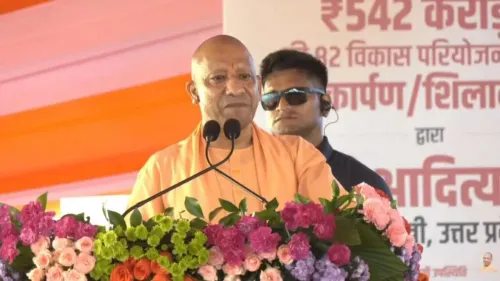
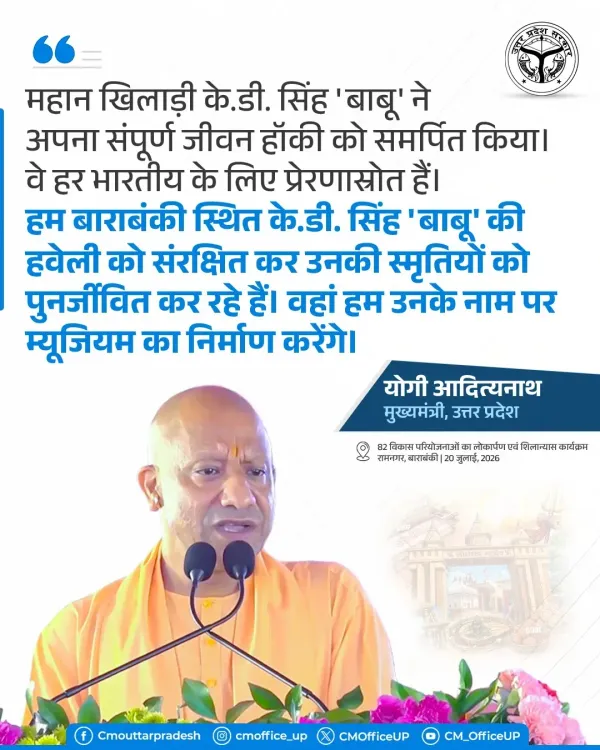
The Chief Minister's Office of Uttar Pradesh announced on Monday, 20 July 2026, that the state government will conserve the historic haveli of legendary hockey player K.D. Singh 'Babu' in Barabanki and construct a museum in his name at the site, with the statement attributed directly to Chief Minister Yogi Adityanath.
Context
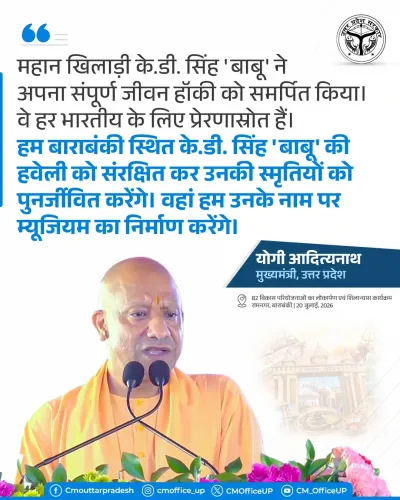
The post, shared by the official CMO account, quotes CM Yogi Adityanath as saying: 'Mahan khiladi K.D. Singh Babu ne apna sampurna jeevan hockey ko samarpit kiya' ('The great player K.D. Singh Babu dedicated his entire life to hockey'). He described the player as 'a source of inspiration for every Indian' and announced that the government is 'reviving his memories by conserving the haveli located in Barabanki' and will 'construct a museum in his name there.'
K.D. Singh 'Babu' was a celebrated Indian field hockey player who represented the country in international competitions through the 1940s and 1950s, earning wide recognition for his skill and complete commitment to the sport. His legacy has long been acknowledged in Uttar Pradesh — the K.D. Singh Babu Stadium in Lucknow was named in his honour, making the Barabanki haveli project a further extension of that public recognition.
Policy Backdrop
The announcement fits within a broader cultural-heritage policy that Uttar Pradesh has pursued under the current government: systematically identifying private residences and sites associated with prominent figures from sports, literature, and public life, and converting them into publicly accessible heritage spaces. Similar efforts have been undertaken across other Indian states for athletes and national icons, but UP has positioned such projects as part of both its heritage conservation mandate and its sports-tourism circuit.
The proposed Barabanki museum would serve a dual purpose — preserving artefacts and memorabilia connected to K.D. Singh 'Babu' while potentially integrating the site into hockey development programmes and regional tourism routes. The state's decision to anchor the museum at the player's actual haveli, rather than a purpose-built facility, signals an emphasis on authentic heritage rather than symbolic commemoration alone.
Stakeholders and Impact
Residents of Barabanki district stand to benefit most directly, both through the cultural recognition the project brings to their region and through potential tourism inflows once the museum becomes operational. Sports enthusiasts and heritage conservationists across the country have long called for greater institutional memory around India's hockey golden era, a period in which K.D. Singh 'Babu' was a central figure.
For the broader hockey community, a dedicated museum at the player's ancestral home would offer a rare, place-specific window into mid-twentieth-century Indian sports history. Schools, academies, and hockey federations could incorporate the site into outreach and inspiration programmes for young athletes.
What's Next
No specific timeline or budget figure for the project was stated in the announcement. The government's next steps will likely include formal heritage documentation of the Barabanki haveli, appointment of a conservation agency, and a design brief for the museum. Observers will watch whether the site is eventually linked to the K.D. Singh Babu Stadium in Lucknow as part of a unified sports-heritage corridor in the state. Any further announcements on additional sports-personality heritage sites in Uttar Pradesh will signal how wide the government intends to cast this initiative.
Point of View
Moving beyond symbolic stadium-naming toward site-specific preservation. Anchoring the museum at K.D. Singh 'Babu's actual haveli in Barabanki lends the project an authenticity that purpose-built facilities typically lack, and positions the district on a potential sports-tourism map. The move also signals an attempt to reclaim and celebrate the state's contribution to India's hockey golden era at a time when the sport is seeing renewed national interest. Whether the project translates into a functioning heritage institution or remains an aspirational announcement will depend on the execution timelines and institutional support that follow.
NationPress
21 Jul 2026
Frequently Asked Questions
Who was K.D. Singh 'Babu' and why is he famous?
K.D. Singh 'Babu' was a legendary Indian field hockey player from Uttar Pradesh who represented India in international competitions during the 1940s and 1950s . He is celebrated for dedicating his entire life to the sport and is regarded as one of the inspirational figures of India's hockey golden era.
Where is K.D. Singh 'Babu's haveli located?
The haveli of K.D. Singh 'Babu' is located in Barabanki , a district in central Uttar Pradesh, and it is at this site that the state government plans to build a museum in his name.
What has CM Yogi Adityanath announced for K.D. Singh 'Babu'?
CM Yogi Adityanath announced on 20 July 2026 that the Uttar Pradesh government will conserve the Barabanki haveli of K.D. Singh 'Babu' and construct a museum dedicated to the hockey legend at that site.
Is there already a stadium named after K.D. Singh 'Babu'?
Yes, the K.D. Singh Babu Stadium in Lucknow is named in his honour, making the proposed Barabanki museum a further extension of the public recognition already accorded to the player in Uttar Pradesh.
When will the K.D. Singh 'Babu' museum in Barabanki be completed?
No specific completion timeline or budget has been disclosed in the government's announcement as of 20 July 2026 . Further details on the project schedule are awaited.