CM Yogi's UP Blends Tradition With Welfare Push
Synopsis
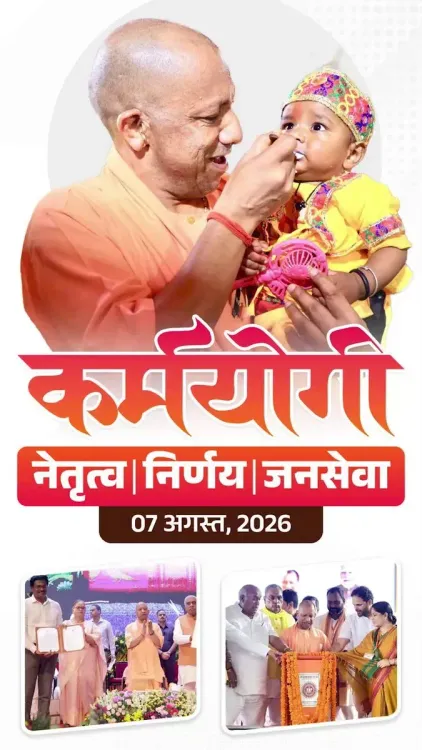
The Chief Minister's Office of Uttar Pradesh reaffirmed CM Yogi Adityanath's dual-track governance model on 7 August 2026 — pairing revival of traditional craft enterprises through the ODOP framework with broad-based public welfare delivery to drive holistic state development.
Key Takeaways
The Chief Minister's Office of Uttar Pradesh posted on 7 August 2026 reaffirming the state's development philosophy under CM Yogi Adityanath .
The Hindi message translates as 'Honour to tradition, expansion to development,' framing tradition and welfare as co-equal growth pillars.
The One District One Product (ODOP) scheme, launched in 2018 , is the flagship vehicle for branding and scaling district-specific crafts across UP.
CM Yogi Adityanath has led Uttar Pradesh since March 2017 , consistently pairing indigenous enterprise promotion with welfare programme expansion.
The next budget speech or annual ODOP progress report will be the key moment to assess updated allocations and beneficiary data.
Honouring the past while building for the future — that is the twin mandate Chief Minister Yogi Adityanath has staked Uttar Pradesh's development story on. The Chief Minister's Office of Uttar Pradesh underscored this direction on Friday, 7 August 2026, sharing a message that frames the state's growth as a deliberate marriage of cultural preservation and public welfare delivery.
The post, in Hindi, reads: 'Parampara ko samman, vikas ko vistar' — 'Honour to tradition, expansion to development.' It states that a new Uttar Pradesh, under CM Yogi Adityanath's leadership, is giving traditional enterprises a fresh identity while driving the state's holistic development through public-welfare projects.
The ODOP blueprint behind the message
The ideological thread running through this communication traces back to the One District One Product (ODOP) scheme, launched in 2018. The programme was designed to brand and scale district-specific crafts and micro-enterprises — from Varanasi's silk weaving to Agra's leather goods — giving artisans a formal market identity and supply-chain support they had historically lacked. It became a template for how the Yogi administration sought to monetise UP's extraordinary craft heritage rather than treat it as a museum piece.
Since CM Yogi Adityanath took office in March 2017, the state government has consistently paired indigenous-enterprise promotion with welfare programme expansion — a dual track that shows up repeatedly in official communications. The logic is straightforward: artisan income alone cannot lift a state of 250 million people; large-scale welfare delivery has to run alongside it.
What the dual-track strategy signals
The framing — tradition and welfare as co-equal pillars — is deliberate political messaging, but it also reflects a real administrative choice. States that have tried to industrialise rapidly without anchoring growth in existing community skills have often seen social dislocation; UP's approach attempts to avoid that by treating the craft economy as a foundation, not a footnote.
Traditional artisans and welfare beneficiaries are the stated stakeholders, and the breadth of that pairing — from a weaver in Muradabad to a beneficiary of a housing or ration scheme in Gorakhpur — is precisely the political and administrative ambition the message is projecting.
The next concrete test of how far this ambition has translated into numbers will come at the state's next budget speech or the annual ODOP progress report, where updated allocations and beneficiary counts will either validate or complicate the narrative.
Point of View
The ODOP model has served as a durable brand: it lets the government claim cultural stewardship while pointing to measurable economic outputs. The dual-track approach also insulates the administration from the standard critique that rapid development bypasses artisans and rural communities. Whether the next round of official data bears out the ambition will determine how much political capital this messaging actually holds.
NationPress
22 Sept 2026
Frequently Asked Questions
What does the UP Chief Minister's Office post on 7 August 2026 say?
The post, in Hindi, states that under CM Yogi Adityanath's leadership, a new Uttar Pradesh is giving traditional enterprises a fresh identity while accelerating holistic development through public-welfare projects — summarised in the phrase 'honour to tradition, expansion to development.'
What is the One District One Product (ODOP) scheme in Uttar Pradesh?
ODOP is a scheme launched in 2018 by the Uttar Pradesh government to identify, brand, and scale one specific traditional craft or product per district, providing artisans with market access, supply-chain support, and a formal economic identity.
When did Yogi Adityanath become Chief Minister of Uttar Pradesh?
Yogi Adityanath became Chief Minister of Uttar Pradesh in March 2017 and has continued to lead the state administration since then.
How does Uttar Pradesh balance traditional crafts with modern welfare programmes?
The state government has pursued a dual-track strategy since 2017 — promoting indigenous enterprises like district crafts through ODOP while simultaneously expanding centrally and state-sponsored welfare schemes covering housing, rations, and other public services.
What should I watch for next on UP's traditional enterprise and welfare policy?
The next state budget speech and the annual ODOP progress report are the key moments to look for updated financial allocations and beneficiary numbers that will test how far the stated ambitions have translated into ground-level outcomes.