CM Yogi: UP School Dropout Rate Down to 3-4%
Synopsis
Uttar Pradesh Chief Minister Yogi Adityanath announced on 1 July 2026 that the state's school dropout rate has dropped to 3–4 per cent, attributing the decline to sustained education and retention programmes including Samagra Shiksha and NEP 2020 implementation.
Key Takeaways
CM Yogi Adityanath stated on 1 July 2026 that Uttar Pradesh 's school dropout rate has fallen to 3–4 per cent .
The claim draws on years of state-level interventions including Operation Kayakalp (launched 2017–18 ) for school infrastructure upgrades.
The centrally sponsored Samagra Shiksha scheme and mid-day meal programme have been key retention levers in the state.
NEP 2020 set a national target of near-zero dropouts by 2030 , within which UP 's figures are being tracked.
The UDISE+ annual report will be the authoritative source for independent verification of the 3–4 per cent figure.
Sustained improvement could position Uttar Pradesh as a benchmark for large-state school retention under national education policy.
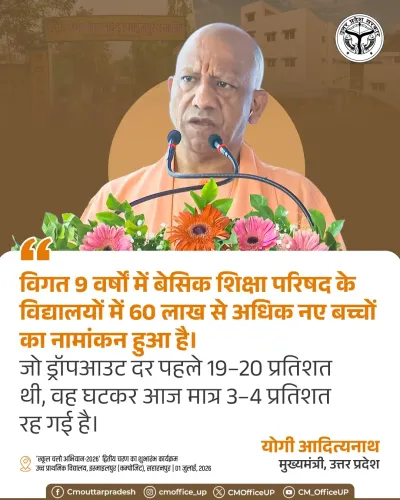
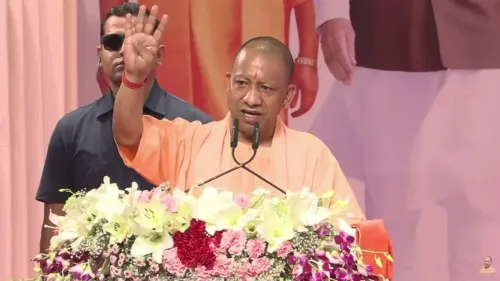
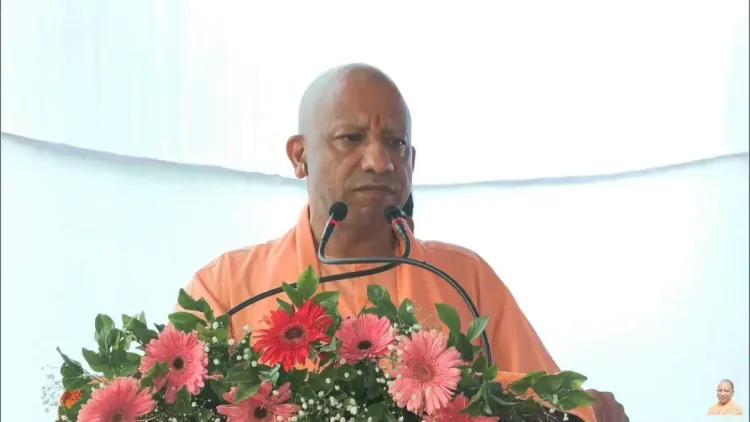
Uttar Pradesh Chief Minister Yogi Adityanath on Wednesday, 1 July 2026, claimed that the school dropout rate in Uttar Pradesh has fallen sharply to 3–4 per cent, highlighting the figure as a marker of the state's progress in school education and student retention.
Context
In his post, CM Yogi Adityanath stated — 'उत्तर प्रदेश में आज ड्रॉप आउट रेट घटकर 3-4% रह गया है' ('Today in Uttar Pradesh, the dropout rate has come down to 3–4 per cent') — framing the decline as a direct outcome of the state government's education initiatives over the past several years. The remark signals the administration's intent to project Uttar Pradesh as a turnaround story in school retention, a metric historically associated with the state's large and dispersed rural population.
Dropout rates in Uttar Pradesh had long been among the higher figures recorded in major Indian states, driven by poverty, seasonal migration, child labour, and inadequate school infrastructure. The state's education bureaucracy has been working under the framework of the centrally sponsored Samagra Shiksha scheme, which integrates elementary and secondary school programmes, to address these structural causes.
Policy Backdrop
The policy architecture behind this claimed improvement spans more than a decade. The Right to Education Act, 2009 established the legal foundation for free and compulsory schooling for children aged 6 to 14, creating state obligations around enrollment and retention. Uttar Pradesh subsequently launched Operation Kayakalp in 2017–18 to upgrade physical school infrastructure — toilets, classrooms, drinking water — factors directly linked to retention, particularly for girls.
The National Education Policy 2020 (NEP 2020) set an ambitious national target of near-zero dropouts by 2030, emphasising foundational literacy in early grades as the primary lever. Samagra Shiksha, the integrated central scheme, channels funds to states for enrollment drives, teacher training, and the mid-day meal programme, all of which the Uttar Pradesh government has cited in previous communications as contributors to improved attendance and retention figures.
Annual school data in India is tracked through the UDISE+ (Unified District Information System for Education Plus) platform, which aggregates school-level data across states. The next UDISE+ report will be the authoritative public record against which the 3–4 per cent figure cited by CM Yogi can be formally verified.
Stakeholders and Impact
The primary beneficiaries of any sustained dropout decline are school-age children across Uttar Pradesh, particularly those from rural and economically marginalised households where the risk of early school exit has historically been highest. Improved retention at the elementary level has downstream effects on secondary enrollment, literacy rates, and long-term employability.
For the state education department, the figure represents a policy deliverable ahead of the Uttar Pradesh 2026–27 budget cycle, where education allocations are expected to come under scrutiny. Rural families stand to benefit most if the retention gains translate into improved learning outcomes, a linkage that education researchers consistently flag as the critical next step beyond enrollment and attendance.
What's Next
The release of the next UDISE+ annual report will provide independent, district-level verification of the dropout figures cited by CM Yogi Adityanath. Education policy watchers will also track whether the Uttar Pradesh 2026–27 budget sustains or increases allocations to Samagra Shiksha-linked programmes, mid-day meals, and school infrastructure — the three pillars most directly tied to retention outcomes.
If the 3–4 per cent dropout rate is corroborated by official data, it would represent a significant shift for India's most populous state and could influence how other large states benchmark their own retention targets under NEP 2020's 2030 deadline.
Point of View
And it arrives at a moment when NEP 2020's 2030 targets are being used as a national yardstick. The framing places the BJP-led state government squarely within the broader national narrative of education reform, leveraging central schemes while claiming state-level execution credit. Until the next UDISE+ report provides district-level granularity, the figure remains a government claim rather than a verified data point — a distinction that will matter to opposition parties and education researchers alike. The announcement also sets an implicit expectation for the 2026–27 budget: sustained or increased education spending to defend the retention gains cited.
NationPress
1 Oct 2026
Frequently Asked Questions
What is the current school dropout rate in Uttar Pradesh?
Chief Minister Yogi Adityanath stated on 1 July 2026 that the dropout rate in Uttar Pradesh has come down to 3–4 per cent , though this figure is yet to be independently verified through the official UDISE+ annual report.
What schemes have helped reduce dropout rates in Uttar Pradesh?
Key schemes include the centrally sponsored Samagra Shiksha programme, the mid-day meal scheme, and the state's own Operation Kayakalp (launched 2017–18 ), which focused on school infrastructure upgrades including toilets and classrooms.
What is the NEP 2020 target for school dropouts?
The National Education Policy 2020 sets a target of near-zero school dropouts across India by 2030 , with foundational literacy in early grades identified as the primary intervention.
How is school dropout data officially tracked in India?
School dropout and enrollment data in India is tracked through the UDISE+ (Unified District Information System for Education Plus) platform, which publishes annual state- and district-level reports compiled from school submissions.
Why does Uttar Pradesh's dropout rate matter nationally?
Uttar Pradesh is India's most populous state, so improvements in its school retention metrics have an outsized effect on national averages and serve as a reference point for other large states implementing NEP 2020 targets.