CM Fadnavis Hails Emirates NBD-RBL Bank Deal as Maharashtra's Biggest FDI
Synopsis
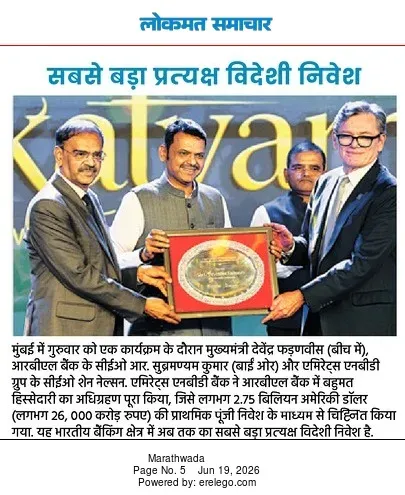
The Chief Minister's Office of Maharashtra on June 19, 2026, described the Emirates NBD–RBL Bank transaction as the state's biggest-ever direct foreign investment, tagging CM Devendra Fadnavis. The deal, pending RBI approval, underscores Maharashtra's continued dominance in attracting foreign financial-sector capital.
Key Takeaways
The CMO Maharashtra official account on June 19, 2026 called the Emirates NBD–RBL Bank deal the single largest direct foreign investment in the state.
Emirates NBD is a Dubai-based banking group; RBL Bank is a private-sector lender headquartered in Mumbai .
India's 2016 FDI policy allows foreign entities to hold up to 74 per cent in private banks under the automatic route, enabling such deals.
Maharashtra has consistently led India in cumulative FDI inflows, competing with Gujarat and Tamil Nadu .
RBI approval for any change in ownership structure remains a key pending regulatory step before the transaction is complete.
The deal aligns with deepening India-UAE economic ties built through comprehensive economic partnership talks from 2015 to 2023 .
The Chief Minister's Office of Maharashtra on Friday, June 19, 2026, reposted a claim describing the Emirates NBD–RBL Bank transaction as the single largest direct foreign investment into the state, tagging Chief Minister Devendra Fadnavis in the post.
Context
The post, shared on the official CMO Maharashtra account, carries the Hindi phrase 'sabse bada pratyaksh videshi nivesh' ('the biggest direct foreign investment'), positioning the deal between Dubai-headquartered Emirates NBD and Mumbai-based RBL Bank as a landmark inbound investment. The post includes the hashtags #Maharashtra, #DevendraFadnavis, #RBLBank, and #EmiratesNBD, signalling the state government's intent to associate the transaction with its investment-promotion record.
RBL Bank is a private-sector lender headquartered in Mumbai, while Emirates NBD is one of the largest banking groups in the Gulf Cooperation Council region and has steadily expanded its India-facing exposure over the past decade.
Policy Backdrop
India's 2016 FDI policy liberalisation permits foreign entities to hold up to 74 per cent ownership in private-sector banks under the automatic route, removing the need for prior government approval up to that threshold. This regulatory change opened the door for Gulf-based financial institutions to pursue controlling or significant stakes in Indian lenders.
Maharashtra has consistently ranked as the top FDI-receiving state in India according to DPIIT data, competing closely with Gujarat and Tamil Nadu, particularly in services and financial-sector inflows. The state government has used high-profile investment events — including the Maharashtra Global Investors Summit 2018, which drew commitments exceeding Rs 12 lakh crore — to cement this positioning.
India-UAE economic ties deepened significantly through comprehensive economic partnership talks between 2015 and 2023, encouraging Gulf-based institutions to increase their India exposure in banking, infrastructure, and real estate.
Stakeholders and Impact
For RBL Bank, a strategic investment from a Gulf banking major would represent a significant capital infusion and lend credibility to its balance sheet at a time when mid-sized private lenders face heightened scrutiny on asset quality and capital adequacy. For Emirates NBD, a stake in an Indian private bank offers direct access to one of the world's fastest-growing retail and corporate banking markets.
The transaction, if confirmed at the scale implied, would be closely watched by private banking sector peers and UAE investors as a benchmark for cross-border financial-sector deals. Regulatory clearance from the Reserve Bank of India (RBI) for any change in ownership structure and the subsequent capital infusion schedule will be the next critical milestones.
What's Next
The deal's formal status — including the investment quantum, shareholding structure, and regulatory approvals — has not been independently detailed in the CMO post. The RBI approval process for a change in ownership in a private bank is typically multi-stage and can take several months. Market participants and industry observers will watch for an official joint announcement from RBL Bank and Emirates NBD, as well as the RBI's formal nod, before the transaction can be considered complete. If validated, the deal would reinforce Maharashtra's standing as India's premier destination for foreign financial-sector capital.
Point of View
Positioning CM Fadnavis as an investment magnet ahead of any future electoral or policy cycle. It fits a well-established pattern where state governments front-run regulatory announcements with communications wins, claiming credit before RBI clearance is secured. The framing also serves a broader competitive purpose — reinforcing Maharashtra's lead over Gujarat and Tamil Nadu in the FDI league table. Investors and analysts will, however, reserve judgement until the deal's size and structure are formally disclosed.
NationPress
19 Sept 2026
Frequently Asked Questions
What is the Emirates NBD–RBL Bank FDI deal in Maharashtra?
The Chief Minister's Office of Maharashtra has described a transaction between Dubai-based Emirates NBD and Mumbai-based RBL Bank as the single largest direct foreign investment received by the state. Formal details of the investment size and shareholding structure are yet to be officially disclosed.
How much can a foreign bank invest in an Indian private bank?
Under India's 2016 FDI policy , foreign entities can hold up to 74 per cent in a private-sector bank under the automatic route, meaning no prior government approval is required up to that threshold. Beyond 74 per cent, government approval is needed.
Does RBI need to approve the Emirates NBD stake in RBL Bank?
Yes. Any significant change in ownership or acquisition of a substantial stake in an Indian private-sector bank requires approval from the Reserve Bank of India (RBI) . This is a multi-stage process and can take several months.
Why is Maharashtra considered India's top FDI destination?
Maharashtra has consistently led India in cumulative foreign direct investment inflows, particularly in financial services, manufacturing, and technology, according to DPIIT data. Its infrastructure, skilled workforce, and Mumbai's status as India's financial capital are key draws.
Who is Devendra Fadnavis?
Devendra Fadnavis is the Chief Minister of Maharashtra and has been a prominent advocate for attracting foreign investment to the state, including leading major investor summits since 2014 .