Karnataka CM's Office Orders Crash Barrier on NH-766C Death Curve

Synopsis
Karnataka's Chief Minister's Office acted on a newspaper report showing villagers had planted fence stakes at a barrier-less cliff curve on NH-766C near Samagodu, Shivamogga. Engineers inspected the site, confirmed a crash barrier is essential at the Chakra valley drop, and administrative approval for 50-plus km of highway safety works is already in place, pending tender finalisation.
Key Takeaways
Karnataka's Chief Minister's Office took 'utmost seriousness' of a newspaper report about an unguarded cliff curve on NH-766C near Samagodu, Hosanagar taluk, Shivamogga district .
Villagers had independently planted wooden fence stakes at the sharp Samagodu bend above the Chakra river valley due to the absence of any official crash barrier.
On CMO directive, National Highway Division engineers personally visited the site and conducted a technical inspection.
Engineers confirmed a crash barrier at the Samagodu curve is 'absolutely essential' given the steep valley gradient.
Administrative approval for road development and safety works across over 50 km of the NH-766C corridor has already been granted; the work is currently in the tendering stage .
The department has committed to installing the crash barrier at Samagodu immediately after the tender is finalised .
A newspaper report about villagers hammering in fence posts to guard a barrier-less cliff bend on National Highway-766C near Samagodu, Hosanagar taluk in Shivamogga district was enough to move Karnataka's highest office — fast. The Chief Minister's Office of Karnataka took the report with 'utmost seriousness' on 10 November 2026 and directed National Highway Division engineers to visit the site the same cycle.
What villagers did — and why it alarmed the CMO
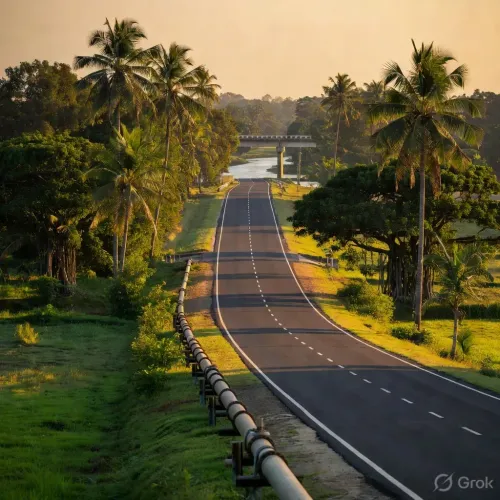
The sharp curve near Samagodu on the Ranebennur–Baindur NH-766C drops into the steep Chakra river valley — a sheer fall with no crash barrier to stop an errant vehicle. With no official safety measure in place, local residents had taken it upon themselves to plant wooden fence stakes along the edge, a makeshift intervention that caught the attention of a regional daily and, through that report, the Chief Minister's Office.
The post, shared in Kannada under the hashtag #CMSolves, described how CMO directed National Highway Division engineers to conduct a technical inspection at the spot — which they did in person.
Engineers confirm: crash barrier is non-negotiable here
Following the site visit, the department filed its report to the CMO: given the precipitous gradient of the Chakra valley, the installation of a crash barrier at the Samagodu curve is 'absolutely essential' for road safety. The finding was unambiguous, and the response scaled up quickly.
Administrative approval has already been granted for road development and safety works covering over 50 km of the highway corridor — the Samagodu stretch included. That sanctioned package is currently in the tendering process. The department has confirmed to the CMO that the crash barrier at the Samagodu curve will be constructed immediately upon completion of the tender, ensuring the safety of motorists on this valley section.
A pattern across Karnataka's Western Ghats highways
This is not an isolated response. Karnataka's state machinery has repeatedly stepped in after media coverage of hazardous curves and unguarded valley drops along Western Ghats highway alignments — directing field inspections and folding urgent safety works into already-sanctioned national highway packages. The approach draws on Bharatmala programme guidelines, which since 2015 have embedded crash barriers and other safety features as standard requirements in highway upgrades managed jointly by the National Highways Authority of India and state public works departments.
What sets the Samagodu case apart is the citizen trigger: not an accident, not a fatality, but villagers quietly doing what the system had not — a detail that travelled from a morning newspaper straight to the Chief Minister's desk.
The one remaining step: closing the tender
The administrative and technical groundwork is done. The only gate left between the Samagodu curve and a permanent crash barrier is the finalisation of the ongoing tender for the broader 50-km-plus corridor works. Once that is cleared, construction at the curve is first in line. For the thousands of vehicles that navigate the Chakra valley drop every day, the fence stakes will not be needed much longer.
Point of View
Yet the specific Samagodu curve had not yet received a barrier, points to the classic last-mile execution gap in large infrastructure packages: works get sanctioned at scale but sequencing leaves individual high-risk spots without protection until scrutiny forces prioritisation. The #CMSolves framing is also deliberate political communication, positioning the Chief Minister's Office as responsive and citizen-facing on granular local issues — a signal that resonates strongly in rural Karnataka where daily infrastructure grievances rarely reach state-level attention.
NationPress
10 Nov 2026
Frequently Asked Questions
Where is the dangerous curve on NH-766C that needs a crash barrier?
The hazardous bend is near Samagodu village in Hosanagar taluk, Shivamogga district , along the Ranebennur–Baindur National Highway-766C, above the steep Chakra river valley .
Why did villagers put fence stakes on the highway curve near Samagodu?
Because there was no official crash barrier at the sharp, valley-edge curve on NH-766C, local residents drove wooden fence stakes into the roadside themselves to prevent vehicles from plunging into the Chakra valley.
What action did Karnataka's Chief Minister's Office take?
The CMO directed National Highway Division engineers to personally inspect the Samagodu site; the engineers confirmed a crash barrier is essential and the department filed a report promising construction immediately after tender finalisation.
When will the crash barrier at Samagodu be built?
Administrative approval for the broader 50-km-plus NH-766C corridor works — including the Samagodu crash barrier — is already granted. Construction will begin immediately once the ongoing tender process is completed.
What is NH-766C and which districts does it connect?
NH-766C is the national highway linking Ranebennur in Haveri district to Baindur on the Karnataka coast, passing through the hilly Shivamogga district and upgraded under central road development programmes.